The Business Research Company’s 2026 market reports are designed to deliver research that is more actionable and strategically valuable. Key offerings include market attractiveness scoring, total addressable market sizing, company benchmarking matrices, interactive Excel dashboards, deeper supply chain intelligence, emerging startup tracking, and granular product-level insights.
Agentic AI Tools Market Historical Growth Vs. Forecast Growth: How Do The Numbers Compare?
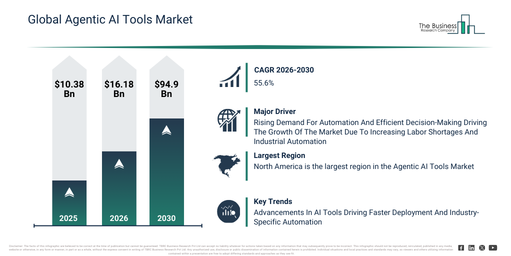
The agentic AI tools market has seen remarkable expansion in recent years. It is projected to increase from $10.38 billion in 2025 to $16.18 billion in 2026, showing a compound annual growth rate (CAGR) of 55.9%. The historical growth of this market is attributable to the rise of automation software, the spread of cloud computing platforms, the incorporation of AI into decision support systems, the increasing amounts of enterprise data, and the early implementation of virtual assistants.
The market for agentic AI tools is projected to experience substantial expansion over the upcoming years. This sector is anticipated to reach $94.9 billion in 2030, exhibiting a compound annual growth rate (CAGR) of 55.6%. During the projected period, this expansion is primarily driven by factors such as the increasing enterprise requirement for autonomous systems, progress in reinforcement learning, the incorporation of AI agents into routine business processes, the growing embrace of generative AI, and the heightened necessity for operational effectiveness. Key developments expected within this timeframe encompass autonomous task-execution agents, systems facilitating multi-agent collaboration, self-learning decision engines, AI-powered workflow orchestration, and intelligent agents with context awareness.
Start With A Free Sample Of The Agentic AI Tools Market Research Report:
The Leading Growth Driver In The Agentic AI Tools Market Explained
The future expansion of the agentic AI tools market is anticipated to be propelled by the escalating requirement for automation. Automation involves employing technology to execute tasks with minimal human input, thereby boosting efficiency, precision, and output. This rising need for automation stems from businesses’ pursuit of greater operational efficiency and productivity, as organizations strive to minimize manual labor and expedite processes via cutting-edge technologies. Agentic AI tools augment automation by facilitating independent decision-making and flexible execution of intricate operations without human oversight. A notable example is observed in April 2024, where data from the International Federation of Robotics, a Germany-based international organization, revealed a substantial increase in automation endeavors by manufacturing companies in the United States, with total industrial robot installations climbing 12% to 44,303 units in 2023. Consequently, the expanding demand for automation acts as a key catalyst for the growth of the agentic AI tools market.
Key Segments Shaping The Agentic AI Tools Market Landscape
The agentic AI tools market covered in this report is segmented –
1) By Technology: Reinforcement Learning (RL), Large Language Models (LLMs), Deep Learning-based AI Agents, Generative AI Agents, Multi-Agent Systems, Other Technologies
2) By Deployment Model: Cloud-Based, On-Premises
3) By Organization Size: Large Enterprises, Small And Medium Enterprises (SMEs)
4) By Application: AI-Powered Virtual Assistants, Autonomous Decision-Making Systems, AI-Based Automation Tools, Customer Service And Chatbots, Self-Learning AI Agents, Autonomous Financial Trading Systems, AI-Driven Code Generation And Development, Other Applications
5) By Industry Vertical: Banking, Financial Services, And Insurance, Healthcare And Life Sciences, Retail And E-commerce, Manufacturing, Information Technology (IT) And Telecom, Automotive, Government And Defense, Other Industries
Subsegments:
1) By Reinforcement Learning: Model-Free Reinforcement Learning, Model-Based Reinforcement Learning, Hierarchical Reinforcement Learning, Multi-Agent Reinforcement Learning, Offline Reinforcement Learning, Inverse Reinforcement Learning
2) By Large Language Models: Transformer-Based Large Language Models, Open-Source Large Language Models, Specialized Domain Large Language Models, Fine-Tuned Large Language Models For Specific Tasks, Multimodal Large Language Models, Knowledge-Augmented Large Language Models
3) By Deep Learning-based AI Agents: Text Generation Agents, Code Generation Agents, Image Generation Agents, Video And Audio Generation Agents, Music And Art Generation Artificial Intelligence, Autonomous Creative Agents
4) By Generative AI Agents: Text Generation Models, Image Generation Models, Video Generation Models, Speech Synthesis Models, Code Generation Models
5) By Multi-Agent Systems: Cooperative Multi-Agent Systems, Competitive Multi-Agent Reinforcement Learning, Distributed Artificial Intelligence Systems, Swarm Intelligence Agents, Decentralized Autonomous Organizations (DAOs) With Artificial Intelligence
6) By Other Technologies: Neuro-Symbolic Artificial Intelligence Agents, Causal Artificial Intelligence Agents, Quantum Artificial Intelligence Agents, Evolutionary Artificial Intelligence Agents, Edge Computing And Internet Of Things (IoT)-Based Agents
Agentic AI Tools Market Trend Spotlight: Key Shifts Shaping Future Demand
Leading companies in the agentic AI tools market are concentrating on technological advancements, such as the AI Refinery Platform, to secure a competitive advantage. The AI Refinery Platform is an advanced AI-powered system designed to process, refine, and optimize raw data into actionable insights. For example, in January 2025, Accenture plc, an Ireland-based professional services company, introduced AI Refinery for Industry. This platform incorporates 12 industry-specific AI agent solutions intended to accelerate the adoption of agentic AI and optimize business processes. Developed with NVIDIA AI Enterprise software, these agents facilitate the rapid deployment of customized AI networks, reducing development time from months to just days. The initial solutions are aimed at key challenges, including revenue growth management, clinical trial support, industrial asset troubleshooting, and B2B marketing optimization.
Agentic AI Tools Market Competitive Analysis: Who Are The Main Competitors?
Major companies operating in the agentic AI tools market are Amazon Web Services Inc., Microsoft Corporation, International Business Machines Corporation, Salesforce Inc., NVIDIA Corporation, ServiceNow Inc., Sierra AI Inc., UiPath Inc., CoreWeave Inc., Anthropic PBC, Conversica Inc., Aisera Inc., Cognigy GmbH, Adept AI Inc., Fluid AI Inc., Parloa, Quiq Inc., Ciroos Inc., Zyphra Technologies Inc., Maisa AI, Alta, TinyFish, Algoscale, Cognition AI Inc., TestingXperts, OpenAI
Find The Complete Agentic AI Tools Market Outlook In The Full Report:
Mapping The Agentic AI Tools Market: Regional Leadership And Global Reach
North America was the largest region in the agentic AI tools market in 2025. The regions covered in the agentic AI tools market report are Asia-Pacific, South East Asia, Western Europe, Eastern Europe, North America, South America, Middle East, Africa.
Reach Out To Our Team:
The Business Research Company: https://www.thebusinessresearchcompany.com/
Americas: +1 310-496-7795
Asia: +44 7882 955267 & +91 8897263534
Europe: +44 7882 955267
Email us at: marketing@tbrc.info
Follow us on:
LinkedIn: https://in.linkedin.com/company/the-business-research-company
YouTube: https://www.youtube.com/channel/UC24_fI0rV8cR5DxlCpgmyFQ
Global Market Model: https://www.thebusinessresearchcompany.com/global-market-model

Wasay has over a decade of experience in market research, data modelling, and analytics, with prior experience at GlobalData and Decision Tree Consulting Services. At The Business Research Company , he leads research operations across syndicated studies, customized consulting engagements, and the Global Market Model platform. His professional experience includes supporting organizations such as Boston Consulting Group, KPMG, and Ernst & Young. Wasay holds a degree in Electronics and Communications Engineering, postgraduate management qualifications from International Management Institute Belgium and Indian School of Business and Entrepreneurship, and completed the Integrated Program in Business Analytics from Indian Institute of Management Indore.