Designed to make market research more actionable and strategically valuable, The Business Research Company’s 2026 market reports feature market attractiveness scoring, total addressable market sizing, company benchmarking matrices, interactive Excel dashboards, deeper supply chain intelligence, emerging startup tracking, and granular product-level insights.
How Big Is The AI-Powered Design Tools Market In 2026, And How Fast Will It Grow?
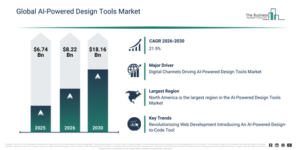
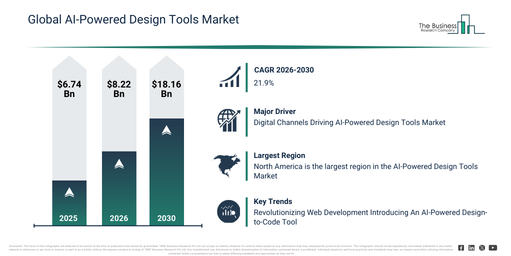
The market size for AI-powered design tools has experienced exponential growth in recent years. This market is set to expand from $6.74 billion in 2025 to $8.22 billion in 2026, registering a compound annual growth rate (CAGR) of 22.0%. The historical growth is attributable to several factors, including increased adoption of design software, advancements in AI and ml algorithms, growing demand for efficient design workflows, expansion of digital media and marketing, and the integration of cloud solutions in design processes.
The AI-powered design tools market size is anticipated to undergo significant expansion in the coming years. It is projected to reach $18.16 billion in 2030, with a compound annual growth rate (CAGR) of 21.9%. This growth during the forecast period is driven by factors such as the rise of generative AI tools, an increase in remote and collaborative design, demand for personalized and adaptive design outputs, heightened investment in AI-driven creative platforms, and the broadening of immersive design applications (AR/VR/XR). Key trends expected in the forecast period include AI-assisted design automation, generative design capabilities, real-time design feedback, predictive user experience optimization, and cloud-based collaborative design platforms.
Download A Free AI-Powered Design Tools Market Sample Report With Size And Forecast Data:
AI-Powered Design Tools Market Growth Driver: The Key Factor Behind Rising Demand
The AI-powered design tools market is anticipated to expand due to the increasing prevalence of digital channels. These channels encompass online platforms and media, such as social media, e-commerce, and web-based applications, utilized for communication, marketing, and product or service distribution. This growth in digital channels stems from wider internet access, enhanced personalization and targeting functionalities, and the economic efficiency of digital marketing when contrasted with traditional approaches. The AI-powered design tools market facilitates this expansion by employing artificial intelligence and machine learning to automate creative processes, elevate content quality, refine visual aesthetics, and boost brand interaction across various digital platforms. An illustrative example is provided by the United States Census Bureau, a U.S.-based government agency, which reported in February 2024 that total e-commerce sales hit USD 1,118.7 billion in 2023, marking a 7.6% rise from 2022, underscoring the ongoing expansion of digital commerce channels. Consequently, the growing influence of digital channels is a key factor propelling the expansion of the AI-powered design tools market.
AI-Powered Design Tools Market Segmentation: Key Segments And Subsegments Covered
The ai-powered design tools market covered in this report is segmented –
1) By Type: Graphic Design Tools, User Experience (UX) And User Interface (UI) Design Tools, Automated Content Creation Tools, Image And Video Processing Tools, 3D Design And Modeling Tools, Automated Layout And Formatting Tools, Branding And Logo Design Tools, Other Types
2) By Technology: Machine Learning, Natural Language Processing, Generative AI
3) By Application: Automotive And Transportation, Media And Entertainment, Education And Research, Fashion And Apparel, Architecture And Construction, E-commerce And Retail, Other Application
Subsegments:
1) By Graphic Design Tools: Logo Design Tools, Social Media Graphics Tools, Print Design Tools, Digital Art Tools
2) By User Experience (UX) And User Interface (UI) Design Tools: Wireframing Tools, Prototyping Tools, UI Or UX Design Automation Tools, User Flow And Journey Mapping Tools
3) By Automated Content Creation Tools: Text Generation And Copywriting Tools, Blog And Article Creation Tools, AI-Powered Email Campaign Tools
4) By Image And Video Processing Tools: Image Editing And Enhancement Tools, AI-Based Video Editing Tools, Image Recognition And Analysis Tools, Visual Content Optimization Tools
5) By 3D Design And Modeling Tools: 3D CAD Tools, 3D Rendering Tools, AR Or VR Design Tools, 3D Animation Tools
6) By Automated Layout And Formatting Tools: Template-Based Layout Tools, Document Automation Tools, Print And Publication Layout Tools
7) By Branding And Logo Design Tools: Logo Generation Tools, Brand Identity And Design Tools, Customizable Branding Templates
8) By Other Types: AI-Powered Web Design Tools, Presentation Design Tools, Data Visualization Tools
AI-Powered Design Tools Market Trends: Key Developments Shaping 2026 And Beyond
Leading enterprises in the AI-powered design tools market are concentrating on creating cutting-edge solutions, like Locofy Lightning, to streamline design-to-code processes and boost productivity in web and app development. Locofy Lightning is an AI-driven software application that leverages artificial intelligence (AI) and machine learning (ML) algorithms to autonomously transform visual design mockups or prototypes into operational HTML, CSS, and JavaScript code for responsive, production-ready user interfaces. An example of this is the launch of Locofy Lightning by Singapore-based technology firm Locofy.ai in January 2024. This AI-powered tool is specifically designed to expedite the transformation of Figma designs into superior frontend code for both websites and mobile apps. Available as a Figma plug-in, the platform produces pixel-perfect, component-based code that is interactive, responsive, and compatible with contemporary development frameworks. Its advanced functionalities include one-click conversion, pre-trained AI models, a design optimizer, and customizable code components and properties. By automating routine coding tasks, Locofy Lightning empowers developers to prioritize creative design enhancements and strategic development, considerably cutting down time-to-market and improving overall efficiency.
Leading Companies Operating In The AI-Powered Design Tools Market
Major companies operating in the ai-powered design tools market are Adobe Inc; Autodesk Inc; Canva Inc; Figma; Tailor Brands LLC; InVisionApp Inc; Corel Corporation; Design Pickle; Desygner Inc; Sketch Inc; Affinity Designer; BrandCrowd; Bannersnack; Crello; Looka; Design Wizard; Vecteezy; Designhill; Vectary; Snappa; PicMonkey; Lunacy; Vectr; Gravit Designer; Boxmode
Access The Full AI-Powered Design Tools Market Research Report:
AI-Powered Design Tools Market Regional Analysis: Largest Region And Key Geographies Covered
North America was the largest region in the AI-powered design tools market in 2025. The regions covered in the AI-powered design tools market report are Asia-Pacific, South East Asia, Western Europe, Eastern Europe, North America, South America, Middle East, Africa.
Reach Out To Our Team:
The Business Research Company: https://www.thebusinessresearchcompany.com/
Americas: +1 310-496-7795
Asia: +44 7882 955267 & +91 8897263534
Europe: +44 7882 955267
Email us at: marketing@tbrc.info
Follow us on:
LinkedIn: https://in.linkedin.com/company/the-business-research-company
YouTube: https://www.youtube.com/channel/UC24_fI0rV8cR5DxlCpgmyFQ
Global Market Model: https://www.thebusinessresearchcompany.com/global-market-model

Wasay has over a decade of experience in market research, data modelling, and analytics, with prior experience at GlobalData and Decision Tree Consulting Services. At The Business Research Company , he leads research operations across syndicated studies, customized consulting engagements, and the Global Market Model platform. His professional experience includes supporting organizations such as Boston Consulting Group, KPMG, and Ernst & Young. Wasay holds a degree in Electronics and Communications Engineering, postgraduate management qualifications from International Management Institute Belgium and Indian School of Business and Entrepreneurship, and completed the Integrated Program in Business Analytics from Indian Institute of Management Indore.