Market attractiveness scoring, total addressable market sizing, company benchmarking matrices, interactive Excel dashboards, deeper supply chain intelligence, emerging startup tracking, and granular product-level insights are among the key offerings featured in The Business Research Company’s 2026 market reports, designed to deliver more actionable and strategically valuable research.
Application Container Market On Course To Reach $34.27 Billion By 2030: Size And Growth Overview
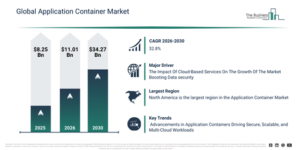
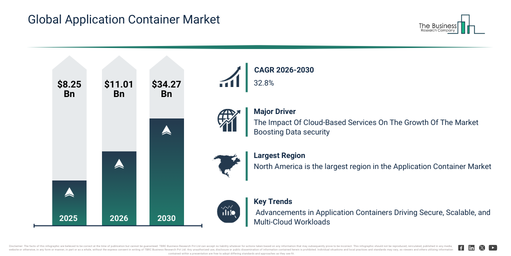
The application container market size has seen substantial growth recently. It is anticipated to increase from $8.25 billion in 2025 to $11.01 billion in 2026, exhibiting a compound annual growth rate (CAGR) of 33.5%. This historical expansion can be attributed to several factors including the development of virtualization technologies, the emergence of DevOps practices, greater adoption of cloud computing, the demand for application portability, and the necessity for accelerated software deployment.
The application container market is projected to experience substantial expansion in the coming years. This market is predicted to reach $34.27 billion by 2030, driven by a compound annual growth rate (CAGR) of 32.8%. This expansion throughout the forecast period can be linked to the broadening of cloud-native architectures, the increasing adoption of enterprise multi-cloud strategies, a heightened emphasis on application scalability, the growing need for container security solutions, and the integration of edge and distributed computing. Key trends anticipated during this period encompass microservices-based application deployment, the modernization of cloud-native applications, advancements in container security and runtime protection, the widespread adoption of multi-cloud container orchestration, and edge containerization for managing distributed workloads.
Need Application Container Market Forecasts? Get Your Free Sample Report Here:
Application Container Market Growth Factors: What Is Strengthening Demand Worldwide?
The future growth of the application container market is anticipated to be significantly propelled by the increasing move towards cloud-based services. These services involve internet-delivered offerings that provide on-demand access to computing resources, applications, and data storage, eliminating the need for local infrastructure. This expanding shift towards cloud-based services can be attributed to multiple factors, including their cost efficiency, scalability, flexibility, enhanced collaboration capabilities, improved security, and the rising demand for remote access to data and applications. Application containers play a crucial role in supporting cloud-based services by offering a lightweight, consistent, and scalable environment for running applications across diverse cloud platforms, which ensures efficient resource utilization and seamless deployment. For instance, data from March 2025 by the Office for National Statistics, a UK-based government agency, indicated that 69% of UK firms reported using cloud-based computing systems and applications in 2023. Consequently, the increasing adoption of cloud-based services serves as a key driver for the application container market.
Application Container Market By Segment: Complete Category And Subcategory Breakdown
The application container market covered in this report is segmented –
1) By Offerings: Container Data Management And Orchestration, Container Monitoring And Security, Container Networking, Consultation, Other Offerings
2) By Deployment Mode: Public Cloud, Private Cloud And On-Premise, Hybrid Cloud
3) By Enterprise Size: Small And Medium Enterprise, Large Enterprise
4) By Application: Collaboration, Modernization, Production, Other Applications
5) By End User: Information Technology And Telecommunication, Banking, Financial Services, And Insurance, Retail And E-Commerce, Healthcare And Lifesciences, Education, Media And Entertainment, Other End Users
Subsegments:
1) By Container Data Management And Orchestration: Kubernetes-Based Orchestration, Container Storage Solutions, Multi-Cloud Container Management
2) By Container Monitoring And Security: Runtime Security Solutions, Vulnerability Scanning, Compliance Management
3) By Container Networking: Service Mesh Solutions, Container Network Interface (CNI) Plugins, Software-Defined Networking (SDN) For Containers
4) By Consultation: Container Adoption Strategy, Containerization Best Practices, Cloud-Native Transformation
5) By Other Offerings: Serverless Containers, Edge Computing Containers, Hybrid Cloud Container Solutions
Application Container Market Trend Outlook: Developments Defining The Forecast Period
Leading companies within the application container market are prioritizing technological innovations, specifically virtualized container runtimes featuring improved isolation, in response to the growing need for secure, multi-tenant, and hybrid-cloud execution environments. These virtualized container runtimes merge the portability found in conventional containers with the robust isolation characteristic of virtual machines; they generally execute container workloads within micro-VMs or sandboxed settings, thereby diminishing potential attack surfaces when contrasted with typical Linux kernel containers. As an example, in July 2024, Red Hat, a prominent US-based leader in open hybrid cloud technology, unveiled Red Hat OpenShift Container Platform 4.16. This platform offers updated virtualization capabilities, strengthened security, and functionalities for edge deployments. The 4.16 release, constructed upon Kubernetes 1.29 and CRI O 1.29, facilitates smoother management of virtualized workloads. It achieves this by providing hot add CPU for live VMs, multi-cluster virtualization monitoring, and image-based updates for single-node clusters, all designed to reduce downtime. Furthermore, it bolsters security through its support for multitenancy and external secrets management, simultaneously simplifying the migration of conventional VM workloads into container-centric infrastructures.
Who Is Competing For Share In The Application Container Market?
Major companies operating in the application container market are Google LLC, Microsoft Corporation, Alibaba Group Holding Limited, Amazon Web Services Inc., International Business Machines Corporation, Cisco Systems Inc., Oracle Corporation, Hewlett Packard Enterprise Development LP, VMware Inc., Palo Alto Networks Inc., SUSE LLC, DigitalOcean Inc., Docker Inc., Sysdig Inc., Kong Inc., Mirantis Inc., Joyent Inc., Rancher Labs Inc., CloudBolt Software Inc., Virtuozzo Inc., Portworx Inc., Portainer Inc., D2iQ Inc., Weaveworks Inc.
Get The Full Picture With The Application Container Market Report:
Application Container Market Regional Snapshot: Leading Geography In 2025
North America was the largest region in the application container market in 2025. Asia-Pacific is expected to be the fastest-growing region in the forecast period. The regions covered in the application container market report are Asia-Pacific, South East Asia, Western Europe, Eastern Europe, North America, South America, Middle East, Africa.
Reach Out To Our Team:
The Business Research Company: https://www.thebusinessresearchcompany.com/
Americas: +1 310-496-7795
Asia: +44 7882 955267 & +91 8897263534
Europe: +44 7882 955267
Email us at: marketing@tbrc.info
Follow us on:
LinkedIn: https://in.linkedin.com/company/the-business-research-company
YouTube: https://www.youtube.com/channel/UC24_fI0rV8cR5DxlCpgmyFQ
Global Market Model: https://www.thebusinessresearchcompany.com/global-market-model

Wasay has over a decade of experience in market research, data modelling, and analytics, with prior experience at GlobalData and Decision Tree Consulting Services. At The Business Research Company , he leads research operations across syndicated studies, customized consulting engagements, and the Global Market Model platform. His professional experience includes supporting organizations such as Boston Consulting Group, KPMG, and Ernst & Young. Wasay holds a degree in Electronics and Communications Engineering, postgraduate management qualifications from International Management Institute Belgium and Indian School of Business and Entrepreneurship, and completed the Integrated Program in Business Analytics from Indian Institute of Management Indore.