Market attractiveness scoring, total addressable market sizing, company benchmarking matrices, interactive Excel dashboards, deeper supply chain intelligence, emerging startup tracking, and granular product-level insights are among the key offerings featured in The Business Research Company’s 2026 market reports, designed to deliver more actionable and strategically valuable research.
Artificial Intelligence (AI)-Powered Employee Recognition Analytics Market Size Estimate For 2026 And Revenue Forecast Through 2030
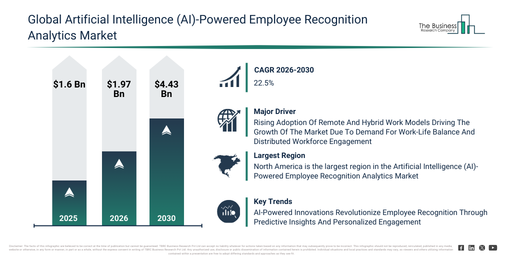
The artificial intelligence (AI)-powered employee recognition analytics market has experienced significant expansion recently. Forecasts indicate it will expand from $1.6 billion in 2025 to $1.97 billion in 2026, demonstrating a compound annual growth rate (CAGR) of 22.8%. Historically, this growth has been driven by a growing emphasis on employee engagement, the adoption of digital HR management tools, an increasing demand for data-driven performance evaluation, the early use of recognition software in enterprises, and rising awareness of workforce productivity analytics.
The artificial intelligence (AI)-powered employee recognition analytics market is anticipated to experience substantial growth in the coming years, with its size projected to reach $4.43 billion by 2030, demonstrating a compound annual growth rate (CAGR) of 22.5%. This expansion during the forecast period is primarily driven by advancements in predictive analytics, the integration of AI-powered HR platforms, increased adoption within large enterprises, the proliferation of cloud-based recognition solutions, and a rising demand for personalized and real-time recognition programs. Key trends identified for this period include AI-driven employee performance insights, predictive recognition analytics, cloud-based recognition platforms, seamless integration with HR workflow systems, and real-time feedback and recognition.
Free Artificial Intelligence (AI)-Powered Employee Recognition Analytics Market Report Sample Available For Download:
Why Is Demand In The Artificial Intelligence (AI)-Powered Employee Recognition Analytics Market Expected To Keep Rising?
The increasing focus on remote and hybrid work arrangements is projected to boost the expansion of the artificial intelligence (AI)-powered employee recognition analytics market in the future. These models describe flexible employment structures where staff either operate completely from off-site locations or divide their work time between home and the office. The growing importance of remote and hybrid work is attributed to employees’ increasing desire for better work-life balance, since adaptable work options enable individuals to handle personal and career duties more efficiently and cut down on travel time. Artificial Intelligence (AI)-powered employee recognition analytics provides advantages for remote and hybrid work setups by facilitating prompt, data-informed acknowledgment of staff accomplishments irrespective of their physical presence, thereby aiding in preserving engagement, motivation, and team cohesion across dispersed groups. An illustration of this trend is seen in data from the Office for National Statistics, a UK-based government agency, which reported in June 2025 that UK workers were working remotely from January to March 2025, with 14% being full-time remote and 27% operating under a hybrid model. Furthermore, in September 2023, Deloitte, a UK-based professional services firm, found that 56% of working adults participate in remote work to varying degrees, with 22% working exclusively from home and 34% adopting a hybrid timetable. Consequently, the increasing importance placed on remote and hybrid work models is fueling the expansion of the artificial intelligence (AI)-powered employee recognition analytics market.
How Is The Artificial Intelligence (AI)-Powered Employee Recognition Analytics Market Divided Across Segments And Subsegments?
The artificial intelligence (AI)-powered employee recognition analytics market covered in this report is segmented –
1) By Component: Software, Services
2) By Deployment Mode: On-Premises, Cloud
3) By Organization Size: Small And Medium Enterprises, Large Enterprises
4) By Application: Performance Management, Employee Recognition, Communication Or Collaboration, Surveys Or Feedback, Learning Or Development, Other Applications
5) By End-User: Banking, Financial Services And Insurance (BFSI), Healthcare, Information Technology And Telecommunications, Retail, Manufacturing, Education, Other End-Users
Subsegments:
1) By Software: On-premises Software, Cloud-based Software (SaaS)
2) By Services: Managed Services, Professional Services
Artificial Intelligence (AI)-Powered Employee Recognition Analytics Market Trends Reshaping Customer Demand And Business Strategies
Leading companies within the artificial intelligence (AI)-powered employee recognition analytics market are concentrating on developing sophisticated solutions, such as machine learning, to enhance personalization, improve real-time feedback, and deliver more profound insights into employee performance and engagement. The application of machine learning in AI-powered employee recognition analytics enables personalized recognition, immediate feedback, and a deeper understanding of employee performance and involvement. For instance, in May 2024, Qualtrics, a US-based management company, introduced advanced AI-driven innovations to its XM for Employee Experience suite, leveraging machine learning to detect attrition risks, summarize feedback into actionable insights, and identify key behavioral signals across the employee journey. Powered by Qualtrics AI and an extensive human sentiment database, the platform boosts employee engagement, retention, and productivity. It automates data analysis and provides predictive insights, empowering managers to make faster, more strategic decisions that support their teams. These capabilities help organizations better comprehend employee needs and respond proactively, resulting in improved performance and greater employee loyalty.
Artificial Intelligence (AI)-Powered Employee Recognition Analytics Market Major Players: Companies At The Forefront Of The Industry
Major companies operating in the artificial intelligence (AI)-powered employee recognition analytics market are Microsoft Corporation, IBM Corporation, Oracle Corporation, SAP SE, ADP Inc., Workday Inc., Ultimate Kronos Group Inc., Qualtrics LLC, O.C. Tanner, Cornerstone OnDemand Inc., Culture Amp Pty. Ltd., Achievers Solutions Inc., Reward Gateway Ltd., Ceridian HCM Inc., Lattice, Reflektive Inc., Motivosity Inc., Quantum Workplace Companies, TinyPulse, Peakon, Bonusly, Leena AI, Kazoo Ltd.
Read More About The Artificial Intelligence (AI)-Powered Employee Recognition Analytics Market In The Full Report:
Artificial Intelligence (AI)-Powered Employee Recognition Analytics Market Regional Share Analysis For 2025
North America was the largest region in the artificial intelligence (AI)-powered employee recognition analytics market in 2025. Asia-Pacific is expected to be the fastest-growing region in the forecast period. The regions covered in the artificial intelligence (AI)-powered employee recognition analytics market report are Asia-Pacific, South East Asia, Western Europe, Eastern Europe, North America, South America, Middle East, Africa.
Reach Out To Our Team:
The Business Research Company: https://www.thebusinessresearchcompany.com/
Americas: +1 310-496-7795
Asia: +44 7882 955267 & +91 8897263534
Europe: +44 7882 955267
Email us at: marketing@tbrc.info
Follow us on:
LinkedIn: https://in.linkedin.com/company/the-business-research-company
YouTube: https://www.youtube.com/channel/UC24_fI0rV8cR5DxlCpgmyFQ
Global Market Model: https://www.thebusinessresearchcompany.com/global-market-model

Wasay has over a decade of experience in market research, data modelling, and analytics, with prior experience at GlobalData and Decision Tree Consulting Services. At The Business Research Company , he leads research operations across syndicated studies, customized consulting engagements, and the Global Market Model platform. His professional experience includes supporting organizations such as Boston Consulting Group, KPMG, and Ernst & Young. Wasay holds a degree in Electronics and Communications Engineering, postgraduate management qualifications from International Management Institute Belgium and Indian School of Business and Entrepreneurship, and completed the Integrated Program in Business Analytics from Indian Institute of Management Indore.