Designed to make market research more actionable and strategically valuable, The Business Research Company’s 2026 market reports feature market attractiveness scoring, total addressable market sizing, company benchmarking matrices, interactive Excel dashboards, deeper supply chain intelligence, emerging startup tracking, and granular product-level insights.
Microbial Fermentation Technology Market To Expand At A 7.7% CAGR: Size And Growth Projections Through 2030
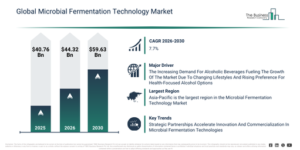
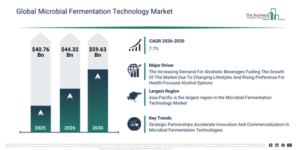
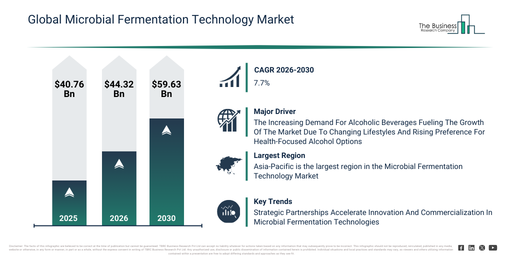
The microbial fermentation technology market has experienced robust expansion recently. Projections indicate its size will increase from $40.76 billion in 2025 to $44.32 billion in 2026, exhibiting a compound annual growth rate (CAGR) of 8.7%. This historical growth can be linked to factors such as the expansion of pharmaceutical and biotech manufacturing, a rising demand for antibiotics and vaccines, the broadening of industrial biotechnology applications, the presence of robust fermentation infrastructure, and heightened research activity in microbiology.
The microbial fermentation technology market is projected to experience substantial expansion in the coming years. It is anticipated to reach $59.63 billion by 2030, exhibiting a compound annual growth rate (CAGR) of 7.7%. This expansion during the forecast period is driven by factors such as the growing need for biologics and biosimilars, increased investments in sustainable bio-based production methods, broader application of precision fermentation, an intensified focus on process automation, and the greater uptake of digital bioprocessing tools. Key developments expected over this period include the wider implementation of high-efficiency bioreactors, an increased emphasis on scalable fermentation processes, the growing utilization of advanced microbial strain engineering, the spread of continuous fermentation techniques, and improved capabilities for process monitoring and control.
Get Your Free Microbial Fermentation Technology Market Report Sample Today:
Which Factor Is Expected To Drive The Microbial Fermentation Technology Market Over The Forecast Period?
The future expansion of the microbial fermentation technology market is anticipated, fueled by the increasing demand for alcoholic beverages. These beverages are fermented liquids containing ethyl alcohol or ethanol, derived from sugars present in fruits, grains, plant saps, honey, tubers, and other natural sources. The surge in demand for alcoholic drinks is attributed to evolving lifestyles and the growing preference for healthier alcoholic alternatives, such as low-calorie, low-alcohol, and organic options. Microbial fermentation technology is critical in alcohol production, providing capabilities for precise control, customization, scalability, and environmentally sustainable fermentation processes. For instance, in February 2023, the Distilled Spirits Council of the United States, Inc. (DISCUS), a national trade association based in the US, reported that the spirits sector’s supplier sales reached US $37.7 billion. Volumes hit $0.3088 billion (308.8 million) 9-litre cases, an increase of 1.2%, while maintaining over 42% of the total U.S. beverage alcohol market share. Thus, the escalating demand for alcoholic beverages is a key driver for the microbial fermentation technology market’s growth.
Microbial Fermentation Technology Market Segmentation Insights: How Is The Industry Categorized?
The microbial fermentation technology market covered in this report is segmented –
1) By Type: Medical, Industrial, Alcohol Beverages, Food And Feed Products
2) By Application: Antibiotics, Probiotics Supplements, Recombinant Proteins, Vaccines, Enzymes
3) By End User: Bio-Pharmaceutical Companies, Contract Research Organizations (CROs), Contract Manufacturing Organization (CMOs) And Contract Development And Manufacturing Organization (CDMOs), Academic And Research Institutes
Subsegments:
1) By Medical: Antibiotics Production, Therapeutic Proteins Production, Vaccines Production
2) By Industrial: Biofuels Production, Biochemicals Production
3) By Alcohol Beverages: Beer Production, Wine Production, Spirits Production
4) By Food And Feed Products: Probiotics, Food Additives
Microbial Fermentation Technology Market Trends Explained: What Is Changing And Why It Matters
Leading companies within the microbial fermentation technology market are actively pursuing advanced strategic collaborations. These efforts aim to bolster research capacities, broaden the array of products derived from fermentation, and expedite the market introduction of innovative bio-based materials. Such strategic alliances in microbial fermentation involve joint ventures where entities integrate their specialized knowledge in areas like strain engineering, optimizing bioprocesses, and manufacturing at scale. The goal is to boost production efficiency and accelerate the delivery of sustainable fermentation-based products to consumers. An illustrative example occurred in April 2023, when Solvay, a materials and chemicals firm based in Belgium, initiated a multi-year strategic partnership with Ginkgo Bioworks, a synthetic biology company from the U.S. Their objective is to jointly develop sustainable biopolymers utilizing microbial fermentation processes. This collaboration is structured to foster quicker innovation and expansion, capitalizing on Ginkgo’s expertise in strain design and bioengineering, combined with Solvay’s industrial research and development framework. This synergy is intended to support the creation and market launch of high-value, renewable specialty materials.
Microbial Fermentation Technology Market Competitor Landscape: Who Are The Major Companies?
Major companies operating in the microbial fermentation technology market are Cargill Inc., Archer Daniels Midland Company, BASF SE, Evonik Industries AG, Royal DSM NV, Ajinomoto Co Inc., Lonza Group, Novozymes A/S, Ginkgo Bioworks Inc., Amyris Inc., Biovectra Inc., BIOZEEN, MycoTechnology Inc., Unibio A/S, Locus Fermentation Solutions, Lygos Inc., Amano Enzyme Inc., ZymoChem Inc., Conagen Inc., NovoNutrients, F. Hoffmann-La Roche AG, AGC Group, Givaudan SA
See The Full Microbial Fermentation Technology Market Report For Complete Market Sizing And Trends:
Microbial Fermentation Technology Market Regional Demand Analysis And Leading Geography
Asia-Pacific was the largest region in the microbial fermentation technology market in 2025. The regions covered in the microbial fermentation technology market report are Asia-Pacific, South East Asia, Western Europe, Eastern Europe, North America, South America, Middle East, Africa.
Reach Out To Our Team:
The Business Research Company: https://www.thebusinessresearchcompany.com/
Americas: +1 310-496-7795
Asia: +44 7882 955267 & +91 8897263534
Europe: +44 7882 955267
Email us at: marketing@tbrc.info
Follow us on:
LinkedIn: https://in.linkedin.com/company/the-business-research-company
YouTube: https://www.youtube.com/channel/UC24_fI0rV8cR5DxlCpgmyFQ
Global Market Model: https://www.thebusinessresearchcompany.com/global-market-model

Wasay has over a decade of experience in market research, data modelling, and analytics, with prior experience at GlobalData and Decision Tree Consulting Services. At The Business Research Company , he leads research operations across syndicated studies, customized consulting engagements, and the Global Market Model platform. His professional experience includes supporting organizations such as Boston Consulting Group, KPMG, and Ernst & Young. Wasay holds a degree in Electronics and Communications Engineering, postgraduate management qualifications from International Management Institute Belgium and Indian School of Business and Entrepreneurship, and completed the Integrated Program in Business Analytics from Indian Institute of Management Indore.