With a focus on actionable insights and strategic value, The Business Research Company’s 2026 market reports include market attractiveness scoring, total addressable market sizing, company benchmarking matrices, interactive Excel dashboards, deeper supply chain intelligence, emerging startup tracking, and granular product-level insights.
Motion Control Software In Robotics Market Size Analysis: Historical Growth And Future Revenue Projections
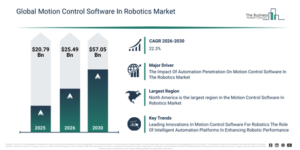
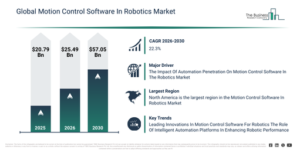
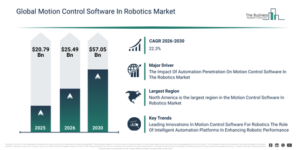
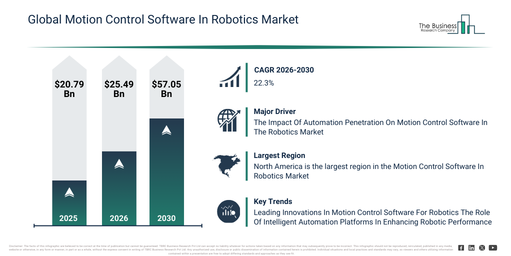
The motion control software in robotics market has recently shown significant expansion. It is forecast to rise from $20.79 billion in 2025 to $25.49 billion in 2026, exhibiting a compound annual growth rate (CAGR) of 22.6%. The historical growth of this market can be attributed to several factors including the adoption of industrial robots, the proliferation of manufacturing automation, the early deployment of articulated and SCARA robots, a growing demand for precision operations, and the integration of robotics within the healthcare sector.
The motion control software in robotics market size is anticipated to experience substantial expansion in the coming years. It is projected to reach $57.05 billion in 2030, exhibiting a compound annual growth rate (CAGR) of 22.3%. This anticipated growth during the forecast period is fueled by several factors, such as the increasing deployment of collaborative robotics, innovations in AI-driven motion control, a growing uptake of multi-axis and omni-directional motion systems, the expansion of consumer and medical robotics applications, and the greater incorporation of simulation and modeling software. Key developments expected within this period encompass precision path planning software, systems for coordinating multiple robots, vision-based motion control, customized motion control solutions, and various simulation and modeling tools.
Preview The Motion Control Software In Robotics Market Report With A Free Sample:
Motion Control Software In Robotics Market Drivers: What Is Fueling Demand Through 2030?
The future growth of the motion control software in robotics market is expected to be propelled by the automation of the manufacturing and automotive industry. This automation in these sectors involves utilizing advanced technologies, including robotics, artificial intelligence (AI), and machine learning, to execute various tasks. The implementation of automation across industries, such as manufacturing and automotive, is driven by factors like higher productivity, cost reduction, continuous risk validation, greater energy efficiency, and demographic trends. Motion control software specifically enhances automation in robotics by precisely directing robot movements, which facilitates complex tasks with high accuracy and repeatability, thereby increasing efficiency, reducing errors, and optimizing production processes. For example, in September 2024, data from the International Federation of Robotics (IFR), a Germany-based non-profit organization, indicated that in 2023, 381,964 industrial robots were active in U.S. factories, marking a 10% increase from 2022, signifying robust ongoing automation momentum. Therefore, automation within the manufacturing and automotive industry acts as a key driver for the motion control software in robotics market.
Motion Control Software In Robotics Market Segmentation Analysis: Core Categories And Subcategories
The motion control software in robotics market covered in this report is segmented –
1) By Function: Pick And Place, Painting, Hold and Rotate, Drilling, Striking, Other Functions
2) By Motion Type: Linear, Rotary, Oscillatory, Omni-Directional
3) By Robot Type: Articulated, Polar, Cylindrical, Cartesian, SCARA, Other Robot Types
4) By Application: Industrial Robot, Medical Robot, Consumer Robot
5) By End-User: Manufacturing Industries, Healthcare, Oil And Gas, Research Academia, Other End-Users
Subsegments:
1) By Pick and Place: Automated Pick and Place Software, Vision-Based Pick and Place Systems, Collaborative Pick and Place Solutions
2) By Painting: Spray Painting Software, Robotic Painting Control Systems, Automated Coating Solutions
3) By Hold and Rotate: Rotary Motion Control Software, Grip and Rotate Systems, Multi-Axis Holding Software
4) By Drilling: Automated Drilling Software, Precision Drilling Control Systems, Multi-Tool Drilling Solutions
5) By Striking: Impact Control Software, Hammering and Striking Automation, Precision Striking Systems
6) By Other Functions: Path Planning Software, Simulation and Modeling Software, Multi-Robot Coordination Software, Custom Motion Control Solutions
Which Trends Will Define The Motion Control Software In Robotics Market Through 2030?
Leading companies in the motion control software in robotics market are focusing on developing innovative solutions, such as intelligent automation platforms, to enable advanced functionalities like real-time data processing, predictive maintenance, and adaptive control strategies. An intelligent automation platform is a comprehensive suite of sophisticated motion control and automation solutions designed to enhance the capabilities of industrial robots. It optimizes robotic operations by integrating high-performance control algorithms, real-time data processing, and advanced analytics. For example, in June 2024, ABB Group, a US-based industrial robots manufacturer, introduced OmniCore, a cutting-edge automation platform supported by a $170 million investment, which delivers exceptional precision with robot path accuracy under 0.6mm and speeds reaching up to 1,600mm/s. This platform enhances versatility with over 1,000 customizable features and integrates seamlessly with ABB’s absolute accuracy and PickMaster Twin software. This unified system boosts productivity and energy efficiency, enabling robots to operate up to 25% faster while consuming 20% less energy.
Motion Control Software In Robotics Market Major Companies And Industry Participants
Major companies operating in the motion control software in robotics market are Siemens AG, Panasonic Holdings Corporation, Schneider Electric SE, Mitsubishi Electric Corporation, ABB Ltd., Parker Hannifin Corporation, Murata Machinery Ltd., Delta Electronics Inc., Kawasaki Heavy Industries Ltd., Seiko Epson Corporation, Rockwell Automation Inc., Omron Corporation, Fanuc Robotics Company, Yaskawa Electric Corp, Kuka AG, Teradyne Inc., Moog Inc., Comau S.p.A., Kollmorgen Corporation, Aerotech Inc., Nachi Robotics System Inc., Toshiba Machine Co. Ltd., Galil Motion Control Inc, Denso Wave Inc, Energid Technologies Corp
Buy The Full Motion Control Software In Robotics Global Market Report 2026:
Motion Control Software In Robotics Market Geographic Analysis: Which Region Accounts For The Biggest Share?
North America was the largest region in the motion control software in robotics market in 2025. Asia-Pacific is expected to be the fastest-growing region in the forecast period. The regions covered in the motion control software in robotics market report are Asia-Pacific, South East Asia, Western Europe, Eastern Europe, North America, South America, Middle East, Africa.
Reach Out To Our Team:
The Business Research Company: https://www.thebusinessresearchcompany.com/
Americas: +1 310-496-7795
Asia: +44 7882 955267 & +91 8897263534
Europe: +44 7882 955267
Email us at: marketing@tbrc.info
Follow us on:
LinkedIn: https://in.linkedin.com/company/the-business-research-company
YouTube: https://www.youtube.com/channel/UC24_fI0rV8cR5DxlCpgmyFQ
Global Market Model: https://www.thebusinessresearchcompany.com/global-market-model

Wasay has over a decade of experience in market research, data modelling, and analytics, with prior experience at GlobalData and Decision Tree Consulting Services. At The Business Research Company , he leads research operations across syndicated studies, customized consulting engagements, and the Global Market Model platform. His professional experience includes supporting organizations such as Boston Consulting Group, KPMG, and Ernst & Young. Wasay holds a degree in Electronics and Communications Engineering, postgraduate management qualifications from International Management Institute Belgium and Indian School of Business and Entrepreneurship, and completed the Integrated Program in Business Analytics from Indian Institute of Management Indore.