The Business Research Company’s 2026 market reports combine market attractiveness scoring, total addressable market sizing, company benchmarking matrices, interactive Excel dashboards, deeper supply chain intelligence, emerging startup tracking, and granular product-level insights to deliver research that is more actionable and strategically valuable.
Open Source Software Market Size Review: What Shaped Past Growth And What Will Drive Future Expansion?
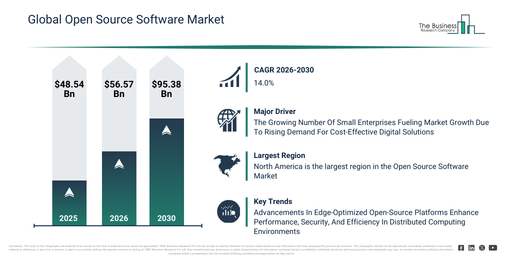
The open source software market has experienced substantial expansion in recent years. This market is projected to expand from $48.54 billion in 2025 to $56.57 billion in 2026, demonstrating a compound annual growth rate (CAGR) of 16.5%. Historically, this expansion has been driven by factors such as an increasing need for economical software options, the proliferation of developer communities, the uptake of Linux-based operating systems, the growing deployment of open source databases, and wider distribution of software through the internet.
The open source software market is projected to expand significantly in the coming years, reaching $95.38 billion by 2030, exhibiting a compound annual growth rate (CAGR) of 14.0%. This growth during the forecast period is fueled by several factors, including increasing enterprise adoption of open source platforms, a rising focus on open source security compliance, the expansion of hybrid and multi-cloud deployments, a growing demand for vendor-neutral software solutions, and increasing investment in open source support services. Concurrently, major trends expected during this period involve the increasing adoption of community-driven software development, a rising use of open source in enterprise environments, the expansion of cloud-native open source solutions, growing integration with DevOps practices, and an enhanced focus on software security and transparency.
Access Free Sample Pages From The Open Source Software Market Report 2026:
Understanding The Main Driver Of The Open Source Software Market
The expanding count of small enterprises is projected to boost the growth of the open-source software market in the future. These businesses are privately owned entities operating with a limited number of employees and moderate revenue, and they are increasingly searching for affordable, high-quality software to aid their operations. This increase in the establishment of small enterprises stems from growing entrepreneurial activity, favorable economic policies, and evolving demands for digital adoption. Open-source software empowers these businesses to lower costs by providing flexible, customizable, and license-free alternatives to proprietary platforms. For instance, in October 2023, according to the Department for Business and Trade, a UK-based government department, there were 5.55 million private sector businesses, with 5.51 million identified as small businesses. Consequently, the rising number of small enterprises is propelling the expansion of the open-source software market.
Open Source Software Market Segment Mapping For 2026 And Beyond
The open source software market covered in this report is segmented –
1) By Type: Public Open Source Software, Commercial Open Source Software
2) By Application: Professional Services, Managed Services
3) By Organization Size: Small And Medium Enterprises, Large Enterprises
4) By End-User: Banking Financial Services And Insurance (BFSI), Education, Manufacturing, Healthcare And Life Sciences, Retail And Distribution, Other End-Users
Subsegments:
1) By Public Open Source Software: Community-Driven Open Source Software, Freely Distributed Open Source Software, Volunteer Maintained Open Source Software, Collaborative Development Open Source Software
2) By Commercial Open Source Software: Enterprise-Supported Open Source Software, Subscription-Based Open Source Software, Vendor-Maintained Open Source Software, Hybrid Open Source Software
What Key Trend Is Expected To Shape The Open Source Software Market Over The Forecast Period?
Major companies operating in the open-source software market are focused on developing advanced solutions, such as edge-optimized platforms, to enhance data processing speed, bolster security, and streamline management across distributed networks. These edge-optimized platforms are engineered to process data closer to its source, thereby minimizing latency, reducing bandwidth consumption, and supporting lightweight deployments on resource-constrained devices. For example, in October 2023, the Linux Foundation, a US-based nonprofit organization, unveiled EdgeX Foundry Version 3.0. This is a next-generation open-source edge framework that boasts a simplified architecture, a smaller system footprint, enhanced security capabilities, and improved device services, all designed to facilitate efficient and interoperable edge computing. This update allows organizations to deploy more secure, responsive, and scalable edge solutions across diverse environments.
Open Source Software Market Major Players And Industry Competition Overview
Major companies operating in the open source software market are Red Hat Inc., Mozilla Corporation, SUSE S.A., HashiCorp, Acquia Inc., Canonical Ltd., Puppet Inc., TYPO3, MariaDB Corporation, The Linux Foundation, Redpill Linpro., ClearCenter, KDE, Eclipse Foundation AISBL, The Apache Software Foundation, Python Software Foundation, FossID, RethinkDB, GitLab, Elastic, MongoDB, Confluent, Sonar, Mattermost
Full Open Source Software Market Report: Market Size, Trends, Segments And Key Players:
Open Source Software Market Geographic Segmentation: Regions Covered In The Report
North America was the largest region in the open source software market in 2025. The regions covered in the open source software market report are Asia-Pacific, South East Asia, Western Europe, Eastern Europe, North America, South America, Middle East, Africa.
Reach Out To Our Team:
The Business Research Company: https://www.thebusinessresearchcompany.com/
Americas: +1 310-496-7795
Asia: +44 7882 955267 & +91 8897263534
Europe: +44 7882 955267
Email us at: marketing@tbrc.info
Follow us on:
LinkedIn: https://in.linkedin.com/company/the-business-research-company
YouTube: https://www.youtube.com/channel/UC24_fI0rV8cR5DxlCpgmyFQ
Global Market Model: https://www.thebusinessresearchcompany.com/global-market-model

Wasay has over a decade of experience in market research, data modelling, and analytics, with prior experience at GlobalData and Decision Tree Consulting Services. At The Business Research Company , he leads research operations across syndicated studies, customized consulting engagements, and the Global Market Model platform. His professional experience includes supporting organizations such as Boston Consulting Group, KPMG, and Ernst & Young. Wasay holds a degree in Electronics and Communications Engineering, postgraduate management qualifications from International Management Institute Belgium and Indian School of Business and Entrepreneurship, and completed the Integrated Program in Business Analytics from Indian Institute of Management Indore.