The Business Research Company’s 2026 market reports combine market attractiveness scoring, total addressable market sizing, company benchmarking matrices, interactive Excel dashboards, deeper supply chain intelligence, emerging startup tracking, and granular product-level insights to deliver research that is more actionable and strategically valuable.
Is The Pervasive Computing Technology Market Expanding? Latest Size Estimates And 2030 Projections
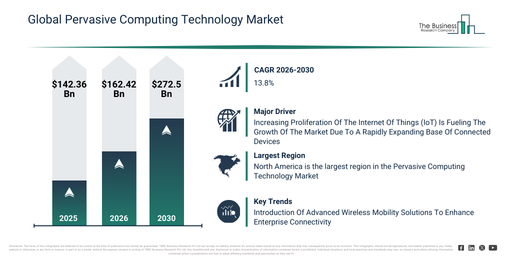
The pervasive computing technology market has experienced rapid expansion in recent years. It is projected to grow from $142.36 billion in 2025 to $162.42 billion in 2026, demonstrating a compound annual growth rate (CAGR) of 14.1%. This historical growth can be attributed to several factors, including the declining cost of sensors and connectivity, the widespread expansion of IoT deployments, the rise of mobile computing and wearables, advancements in edge analytics, and an increasing demand for automation in daily environments.
The pervasive computing technology market is poised for significant expansion over the coming years. Its size is projected to reach $272.5 billion by 2030, demonstrating a compound annual growth rate (CAGR) of 13.8%. This anticipated growth during the forecast period is primarily driven by advancements such as AI at the edge for enhanced privacy and reduced latency, the standardization of interoperable device ecosystems, the integration of pervasive computing in smart cities, the development of energy-efficient always-on computing, and human-centric interfaces featuring ambient assistants. Furthermore, major trends contributing to this outlook include context-aware edge computing for real-time decisions, the implementation of ambient intelligence in smart spaces, sensor fusion to create seamless user experiences, the assurance of secure device identity alongside embedded cybersecurity, and the adoption of digital twins for optimizing pervasive systems.
Free Pervasive Computing Technology Market Sample: Market Size, Growth Drivers And Competitive Landscape:
Pervasive Computing Technology Market Drivers Explained: What Is Supporting A 13.8% CAGR?
The increasing adoption of the internet of things (IoT) is anticipated to drive the expansion of the pervasive computing technology market in the upcoming years. The internet of things (IoT) represents a network of physical devices linked together that exchange and transmit data over the internet to perform automated and intelligent tasks. The rise in internet of things (IoT) proliferation stems from factors such as smart city initiatives, industrial automation, wearable devices, and enhanced connectivity infrastructure, thereby increasing the demand for intelligent and automated systems. Pervasive computing technology employs internet of things (IoT) devices to enable continuous monitoring, automation, and decisions based on data across different industries. For instance, in April 2025, a report published by Ericsson, a telecommunication company headquartered in Sweden, revealed that global cellular IoT connections totaled approximately 4 billion by the close of 2024, and by 2030, Broadband IoT is projected to represent about 60% of these connections. Therefore, the expanding proliferation of the internet of things (IoT) is fueling the growth of the pervasive computing technology market.
Pervasive Computing Technology Market Segment Guide: Main Divisions And Subsegments
The pervasive computing technology market covered in this report is segmented –
1) By Component: Hardware, Software, Services
2) By Technology: Internet Of Things (IoT), Artificial Intelligence, Sensor Networks, Cloud Computing
3) By Deployment Mode: On-Premises, Cloud
4) By Enterprise Size: Small And Medium Enterprises, Large Enterprises
5) By End-User: Banking, Financial Services, And Insurance (BFSI), Healthcare, Retail, Manufacturing, Information Technology (IT) And Telecommunications, Other End-Users
Subsegments:
1) By Hardware: Embedded Microcontrollers, Edge Gateways, Sensors And Actuators, Radio Frequency Identification Readers And Tags, Global Positioning System And Global Navigation Satellite System Modules, Wireless Local Area Network Access Points, Cellular Modules And Modems, Near Field Communication Modules
2) By Software: Device Operating Systems, Middleware And Device Management Platforms, Edge Analytics Software, Digital Twin Software, Artificial Intelligence And Machine Learning Frameworks, Data Integration And Application Programming Interface Management
3) By Services: Consulting And Advisory Services, System Integration And Deployment Services, Managed Services, Support And Maintenance Services, Training And Certification Services, Cloud Hosting And Infrastructure Services, Network Design And Optimization Services, Security Assessment And Compliance Services
Pervasive Computing Technology Market Trends And Opportunities For 2026–2030
Key companies operating in the pervasive computing technology market are prioritizing the launch of advanced wireless mobility solutions to improve enterprise connectivity and accelerate their market adoption. These wireless mobility solutions typically merge managed network services with sophisticated backhaul technologies, aiming to deliver secure, low-latency, and uninterrupted connectivity across diverse enterprise and industrial environments. For example, in May 2024, HCLTech, an India-based information technology services and consulting company, partnered with Cisco, a US-based networking technology provider, to unveil the Pervasive Wireless Mobility as-a-Service. This offering unites HCLTech’s managed network services with Cisco’s Ultra-Reliable Wireless Backhaul (URWB) technology into a single package. It guarantees secure and continuous connectivity across sectors such as manufacturing, mining, healthcare, retail, and logistics. This innovation is distinguished by its ability to facilitate mission-critical communication, boost operational efficiency, and support a scalable, resilient pervasive computing infrastructure.
Which Major Players Are Active In The Pervasive Computing Technology Market?
Major companies operating in the pervasive computing technology market are Microsoft Corporation, Verizon Communications Inc., AT&T Inc., Dell Technologies Inc., Huawei Technologies Co. Ltd., Robert Bosch GmbH, Panasonic Holdings Corporation, Intel Corporation, Xiaomi Corporation, Schneider Electric SE, SAP SE, Telefonaktiebolaget LM Ericsson, NEC Corporation, MediaTek Inc., NXP Semiconductors N.V., Rockwell Automation Inc., Garmin Ltd., Samsara Inc., Exosite LLC, Eurotech S.p.A.
Unlock The Complete Pervasive Computing Technology Market Report With Company Benchmarking:
Pervasive Computing Technology Market World Regions Compared: Which Leads In Revenue?
North America was the largest region in the pervasive computing technology market in 2025. Asia-Pacific is expected to be the fastest-growing region in the forecast period. The regions covered in the pervasive computing technology market report are Asia-Pacific, South East Asia, Western Europe, Eastern Europe, North America, South America, Middle East, Africa.
Reach Out To Our Team:
The Business Research Company: https://www.thebusinessresearchcompany.com/
Americas: +1 310-496-7795
Asia: +44 7882 955267 & +91 8897263534
Europe: +44 7882 955267
Email us at: marketing@tbrc.info
Follow us on:
LinkedIn: https://in.linkedin.com/company/the-business-research-company
YouTube: https://www.youtube.com/channel/UC24_fI0rV8cR5DxlCpgmyFQ
Global Market Model: https://www.thebusinessresearchcompany.com/global-market-model

Wasay has over a decade of experience in market research, data modelling, and analytics, with prior experience at GlobalData and Decision Tree Consulting Services. At The Business Research Company , he leads research operations across syndicated studies, customized consulting engagements, and the Global Market Model platform. His professional experience includes supporting organizations such as Boston Consulting Group, KPMG, and Ernst & Young. Wasay holds a degree in Electronics and Communications Engineering, postgraduate management qualifications from International Management Institute Belgium and Indian School of Business and Entrepreneurship, and completed the Integrated Program in Business Analytics from Indian Institute of Management Indore.