Market attractiveness scoring, total addressable market sizing, company benchmarking matrices, interactive Excel dashboards, deeper supply chain intelligence, emerging startup tracking, and granular product-level insights are among the key offerings featured in The Business Research Company’s 2026 market reports, designed to deliver more actionable and strategically valuable research.
East‑West Threat Detection Appliance Market On Course To Reach $6.72 Billion By 2030: Size And Growth Overview
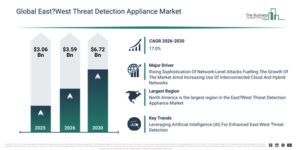
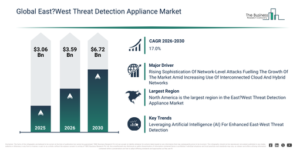
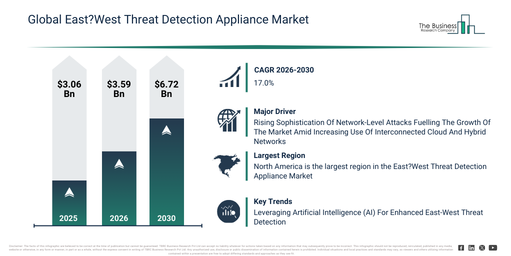
The east-west threat detection appliance market has experienced rapid growth in recent years. It is projected to increase from $3.06 billion in 2025 to $3.59 billion in 2026, achieving a compound annual growth rate (CAGR) of 17.3%. This historical growth can be attributed to several factors including the rise in ransomware and internal propagation attacks, the expansion of virtualized and cloud workloads, the limitations inherent in perimeter-only security models, increasing regulatory scrutiny concerning breaches, and the broader implementation of SOC and SIEM deployments.
The east-west threat detection appliance market is anticipated to undergo significant expansion in the next few years, with its size projected to reach $6.72 billion by 2030, growing at a compound annual growth rate (CAGR) of 17.0%. This growth during the forecast period can be attributed to several factors such as AI-assisted anomaly detection at line rate, the increasing adoption of microsegmentation policies, integration with cloud-native security controls, a rising demand for unified visibility across hybrid networks, and an enhanced focus on insider threat detection. Key trends expected in this period include lateral movement detection in data centers, the application of behavioral analytics for east-west traffic, improved encrypted traffic inspection and visibility, monitoring of zero trust microsegmentation, and the integration of NDR and SOC workflows.
Need East‑West Threat Detection Appliance Market Forecasts? Get Your Free Sample Report Here:
East‑West Threat Detection Appliance Market Growth Factors: What Is Strengthening Demand Worldwide?
The increasing complexity of network-level attacks is projected to drive the expansion of the east-west threat detection appliance market in the future. Network-level attacks are defined as cyber intrusions that exploit vulnerabilities within interconnected systems, enabling adversaries to move laterally across internal networks to steal data or disrupt operations. The frequency of these attacks is surging due to the wider adoption of interconnected cloud and hybrid networks, which furnish attackers with more entry points and pathways for lateral movement within enterprise environments. East-west threat detection appliances continuously monitor and analyze lateral traffic between systems in a data center or cloud setting, thereby enabling the detection and prevention of network-level attacks such as lateral movement, malware propagation, and insider threats. This is achieved by providing deep visibility, real-time anomaly detection, and automated response capabilities across internal network segments. For instance, in April 2025, according to the Federal Bureau of Investigation (FBI), a US-based government law-enforcement agency, internet-crime losses in the United States exceeded US $16 billion in 2024, representing a 33% increase compared to 2023. Consequently, the rising sophistication of network-level attacks is a key driver for the growth of the east-west threat detection appliance market.
East‑West Threat Detection Appliance Market By Segment: Complete Category And Subcategory Breakdown
The east‑west threat detection appliance market covered in this report is segmented –
1) By Component: Hardware, Software, Services
2) By Deployment Mode: On-Premises, Cloud
3) By Organization Size: Small And Medium Enterprises, Large Enterprises
4) By Application: Network Security, Data Center Security, Cloud Security, Other Applications
5) By End-User: Banking, Financial Services, And Insurance (BFSI), Healthcare, Information Technology And Telecom, Government, Retail, Manufacturing, Other End-Users
Subsegments:
1) By Hardware Type: Sensors, Detection Modules, Processing Units, User Interface Panels, Network Connectivity Units
2) By Software Type: Threat Analytics Software, Data Visualization Software, Device Management Software, Alert Management Software, Reporting And Dashboard Software
3) By Services Type: Installation And Setup Services, Maintenance And Support Services, System Integration Services, Training And Education Services, Managed Detection Services
East‑West Threat Detection Appliance Market Trend Outlook: Developments Defining The Forecast Period
Major companies operating in the east-west threat detection appliance market are focusing on incorporating advancements in technology, such as artificial intelligence (AI) network security solutions, to enhance network visibility, monitoring, and threat prevention. An artificial intelligence (AI) network security solution is a system that leverages AI and machine learning to monitor, detect, and respond to cyber threats in real time, thereby improving protection against malware, intrusions, and anomalous network behavior. For instance, in September 2025, Huawei Technologies Co. Ltd., a China-based provider of telecommunications and enterprise network infrastructure, launched the Upgraded Xinghe AI Network Security Solution. This AI-powered zero-trust platform is designed to secure enterprise branches, campuses, and data centers, featuring east-west application-layer threat detection, automatic policy generation, and unified AI-driven security management. Xinghe AI Network Security improves real-time detection, automated response, and internal attack prevention.
Who Is Competing For Share In The East‑West Threat Detection Appliance Market?
Major companies operating in the east‑west threat detection appliance market are Cisco Systems Inc., Broadcom Inc., Palo Alto Networks Inc., Arista Networks Inc., Fortinet Inc., AkamAI Technologies Inc., Check Point Software Technologies Ltd, Nutanix Inc., Zscaler Inc., Trend Micro Incorporated, Sangfor Technologies Inc., Netskope Inc., Rapid7 Inc., Bitdefender LLC, ExtraHop Networks Inc., Vectra AI Inc., Illumio Inc., Corelight Inc., ColorTokens Inc., Tigera Inc.
Get The Full Picture With The East‑West Threat Detection Appliance Market Report:
East‑West Threat Detection Appliance Market Regional Snapshot: Leading Geography In 2025
North America was the largest region in the east‑west threat detection appliance market in 2025. Asia-Pacific is expected to be the fastest-growing region in the forecast period. The regions covered in the east‑west threat detection appliance market report are Asia-Pacific, South East Asia, Western Europe, Eastern Europe, North America, South America, Middle East, Africa.
Reach Out To Our Team:
The Business Research Company: https://www.thebusinessresearchcompany.com/
Americas: +1 310-496-7795
Asia: +44 7882 955267 & +91 8897263534
Europe: +44 7882 955267
Email us at: marketing@tbrc.info
Follow us on:
LinkedIn: https://in.linkedin.com/company/the-business-research-company
YouTube: https://www.youtube.com/channel/UC24_fI0rV8cR5DxlCpgmyFQ
Global Market Model: https://www.thebusinessresearchcompany.com/global-market-model

Wasay has over a decade of experience in market research, data modelling, and analytics, with prior experience at GlobalData and Decision Tree Consulting Services. At The Business Research Company , he leads research operations across syndicated studies, customized consulting engagements, and the Global Market Model platform. His professional experience includes supporting organizations such as Boston Consulting Group, KPMG, and Ernst & Young. Wasay holds a degree in Electronics and Communications Engineering, postgraduate management qualifications from International Management Institute Belgium and Indian School of Business and Entrepreneurship, and completed the Integrated Program in Business Analytics from Indian Institute of Management Indore.