The Business Research Company’s 2026 market reports combine market attractiveness scoring, total addressable market sizing, company benchmarking matrices, interactive Excel dashboards, deeper supply chain intelligence, emerging startup tracking, and granular product-level insights to deliver research that is more actionable and strategically valuable.
What Is The Information Technology (IT) Asset Management Software Market Growth Rate? A 7.7% CAGR Outlook Through 2030
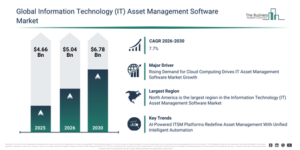
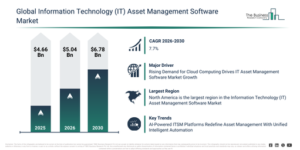
The information technology (it) asset management software market has shown robust expansion in recent years. It is projected to increase from $4.66 billion in 2025 to $5.04 billion in 2026, demonstrating a compound annual growth rate (CAGR) of 8.0%. Historically, this growth has been fueled by factors such as the growth of enterprise IT infrastructure, the increasing complexity of hardware assets, the practice of early software license audits, the expansion of enterprise networks, and the rising need for operational cost control.
The information technology (it) asset management software market is projected to experience substantial expansion over the upcoming years. Its valuation is set to reach $6.78 billion by 2030, exhibiting a compound annual growth rate (CAGR) of 7.7%. This anticipated growth within the forecast period stems from several factors, including the proliferation of hybrid IT environments, increasing demand for cloud asset management, heightened cybersecurity compliance demands, the automation of IT operations, and the overall expansion of digital enterprises. Key developments expected during this period encompass automated asset discovery and tracking, cloud-based IT asset management solutions, AI-driven asset optimization, stringent license compliance and cost control measures, and enhanced integration with IT service management.
Access A Free Sample Of The Latest Information Technology (IT) Asset Management Software Market Analysis:
Why Is The Information Technology (IT) Asset Management Software Market Growing? The Key Demand Driver Explained
The expansion of cloud computing is projected to fuel the growth of the information technology (IT) asset management software market moving forward. Cloud computing delivers on-demand access to various computing resources like servers, storage, and software over the internet. This approach allows users to utilize these services without needing to own or manage physical hardware themselves. Cloud computing’s increasing appeal is due to its cost-effectiveness, scalability, and flexibility, which enable businesses to adjust their resources as necessary without investing in costly hardware and infrastructure. IT asset management software supports cloud computing by providing tools to track and manage cloud resources, optimize asset use, ensure compliance, and integrate various cloud services, thereby enhancing overall efficiency and control. For instance, in December 2023, according to Eurostat, a Luxembourg-based statistical office of the European Union (EU), enterprise adoption of cloud computing rose by 4.2 percentage points in 2023, with e-mail services being the most widely adopted at 82.7 percent, followed by file storage at 68.0 percent and office software at 66.3 percent. Therefore, the proliferation of cloud computing is driving the expansion of the information technology (IT) asset management software market.
What Are The Main Segments Of The Information Technology (IT) Asset Management Software Market?
The information technology (it) asset management software market covered in this report is segmented –
1) By Component: Hardware, Software, Service
2) By Tools: Discovery Or Automated Inventory, License Management, Patch And Version Management, Request Management, Product Or Service Catalog, Digital Asset Management, Other Tools
3) By Deployment: Cloud, On-Premise
4) By Organization Size: Small And Medium Enterprises (SMEs), Large Enterprise
5) By End User Industry: Information Technology (IT) And Telecom, Banking, Financial Services, And Insurance (BFSI), Healthcare, Retail, Manufacturing, Government, Other End Users
Subsegments:
1) By Hardware: Servers And Data Center Hardware, Networking Equipment, End-User Devices, Storage Devices Printers And Peripherals
2) By Software: Asset Tracking And Monitoring Software, License Management Software, Inventory Management Software, Configuration Management Software, Cloud-Based IT Asset Management Software, Mobile Device Management (MDM) Software
3) By Service: IT Asset Management Consulting Services, Implementation And Integration Services, Maintenance And Support Services, Training And Support Services, Cloud Migration Services
Information Technology (IT) Asset Management Software Market Trend Analysis: Where Leading Companies Are Focusing
Leading firms within the IT Asset Management Software market are concentrating on technological innovations, specifically AI-enabled ITSM platforms, to bolster the precision, automation, and smart capabilities of their service and asset management processes. An AI-enabled ITSM platform represents a technological structure that employs artificial intelligence to streamline IT service activities, enhance configuration and asset information, and refine decision-making throughout the IT environment. For example, in October 2025, Salesforce Inc., a US-based company providing cloud-based enterprise software and customer service platforms, introduced Agentforce IT Service. This platform integrates IT operations, employee assistance, and service workflows through automation powered by artificial intelligence, conversational interfaces, and unified data management. It improves service standards and operational dependability by utilizing high-quality configuration and asset data to facilitate proactive problem-solving, immediate insights, and connectivity across the entire enterprise.
Which Companies Are Major Players In The Information Technology (IT) Asset Management Software Market?
Major companies operating in the information technology (it) asset management software market are Deloitte, International Business Machines Corporation, HP Inc., Broadcom Inc., SAP SE, Salesforce Inc., ServiceNow Inc., BMC Software Inc., Atlassian Corporation, Micro Focus International plc, Zoho Corporation, IFS AB, Quest Software Inc., Ivanti Software Inc., SolarWinds Corporation, Freshworks Inc., Flexera Software LLC, ASG Technologies Group Inc., TOPdesk, Chevin Fleet Solutions, Lansweeper, Spiceworks Inc., Agiloft Inc., SysAid Technologies, InvGate
Get The Complete Information Technology (IT) Asset Management Software Market Analysis Here:
Which Region Held The Largest Share Of The Information Technology (IT) Asset Management Software Market In 2025?
North America was the largest region in the information technology (IT) asset management software market in 2025. Asia-Pacific is expected to be the fastest-growing region in the forecast period. The regions covered in the information technology (it) asset management software market report are Asia-Pacific, South East Asia, Western Europe, Eastern Europe, North America, South America, Middle East, Africa.
Reach Out To Our Team:
The Business Research Company: https://www.thebusinessresearchcompany.com/
Americas: +1 310-496-7795
Asia: +44 7882 955267 & +91 8897263534
Europe: +44 7882 955267
Email us at: marketing@tbrc.info
Follow us on:
LinkedIn: https://in.linkedin.com/company/the-business-research-company
YouTube: https://www.youtube.com/channel/UC24_fI0rV8cR5DxlCpgmyFQ
Global Market Model: https://www.thebusinessresearchcompany.com/global-market-model

Wasay has over a decade of experience in market research, data modelling, and analytics, with prior experience at GlobalData and Decision Tree Consulting Services. At The Business Research Company , he leads research operations across syndicated studies, customized consulting engagements, and the Global Market Model platform. His professional experience includes supporting organizations such as Boston Consulting Group, KPMG, and Ernst & Young. Wasay holds a degree in Electronics and Communications Engineering, postgraduate management qualifications from International Management Institute Belgium and Indian School of Business and Entrepreneurship, and completed the Integrated Program in Business Analytics from Indian Institute of Management Indore.