The Business Research Company’s 2026 market reports combine market attractiveness scoring, total addressable market sizing, company benchmarking matrices, interactive Excel dashboards, deeper supply chain intelligence, emerging startup tracking, and granular product-level insights to deliver research that is more actionable and strategically valuable.
Fiber-To-The-Room (FTTR) Market Revenue Forecast: $3.35 Billion In 2026 Rising To $7.07 Billion In 2030
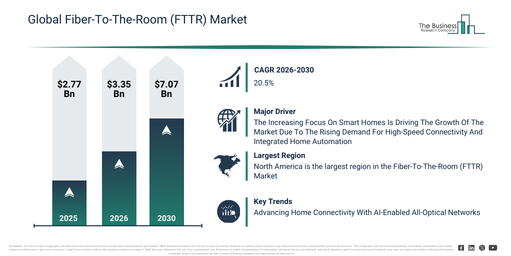
The fiber-to-the-room (fttr) market has experienced rapid expansion in recent years. It is projected to increase from $2.77 billion in 2025 to $3.35 billion in 2026, at a compound annual growth rate (CAGR) of 20.8%. The historical growth of this market can be attributed to several factors, including a reliance on Wi-Fi and copper cabling, issues with inconsistent connectivity within rooms, high latency in multi-room setups, a fragmented network infrastructure, and limited bandwidth allocation.
The fiber-to-the-room (fttr) market size is anticipated to undergo significant growth in the coming years. It is projected to expand to $7.07 billion by 2030, demonstrating a compound annual growth rate (CAGR) of 20.5%. This market expansion during the forecast period is primarily driven by the escalating demand for ultra-fast in-building connectivity, the increasing number of smart buildings in residential and commercial sectors, broader adoption of high-speed fiber optics, the growing necessity for scalable network solutions, and the continuous expansion of digital services and applications. Key trends expected in the forecast period include high-speed in-room connectivity, low-latency data transmission, scalable fiber deployment, reliable bandwidth utilization, and a seamless digital experience.
Free Sample Report: Fiber-To-The-Room (FTTR) Market Size, Trends And Forecast To 2030:
Fiber-To-The-Room (FTTR) Market Growth Catalyst: What Is Creating New Demand?
The expanding emphasis on smart homes is anticipated to boost the expansion of the fiber-to-the-room (FTTR) market. A smart home describes a residential environment equipped with connected devices that oversee, supervise, and automate various systems to enhance convenience, efficiency, and comfort. The rising prominence of smart homes stems from evolving digital lifestyles, as consumers seek uninterrupted connectivity and integrated home automation solutions that depend on resilient, high-speed internet infrastructure. The widespread adoption of smart homes generates a need for ultra-high-speed, low-latency internet connections capable of supporting numerous connected devices concurrently, thereby accelerating the demand for sophisticated fiber connectivity solutions that extend directly into individual rooms. For example, in October 2024, data from the Central Statistics Office, an Ireland-based government body, indicated that approximately 28% of internet users now employ connected devices for managing home energy, representing a 6-point increase compared to the same period in 2022. Consequently, the heightened focus on smart homes is propelling the growth of the fiber-to-the-room (FTTR) market.
Fiber-To-The-Room (FTTR) Market Segment Overview: Categories Covered In The 2026 Report
The fiber-to-the-room (fttr) market covered in this report is segmented –
1) By Component: Optical Network Units, Optical Line Terminals, Cables, Other Components
2) By Service Type: Installation And Maintenance, Consulting, Other Service Types
3) By Deployment Mode: New Installations, Upgrades And Retrofits
4) By Application: Residential, Commercial, Hospitality, Education, Healthcare, Other Applications
5) By End-User: Individual Consumers, Enterprises, Service Providers
Subsegments:
1) By Optical Network Units (ONU): Residential Optical Network Units (ONU), Enterprise Optical Network Units (ONU), Industrial Optical Network Units (ONU), Multi-Service Optical Network Units (ONU)
2) By Optical Line Terminals (OLT): Fixed Optical Line Terminals (OLT), Modular Optical Line Terminals (OLT), Chassis-Based Optical Line Terminals (OLT), Compact Optical Line Terminals (OLT)
3) By Cables: Single-Mode Fiber Cables (SMF), Multi-Mode Fiber Cables (MMF), Armored Fiber Cables, Indoor Fiber Cables, Outdoor Fiber Cables
4) By Other Components: Splitters, Optical Transceivers, Media Converters, Patch Panels, Connectors And Adapters
How Are Leading Companies Shaping Fiber-To-The-Room (FTTR) Market Trends?
Leading firms in the fiber-to-the-room (FTTR) market are prioritizing the creation of advanced solutions, including AI-enabled all-optical networks, to improve connectivity, storage capabilities, computational power, and overall user satisfaction. These AI-enabled all-optical networks leverage advanced AI chips and symmetric 2.5G optical networks to provide uninterrupted connectivity and smart functionalities. An example of this is ZTE Corporation, a telecommunications equipment company from China, which introduced its Next-Gen FTTR series products, incorporating AI-enabled all-optical networks, in September 2024. These offerings employ symmetric 2.5G optical networks and Wi-Fi 7 technology to deliver a consistent 3000 Mbps across the whole home, addressing future growth requirements. The device is equipped with a powerful six-antenna configuration and intelligent antenna algorithms, boosting Wi-Fi coverage by 20%. Its D-WLAN architecture enables multiple access points (APs) to collaborate fluidly, forming a cohesive home network with a business-grade latency of just 10 ms. Furthermore, it increases AP throughput by 10% to ensure uninterrupted performance, while Wi-Fi sensing technology offers “invisible” monitoring, providing precise attention to private spaces within the residence.
Fiber-To-The-Room (FTTR) Market Players: Key Companies Shaping Competition
Major companies operating in the fiber-to-the-room (fttr) market are Huawei Technologies Co. Ltd., Sumitomo Electric Industries Ltd., Nokia Corporation, ZTE Corporation, TE Connectivity Ltd., Prysmian Group, Corning Incorporated, Amphenol Corporation, Furukawa Electric Co. Ltd., Fujikura Ltd., LS Cable & System Ltd., CommScope Holding Company Inc., FiberHome Telecommunication Technologies Co. Ltd., Belden Inc., Yangtze Optical Fibre and Cable Joint Stock Limited Company (YOFC), Huber+Suhner AG, OFS Fitel LLC, Sterlite Technologies Limited, Allied Telesis Holdings K.K., Reichle & De-Massari AG
Access Complete Fiber-To-The-Room (FTTR) Market Data, Forecasts And Competitive Insights:
Fiber-To-The-Room (FTTR) Market Regional Performance And Geographic Coverage
North America was the largest region in the fiber-to-the-room (FTTR) market in 2025. Asia-Pacific is expected to be the fastest-growing region in the forecast period. The regions covered in the fiber-to-the-room (fttr) market report are Asia-Pacific, South East Asia, Western Europe, Eastern Europe, North America, South America, Middle East, Africa.
Reach Out To Our Team:
The Business Research Company: https://www.thebusinessresearchcompany.com/
Americas: +1 310-496-7795
Asia: +44 7882 955267 & +91 8897263534
Europe: +44 7882 955267
Email us at: marketing@tbrc.info
Follow us on:
LinkedIn: https://in.linkedin.com/company/the-business-research-company
YouTube: https://www.youtube.com/channel/UC24_fI0rV8cR5DxlCpgmyFQ
Global Market Model: https://www.thebusinessresearchcompany.com/global-market-model

Wasay has over a decade of experience in market research, data modelling, and analytics, with prior experience at GlobalData and Decision Tree Consulting Services. At The Business Research Company , he leads research operations across syndicated studies, customized consulting engagements, and the Global Market Model platform. His professional experience includes supporting organizations such as Boston Consulting Group, KPMG, and Ernst & Young. Wasay holds a degree in Electronics and Communications Engineering, postgraduate management qualifications from International Management Institute Belgium and Indian School of Business and Entrepreneurship, and completed the Integrated Program in Business Analytics from Indian Institute of Management Indore.