Designed to make market research more actionable and strategically valuable, The Business Research Company’s 2026 market reports feature market attractiveness scoring, total addressable market sizing, company benchmarking matrices, interactive Excel dashboards, deeper supply chain intelligence, emerging startup tracking, and granular product-level insights.
Fifth Generation (5G) Radio Access Network Market To Expand At A 20.4% CAGR: Size And Growth Projections Through 2030
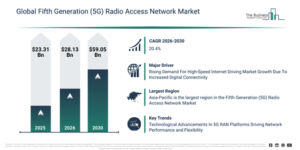
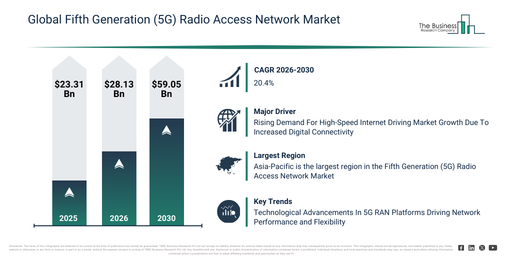
The size of the fifth generation (5g) radio access network market has witnessed exponential growth in recent years. It is forecast to grow from $23.31 billion in 2025 to $28.13 billion in 2026, at a compound annual growth rate (CAGR) of 20.7%. This historical expansion stemmed from factors such as growth in mobile data traffic, early LTE network congestion, increasing smartphone penetration, the demand for higher network capacity, and initial 5G infrastructure investments.
The fifth generation (5G) radio access network market size is anticipated to see considerable expansion in the coming years. It is projected to climb to $59.05 billion in 2030, achieving a compound annual growth rate (CAGR) of 20.4%. This growth during the forecast period can be attributed to the expansion of private 5G networks, the increasing development of smart city infrastructure, the high demand for massive IoT connectivity, the implementation of edge integrated RAN architectures, and greater spectrum availability. Key trends for the forecast period include the embrace of open RAN architecture, the deployment of virtualized RAN, the densification of small cell networks, AI-based network optimization, and the adoption of cloud-native RAN solutions.
Get Your Free Fifth Generation (5G) Radio Access Network Market Report Sample Today:
Which Factor Is Expected To Drive The Fifth Generation (5G) Radio Access Network Market Over The Forecast Period?
The increasing demand for rapid internet connectivity is projected to fuel the expansion of the fifth-generation (5G) radio access networks market in the future. High-speed internet refers to an internet connection that provides swift data transfer rates, allowing for quick downloads, seamless streaming, and efficient browsing with minimal lag or buffering. The necessity for high-speed internet is escalating due to the growing dependency on uninterrupted digital connections for effective communication, information access, and the smooth operation of numerous online services in everyday life. High-speed internet boosts the 5G radio access network by enhancing data transmission speeds, decreasing latency, expanding network capacity, guaranteeing dependable connectivity, and facilitating advanced applications like IoT, autonomous systems, and high-definition streaming. For instance, in September 2025, according to Innovation, Science and Economic Development Canada (ISED), a Canada-based government department, the Government of Canada is connecting 98% of Canadians to high-speed Internet by 2026 and 100% of Canadians by 2030. Consequently, the escalating demand for high-speed internet is a key factor propelling the fifth-generation (5G) radio access networks market.
Fifth Generation (5G) Radio Access Network Market Segmentation Insights: How Is The Industry Categorized?
The fifth generation (5g) radio access network market covered in this report is segmented –
1) By Component: Hardware, Software, Services
2) By Architecture Type: Centralized Radio Access Network (CRAN), Open Radio Access Network (ORAN), Virtualized Radio Access Network (VRAN)
3) By Deployment: Indoor, Outdoor
4) By End-User: Telecom Operators, Enterprises
Subsegments:
1) By Hardware: Radio Units (RU), Distributed Antenna Systems (DAS), Small Cells (Femtocells, Picocells, Microcells), Massive MIMO Antennas, Baseband Units (BBU)
2) By Software: Network Virtualization Software, Cloud RAN (C-RAN) Software, AI-Based Network Optimization Software, Network Slicing Software, SDN (Software-Defined Networking) Solutions
3) By Services: Deployment And Integration Services, Network Optimization And Maintenance Services, Managed Services, Consulting And Advisory Services, Training And Support Services
Fifth Generation (5G) Radio Access Network Market Trends Explained: What Is Changing And Why It Matters
Leading companies in the fifth-generation (5G) radio access networks market are concentrating on developing advanced commercial 5G radio access network (RAN) platforms to improve network capabilities. These commercial 5G RAN platforms are comprehensive hardware and software solutions that enable mobile operators to deploy, manage, and enhance 5G networks, ensuring high-speed performance, low latency, and extensive device connectivity. For instance, in November 2024, Viettel, a Vietnam-based telecom company, introduced its Open Radio Access Network (O-RAN) 5G Network. This is the first Open RAN (O-RAN) 5G network to utilize Qualcomm Technologies’ 5G RAN platforms. This achievement establishes Viettel as a key advocate in the O-RAN community and one of the largest carriers to launch a commercial O-RAN network. The network features crucial equipment developed internally by Viettel and is planned for deployment across over 300 sites in Vietnamese provinces by early 2025, with intentions for broader expansion. This partnership with Qualcomm aims to provide cost-effective, high-quality 5G solutions while fostering a sustainable vendor ecosystem.
Fifth Generation (5G) Radio Access Network Market Competitor Landscape: Who Are The Major Companies?
Major companies operating in the fifth generation (5g) radio access network market are Samsung Electronics Co. Ltd., Verizon Communications Inc., Huawei Technologies Co. Ltd., Intel Corporation, Cisco Systems Inc., Qualcomm Technologies Inc., Fujitsu Limited, Telefonaktiebolaget LM Ericsson, Nokia Corporation, NEC Corporation, ZTE Corporation, TE Connectivity, Corning Inc., Juniper Networks Inc., Arm Limited, Mavenir, Comba Telecom Systems Holdings Limited, Comarch SA, Parallel Wireless, Rakuten Symphony Singapore Pte. Ltd.
See The Full Fifth Generation (5G) Radio Access Network Market Report For Complete Market Sizing And Trends:
Fifth Generation (5G) Radio Access Network Market Regional Demand Analysis And Leading Geography
Asia-Pacific was the largest region in the fifth-generation (5G) radio access networks market in 2025. The regions covered in the fifth generation (5g) radio access network market report are Asia-Pacific, South East Asia, Western Europe, Eastern Europe, North America, South America, Middle East, Africa.
Reach Out To Our Team:
The Business Research Company: https://www.thebusinessresearchcompany.com/
Americas: +1 310-496-7795
Asia: +44 7882 955267 & +91 8897263534
Europe: +44 7882 955267
Email us at: marketing@tbrc.info
Follow us on:
LinkedIn: https://in.linkedin.com/company/the-business-research-company
YouTube: https://www.youtube.com/channel/UC24_fI0rV8cR5DxlCpgmyFQ
Global Market Model: https://www.thebusinessresearchcompany.com/global-market-model

Wasay has over a decade of experience in market research, data modelling, and analytics, with prior experience at GlobalData and Decision Tree Consulting Services. At The Business Research Company , he leads research operations across syndicated studies, customized consulting engagements, and the Global Market Model platform. His professional experience includes supporting organizations such as Boston Consulting Group, KPMG, and Ernst & Young. Wasay holds a degree in Electronics and Communications Engineering, postgraduate management qualifications from International Management Institute Belgium and Indian School of Business and Entrepreneurship, and completed the Integrated Program in Business Analytics from Indian Institute of Management Indore.