Market attractiveness scoring, total addressable market sizing, company benchmarking matrices, interactive Excel dashboards, deeper supply chain intelligence, emerging startup tracking, and granular product-level insights are among the key offerings featured in The Business Research Company’s 2026 market reports, designed to deliver more actionable and strategically valuable research.
What Is The Fifth Generation (5G) Radio Frequency (RF) Transceiver Market Size In 2026, And Where Is It Heading By 2030?
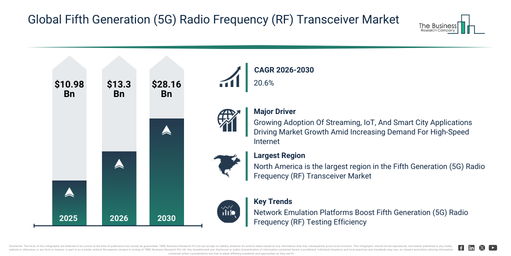
The market size for the fifth generation (5g) radio frequency (rf) transceiver has experienced significant growth in recent years. This market is anticipated to expand from $10.98 billion in 2025 to $13.3 billion in 2026, demonstrating a compound annual growth rate (CAGR) of 21.1%. Historically, this expansion can be attributed to the early development of 4g LTE infrastructure, increasing demand for mobile data, a rise in smartphone penetration, ongoing base station modernization, and progress in spectrum allocation.
The fifth generation (5g) radio frequency (rf) transceiver market is forecast to undergo significant expansion in the coming years. It is expected to reach $28.16 billion in 2030, demonstrating a compound annual growth rate (CAGR) of 20.6%. This anticipated growth is primarily fueled by the global deployment of 5G networks, the increasing connectivity of IoT devices, the rise of autonomous vehicles, the growing adoption of edge computing, and the heightened demand for high-speed wireless communication. Noteworthy trends during this forecast period include the integration of multi-band RF transceivers, the embracing of millimeter wave technology, the implementation of massive MIMO, the miniaturization of RF components, and the development of energy-efficient RF designs.
Request Your Free Fifth Generation (5G) Radio Frequency (RF) Transceiver Market Sample With Segment And Regional Data:
Fifth Generation (5G) Radio Frequency (RF) Transceiver Market Growth Drivers And Their Impact On Future Demand
The escalating demand for rapid internet access is projected to fuel the expansion of the fifth generation (5G) radio frequency (RF) transceiver market moving ahead. This heightened requirement for swift internet connectivity stems from various elements, including the surge in streaming services, widespread remote employment, proliferation of IoT devices, development of smart cities, and the increasing reliance on data-intensive applications. These 5G RF transceivers are crucial for achieving high-speed connectivity within 5G networks, primarily due to their capacity to manage elevated frequencies, facilitate quicker data transmission, and support cutting-edge innovations such as beamforming and massive MIMO, thereby enhancing network efficiency and overall performance. To illustrate, in March 2023, data from the Office of Communications (Ofcom), a UK government body, revealed that the average download speed for UK home broadband connections reached 65.3 Mbit/s, marking a 10% increase from March 2022. Consequently, the expanding necessity for high-speed internet access will be a key impetus for the fifth generation (5G) radio frequency (RF) transceiver market.
What Categories Define The Fifth Generation (5G) Radio Frequency (RF) Transceiver Market?
The fifth generation (5g) radio frequency (rf) transceiver market covered in this report is segmented –
1) By Component: Transmitter, Receiver, Duplexer, Other Components
2) By Technology Type: Sub-6 GHz, Millimeter Wave (mmWave), Massive MIMO (Multiple-Input, Multiple-Output), Beamforming
3) By Frequency Band: Sub-6 GHz, Millimeter Wave (mmWave)
4) By Application: Smartphones, Base Stations, Internet Of Things (IoT) Devices, Automotive, Other Applications
5) By End-User: Telecommunications, Automotive, Consumer Electronics, Industrial, Other End-Users
Subsegments:
1) By Transmitter: Power Amplifiers (PA), Upconverters, Modulators, RF Filters
2) By Receiver: Low Noise Amplifiers (LNA), Downconverters, Demodulators, RF Filters
3) By Duplexer: Frequency Division Duplex (FDD) Duplexers, Time Division Duplex (TDD) Duplexers, Diplexers, Triplexers
4) By Other Components: Phase-Locked Loops (PLLs), Mixers, Oscillators, Antenna Switch Modules
What New Developments Are Emerging In The Fifth Generation (5G) Radio Frequency (RF) Transceiver Market?
Leading companies in the fifth generation (5G) radio frequency (RF) transceiver market are concentrating on developing innovative solutions, such as fifth generation (5G) network emulation solutions platforms, to expedite the testing and optimization of fifth generation (5G) radio frequency (RF) components. These platforms establish a testing environment that simulates real-world fifth generation (5G) networks to evaluate and refine the performance of radio frequency (RF) transceivers and other 5G components before deployment. For example, in February 2023, Keysight Technologies Inc., a US-based electronics company, introduced the E7515R solution. This solution, built upon its fifth generation (5G) network emulation solutions platform, is specifically designed for fifth generation (5G) RedCap and supports all Cellular internet of things (CIoT) technologies. It operates by emulating real-world fifth generation (5G) network conditions to test and validate the performance of fifth generation (5G) radio frequency (RF) transceivers, ensuring their reliability, efficiency, and compliance with fifth generation (5G) standards.
Major Players Driving Competition In The Fifth Generation (5G) Radio Frequency (RF) Transceiver Market
Major companies operating in the fifth generation (5g) radio frequency (rf) transceiver market are Huawei Technologies Co. Ltd., Taiwan Semiconductor Manufacturing Company Limited, Intel Corporation, Cisco Systems Inc., Qualcomm Technologies Inc., Broadcom Inc., Fujitsu Limited, Ericsson, Nokia Corporation, Texas Instruments Incorporated, MediaTek Inc., STMicroelectronics NV, Infineon Technologies AG, NXP Semiconductors N.V., Murata Manufacturing Co. Ltd., Analog Devices Inc., Renesas Electronics Corporation, On Semiconductor Corporation, Skyworks Solutions Inc., Keysight Technologies Inc., Qorvo Inc., Marvell Technology Inc., Rohde & Schwarz GmbH & Co. KG, Lumentum Operations LLC, NEC Corporation, Maxlinear Technologies Pvt Ltd., Anritsu Corporation, Spirent Communications plc, Samsung Electronics Co. Ltd., ZTE Corporation
View The Comprehensive Fifth Generation (5G) Radio Frequency (RF) Transceiver Market Analysis:
Fifth Generation (5G) Radio Frequency (RF) Transceiver Market Regional Leaders: Insights From The 2026 Report
North America was the largest region in the fifth generation (5G) radio frequency (RF) transceiver market in 2025. Asia-Pacific is expected to be the fastest-growing region in the forecast period. The regions covered in the fifth generation (5g) radio frequency (rf) transceiver market report are Asia-Pacific, South East Asia, Western Europe, Eastern Europe, North America, South America, Middle East, Africa.
Reach Out To Our Team:
The Business Research Company: https://www.thebusinessresearchcompany.com/
Americas: +1 310-496-7795
Asia: +44 7882 955267 & +91 8897263534
Europe: +44 7882 955267
Email us at: marketing@tbrc.info
Follow us on:
LinkedIn: https://in.linkedin.com/company/the-business-research-company
YouTube: https://www.youtube.com/channel/UC24_fI0rV8cR5DxlCpgmyFQ
Global Market Model: https://www.thebusinessresearchcompany.com/global-market-model

Wasay has over a decade of experience in market research, data modelling, and analytics, with prior experience at GlobalData and Decision Tree Consulting Services. At The Business Research Company , he leads research operations across syndicated studies, customized consulting engagements, and the Global Market Model platform. His professional experience includes supporting organizations such as Boston Consulting Group, KPMG, and Ernst & Young. Wasay holds a degree in Electronics and Communications Engineering, postgraduate management qualifications from International Management Institute Belgium and Indian School of Business and Entrepreneurship, and completed the Integrated Program in Business Analytics from Indian Institute of Management Indore.