Designed to make market research more actionable and strategically valuable, The Business Research Company’s 2026 market reports feature market attractiveness scoring, total addressable market sizing, company benchmarking matrices, interactive Excel dashboards, deeper supply chain intelligence, emerging startup tracking, and granular product-level insights.
Free Space Optic Communication Market Forecast 2026–2030: Size, Value And Compound Annual Growth Rate
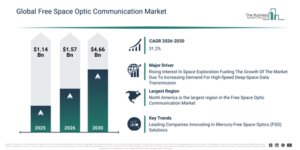
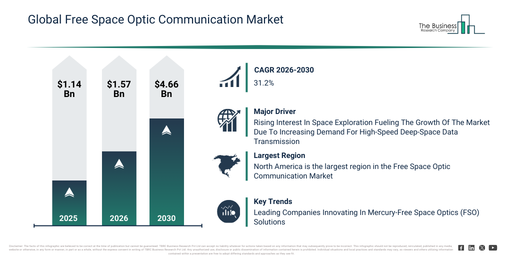
The free space optic communication market size has experienced exponential growth in recent years. It is forecast to increase from $1.14 billion in 2025 to $1.57 billion in 2026, achieving a compound annual growth rate (CAGR) of 37.5%. This market’s expansion in the past can be attributed to factors such as the growing demand for broadband networks, difficulties in deploying fiber in urban areas, the rise of temporary communication networks, the adoption of optical wireless technologies, and an increasing need for secure data connections.
The free space optic communication market size is anticipated to experience substantial expansion over the next few years. It is projected to grow to $4.66 billion in 2030 at a compound annual growth rate (CAGR) of 31.2%. This growth during the forecast period is primarily driven by increasing investments in smart city connectivity, a rising demand for high-capacity wireless infrastructure, the expansion of defense and aerospace communication requirements, the growing application of FSO in 5G backhaul, and advancements in optical transmission technologies. Prominent trends for this period involve the increasing deployment of high-speed wireless backhaul links, the rising utilization of FSO in disaster recovery networks, a growing adoption for last-mile connectivity, the expansion of secure line-of-sight communication systems, and an enhanced focus on low-latency data transmission.
Try Before You Buy: Free Sample Of The Free Space Optic Communication Market Report:
Free Space Optic Communication Market Growth Engine: The Factor Boosting Demand Globally
The escalating enthusiasm for space exploration is set to stimulate the expansion of the free space optic communication market in the foreseeable future. Space exploration encompasses the investigation and discovery of celestial bodies using spacecraft, satellites, and advanced technological instruments. This growing interest in exploring space is fueled by an increasing need for sophisticated communication and Earth observation satellites, which are crucial for global connectivity, environmental monitoring, and enhanced security capabilities. Free-space optic communication significantly aids space exploration by enabling high-speed, laser-based data transmission, making it an optimal solution for deep-space missions that require swift and dependable information exchange. It also improves mission accuracy and operational efficiency through faster scientific data transfer and real-time communication between spacecraft and ground stations. For example, in September 2023, Novaspace, a France-based space governance provider, indicated that government spending on space exploration reached $27 billion in 2024 and is forecast to increase to nearly $31 billion by 2034. Therefore, the heightened interest in space exploration is a key driver for the growth of the free space optic communication market.
Which Categories And Subcategories Shape The Free Space Optic Communication Market?
The free space optic communication market covered in this report is segmented –
1) By Component: Transmitter, Transceiver, Receiver, Other Components
2) By Platform: Space, Airborne, Ground
3) By Range: Short Range, Medium Range, Long Range
4) By Application: Mobile Backhaul, Disaster Recovery, Data Transmission, Airborne Application, Last-Mile Access, Security And Surveillance, Other Applications
5) By End Use: Healthcare, Defense, Telecommunications, Other End Uses
Subsegments:
1) By Transmitter: Laser Diodes, Modulators, Beam Shaping Devices, Optics (Lenses, Mirrors), Power Supply Units
2) By Transceiver: Optical Transceivers, Photodetectors, Digital Signal Processors, Integrated Circuit (IC) Chips, Wavelength Division Multiplexing (WDM) Modules
3) By Receiver: Photodiodes (APDs, PIN Diodes), Photodetector Arrays, Optical Amplifiers, Signal Processing Units, Optical Lenses
4) By Other Components: Optical Filters, Beam Splitters, Communication Cables (Optical Fiber, Fiber Connectors), Power Management Systems, Environmental Protection And Cooling Systems
Free Space Optic Communication Market Trend Insights: Strategic Focus Areas Of Leading Companies
Prominent companies operating in the free space optic communication market are developing innovative solutions, such as mercury-free space optics (FSO) solutions, to gain a competitive advantage. These mercury-free space optics solutions offer improved performance, reliability, and safety, while also addressing environmental concerns associated with mercury-containing technologies. For instance, in April 2023, Viasat Inc., a US-based communications company, launched the Mercury Free Space Optical Communications (FSOC) terminal. This leverages free-space optical technology to enable rapid deployment and reliable connectivity in challenging environments without physical cable infrastructure. The terminal is designed as a high-capacity and cost-effective solution to support a range of expeditionary communications scenarios, including ground-to-ground, ground-to-air, ship-to-ship, and ship-to-shore.
Leading Organizations In The Free Space Optic Communication Market
Major companies operating in the free space optic communication market are Amazon Inc., Huawei Technologies Co. Ltd., Furukawa Electric Co. Ltd., Koninklijke Philips N.V., NEC Corporation, L3Harris Technologies Inc., ZTE Corporation, Panasonic Corp., ViaSat Inc., QinetiQ Group, Space Exploration Technologies Corp (SpaceX), Tesat Spacecom GmbH Co Kg, Fsona Networks Corporation, EC System, SA Photonics Inc., Redline Infrastructure, Cailabs, Collinear Networks Inc., Plaintree Systems Inc., Anova Technologies Inc., Mostcom Inc., Airlinx Communications Inc., Mynaric AG, NTT Electronics Corporation, Laser Light Communications LLC
Continue Reading: The Full Free Space Optic Communication Market Report:
Free Space Optic Communication Market Regional Spotlight: Top Geography And Report Coverage
North America was the largest region in the free space optic communication market in 2025. Asia-Pacific is expected to be the fastest-growing region in the forecast period. The regions covered in the free space optic communication market report are Asia-Pacific, South East Asia, Western Europe, Eastern Europe, North America, South America, Middle East, Africa.
Reach Out To Our Team:
The Business Research Company: https://www.thebusinessresearchcompany.com/
Americas: +1 310-496-7795
Asia: +44 7882 955267 & +91 8897263534
Europe: +44 7882 955267
Email us at: marketing@tbrc.info
Follow us on:
LinkedIn: https://in.linkedin.com/company/the-business-research-company
YouTube: https://www.youtube.com/channel/UC24_fI0rV8cR5DxlCpgmyFQ
Global Market Model: https://www.thebusinessresearchcompany.com/global-market-model

Wasay has over a decade of experience in market research, data modelling, and analytics, with prior experience at GlobalData and Decision Tree Consulting Services. At The Business Research Company , he leads research operations across syndicated studies, customized consulting engagements, and the Global Market Model platform. His professional experience includes supporting organizations such as Boston Consulting Group, KPMG, and Ernst & Young. Wasay holds a degree in Electronics and Communications Engineering, postgraduate management qualifications from International Management Institute Belgium and Indian School of Business and Entrepreneurship, and completed the Integrated Program in Business Analytics from Indian Institute of Management Indore.