The Business Research Company’s 2026 market reports combine market attractiveness scoring, total addressable market sizing, company benchmarking matrices, interactive Excel dashboards, deeper supply chain intelligence, emerging startup tracking, and granular product-level insights to deliver research that is more actionable and strategically valuable.
Is The Free Space Optics Backhaul Market Expanding? Latest Size Estimates And 2030 Projections
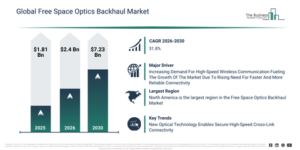
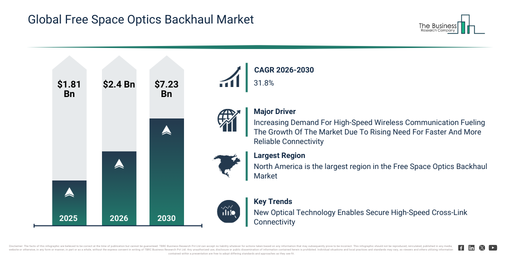
The free space optics backhaul market size has experienced substantial growth in recent years. It is projected to expand from $1.81 billion in 2025 to $2.4 billion in 2026, demonstrating a compound annual growth rate (CAGR) of 32.1%. Historically, this growth is attributable to the need for high bandwidth backhaul, the high cost of fiber installation, increasing urban network densification, the demand for quick connectivity rollout, and advancements in telecom infrastructure upgrades.
The free space optics backhaul market is projected to experience substantial expansion over the upcoming years. Its valuation is anticipated to reach $7.23 billion in 2030, demonstrating a compound annual growth rate (CAGR) of 31.8%. This expansion during the forecast timeframe is primarily driven by factors such as the broadening of 5G networks and fronthaul capabilities, the escalating demand for smart city connectivity, the necessity for robust disaster recovery links, progress in optical modulation techniques, and increasing implementation within enterprise campus networks. Key developments expected during this period involve the scaling up of high-capacity wireless backhaul, support for 5G and small cell densification, the swift rollout of fiber alternatives, advancements in adaptive beam steering, and the provision of resilient urban connectivity solutions.
Free Free Space Optics Backhaul Market Sample: Market Size, Growth Drivers And Competitive Landscape:
Free Space Optics Backhaul Market Drivers Explained: What Is Supporting A 31.8% CAGR?
The escalating requirement for swift wireless communication is anticipated to boost the expansion of the free space optics backhaul market in the future. High-speed wireless communication refers to the rapid transfer of substantial data volumes across varying distances without physical cables, guaranteeing prompt and dependable connectivity. This increasing demand is driven by the growing imperative for quicker data transfer, which facilitates uninterrupted connectivity and instant information exchange. Free space optics backhaul enhances high-speed wireless communication by offering data transmission akin to fiber, using light beams. This technology allows for fast, reliable connections over extensive distances, lessening reliance on traditional fiber infrastructure and boosting network efficiency, even in difficult settings. For instance, the International Telecommunication Union, a Switzerland-based specialized agency of the United Nations, reported that in 2023, the count of internet users climbed from 5.1 billion (64% penetration) in 2022 to 5.4 billion (67% penetration) in 2023. Consequently, the heightened demand for high-speed wireless communication is propelling the growth of the free space optics backhaul market.
Free Space Optics Backhaul Market Segment Guide: Main Divisions And Subsegments
The free space optics backhaul market covered in this report is segmented –
1) By Component: Transmitters, Receivers, Modulators, Demodulators, Other Components
2) By Transmission Range: Short Range, Medium Range, Long Range
3) By Data Rate: Up To 10 Gbps, 10-40 Gbps, Above 40 Gbps
4) By Application: Telecommunications, Military And Defense, Healthcare, Aerospace, Other Application Types
5) By End-User: Telecom Operators, Enterprises, Government, Other End-Users
Subsegments:
1) By Transmitters: Laser Diode Transmitters, Light Emitting Diode Transmitters, Vertical Cavity Surface Emitting Laser Transmitters, High-Power Optical Transmitters
2) By Receivers: Avalanche Photodiode Receivers, PIN Photodiode Receivers, Optical Heterodyne Receivers, Coherent Detection Receivers
3) By Modulators: Electro-Optic Modulators, Acousto-Optic Modulators, Mach–Zehnder Modulators, External Cavity Modulators
4) By Demodulators: Coherent Optical Demodulators, Direct Detection Demodulators, Quadrature Demodulators, Phase Shift Demodulators
5) By Other Components: Beam Steering Units, Optical Amplifiers, Lenses And Mirrors, Optical Filters And Couplers
Free Space Optics Backhaul Market Trends And Opportunities For 2026–2030
Leading companies active in the free space optics backhaul market are concentrating on developing technologically advanced solutions, such as free-space optical links, to boost data transmission speeds, enhance security, and reduce reliance on radio frequency spectrum. Free-space optical (FSO) links refer to wireless communication connections that transmit data using light beams through the air or vacuum instead of optical fiber cables. For instance, in July 2025, General Dynamics Mission Systems Inc., a US-based aerospace and defense company, demonstrated a free-space optics link over a 52 km distance. The demonstration exhibited a resilient, high-capacity FSO cross-link capable of maintaining a stable connection, which is a critical step in providing secure, high-speed communications for ground, air and space platforms. This technology offers a significant advantage for beyond-line-of-sight communications, enabling seamless data transfer in contested environments without the need for fixed infrastructure.
Which Major Players Are Active In The Free Space Optics Backhaul Market?
Major companies operating in the free space optics backhaul market are Airbus SE, Raytheon Technologies Corporation, Northrop Grumman Corporation, L3Harris Technologies Inc., Viasat Inc., General Atomics, Cailabs SAS, SA Photonics Inc., fSONA Networks Corp., Plaintree Systems Inc., Collinear Networks Inc., Anova Technologies LLC, Wireless Excellence Ltd., Mostcom Ltd., Mynaric AG, Taara, LightPointe Communications Inc., Laser Light Communications LLC, Airlinx Communications Inc., SkyFiber Inc.
Unlock The Complete Free Space Optics Backhaul Market Report With Company Benchmarking:
Free Space Optics Backhaul Market World Regions Compared: Which Leads In Revenue?
North America was the largest region in the free space optics backhaul market in 2025. Asia-Pacific is expected to be the fastest-growing region in the forecast period. The regions covered in the free space optics backhaul market report are Asia-Pacific, South East Asia, Western Europe, Eastern Europe, North America, South America, Middle East, Africa.
Reach Out To Our Team:
The Business Research Company: https://www.thebusinessresearchcompany.com/
Americas: +1 310-496-7795
Asia: +44 7882 955267 & +91 8897263534
Europe: +44 7882 955267
Email us at: marketing@tbrc.info
Follow us on:
LinkedIn: https://in.linkedin.com/company/the-business-research-company
YouTube: https://www.youtube.com/channel/UC24_fI0rV8cR5DxlCpgmyFQ
Global Market Model: https://www.thebusinessresearchcompany.com/global-market-model

Wasay has over a decade of experience in market research, data modelling, and analytics, with prior experience at GlobalData and Decision Tree Consulting Services. At The Business Research Company , he leads research operations across syndicated studies, customized consulting engagements, and the Global Market Model platform. His professional experience includes supporting organizations such as Boston Consulting Group, KPMG, and Ernst & Young. Wasay holds a degree in Electronics and Communications Engineering, postgraduate management qualifications from International Management Institute Belgium and Indian School of Business and Entrepreneurship, and completed the Integrated Program in Business Analytics from Indian Institute of Management Indore.