The Business Research Company’s 2026 market reports combine market attractiveness scoring, total addressable market sizing, company benchmarking matrices, interactive Excel dashboards, deeper supply chain intelligence, emerging startup tracking, and granular product-level insights to deliver research that is more actionable and strategically valuable.
Generative AI In Retail Market Size Trajectory: Key Numbers Every Industry Stakeholder Should Know
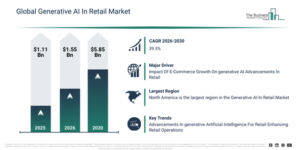
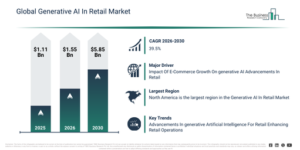
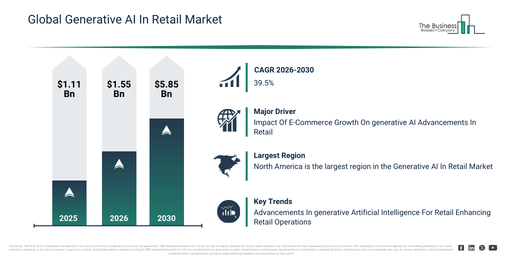
The generative AI in retail market has experienced rapid expansion in recent years. It will grow from $1.11 billion in 2025 to $1.55 billion in 2026 at a compound annual growth rate (CAGR) of 39.8%. This historical growth can be attributed to factors such as the proliferation of e-commerce platforms, increased integration of AI tools within the retail sector, the rising demand for personalized shopping experiences, advancements in cloud computing, and the incorporation of big data analytics.
The generative AI in retail market is set for considerable expansion in the upcoming years, with projections indicating a rise to $5.85 billion in 2030, maintaining a compound annual growth rate (CAGR) of 39.5%. This growth during the forecast period is fueled by the broadening of immersive retail experiences, an increasing demand for real-time inventory optimization, the proliferation of AI-powered chatbots, enhanced adoption of generative design for products, and the integration of predictive analytics within the supply chain. Key trends expected in this period include personalized product recommendations, automated marketing content creation, AI-driven inventory management, dynamic pricing models, and comprehensive customer behavior analysis.
Looking For Reliable Generative AI In Retail Market Data? Request A Free Sample:
What Is Behind The Rising Demand In The Generative AI In Retail Market?
The increasing prevalence of e-commerce shopping is anticipated to fuel the expansion of generative AI in retail market going forward. This surge in online purchasing is primarily attributed to the ease, extensive selection, and widespread availability offered by digital platforms, contrasting with traditional retail methods. Generative AI further enhances the e-commerce experience by generating customized product suggestions and refining customer engagements with intelligent, context-sensitive content. Evidencing this trend, a May 2024 report from the Census Bureau of the Department of Commerce, a US-based governmental organization, indicated that e-commerce sales reached approximately $1,118.7 billion in 2023. Looking at the first quarter of 2024, total retail sales were estimated at $1,820.0 billion. During this period, e-commerce sales experienced an 8.5% increase (±1.1%) compared to the same quarter in 2023, while overall retail sales saw a 2.8% growth (±0.5%). Consequently, the expansion of e-commerce shopping is a significant catalyst for the growth of generative AI in retail market.
Generative AI In Retail Market Segment Coverage And Subsegment Analysis
The generative AI in retail market covered in this report is segmented –
1) By Technology: Variational Autoencoders, Generative Adversarial Networks, Deep Reinforcement Learning, Recurrent Neural Networks, Transformer Networks, Other Technologies
2) By Deployment: Cloud, On-Premise
3) By Application: Product Design And Development, Visual Merchandising, Demand Forecasting, Personalized Marketing, Fraud Detection, Inventory Management, Supply Chain And Logistics, Other Applications
4) By Industry: Fashion And Apparel, Consumer Electronics, Home Decor, Beauty And Cosmetics, Grocery Shops, Online Platforms
Subsegments:
1) By Variational Autoencoders (VAEs): Product Recommendation Systems, Customer Behavior Analysis, Personalized Marketing Campaigns, Image Generation For Products, Inventory Management Solutions
2) By Generative Adversarial Networks (GANs): Synthetic Data Generation, Virtual Try-On Solutions, Image-To-Image Translation For Product Images, Style Transfer For Marketing Content, Fraud Detection In Transactions
3) By Deep Reinforcement Learning: Dynamic Pricing Models, Inventory Optimization, Personalized Customer Experience Systems, Supply Chain Management, Sales Forecasting
4) By Recurrent Neural Networks (RNNs): Time Series Forecasting For Sales, Customer Engagement Prediction, Sentiment Analysis On Customer Feedback, Churn Prediction Models, Recommendation Systems For Repeat Purchases
5) By Transformer Networks: Natural Language Processing For Customer Interactions, Chatbots And Virtual Assistants, Automated Content Generation For Marketing, Customer Sentiment Analysis, Demand Forecasting
6) By Other Technologies: Self-Supervised Learning Techniques, Diffusion Models For Image Generation, Flow-Based Models For Data Generation, Federated Learning For Privacy-Preserving Data Analysis, Hybrid Models Combining Multiple Approaches.
Generative AI In Retail Market Future Trends: Where Is The Industry Heading?
Leading companies in the generative AI retail sector are concentrating on creating sophisticated generative artificial intelligence tools. These innovations aim to enhance customer personalization, streamline inventory management, and refine sales forecasting. Generative AI-powered tools are advanced technologies that utilize AI algorithms to generate, optimize, and automate functions such as tailored product recommendations, inventory control, and marketing strategies. They achieve this by analyzing data and producing insights, thereby boosting efficiency and decision-making in the retail sector. As an example, in January 2024, Google LLC, a US-based technology company, introduced new generative AI tools for retailers. These tools are designed to elevate online shopping experiences, streamline retail operations, and modernize customer service. The new AI tools for retail incorporate a conversational commerce solution, which integrates AI-driven virtual agents for personalized recommendations and natural language interactions. They also feature enhanced search capabilities with advanced LLM for improved product discovery, along with catalog and content enrichment to optimize product listings, and leverage Google Distributed Cloud Edge to scale AI applications across multiple locations.
Generative AI In Retail Market Top Players List For 2026
Major companies operating in the generative AI in retail market are Google LLC, Microsoft Corporation, Tencent Holdings Limited, Amazon Web Services (AWS), International Business Machines (IBM), Oracle Corporation,Nvidia Corporation, Adobe Inc., SAS Institute Inc., C3.AI Inc., DataRobot Inc., ClarifAI Inc., H2O.AI Inc., Shopify Inc., Walmart Global Tech, Target Corporation (AI & Data Science), Stitch Fix Inc., Ocado Group plc, Zalando SE, Bloomreach Inc., Dynamic Yield Ltd., Coveo Solutions Inc., Stability AI
Order Your Copy Of The Generative AI In Retail Market Report 2026:
How Does The Generative AI In Retail Market Vary By Region?
North America was the largest region in the generative AI in retail market in 2025. Asia-Pacific is expected to be the fastest-growing region in the forecast period. The regions covered in the generative AI in retail market report are Asia-Pacific, South East Asia, Western Europe, Eastern Europe, North America, South America, Middle East, Africa.
Reach Out To Our Team:
The Business Research Company: https://www.thebusinessresearchcompany.com/
Americas: +1 310-496-7795
Asia: +44 7882 955267 & +91 8897263534
Europe: +44 7882 955267
Email us at: marketing@tbrc.info
Follow us on:
LinkedIn: https://in.linkedin.com/company/the-business-research-company
YouTube: https://www.youtube.com/channel/UC24_fI0rV8cR5DxlCpgmyFQ
Global Market Model: https://www.thebusinessresearchcompany.com/global-market-model

Wasay has over a decade of experience in market research, data modelling, and analytics, with prior experience at GlobalData and Decision Tree Consulting Services. At The Business Research Company , he leads research operations across syndicated studies, customized consulting engagements, and the Global Market Model platform. His professional experience includes supporting organizations such as Boston Consulting Group, KPMG, and Ernst & Young. Wasay holds a degree in Electronics and Communications Engineering, postgraduate management qualifications from International Management Institute Belgium and Indian School of Business and Entrepreneurship, and completed the Integrated Program in Business Analytics from Indian Institute of Management Indore.