The Business Research Company’s 2026 market reports combine market attractiveness scoring, total addressable market sizing, company benchmarking matrices, interactive Excel dashboards, deeper supply chain intelligence, emerging startup tracking, and granular product-level insights to deliver research that is more actionable and strategically valuable.
Generative Artificial Intelligence (AI) In Chatbots Market Size Review: What Shaped Past Growth And What Will Drive Future Expansion?
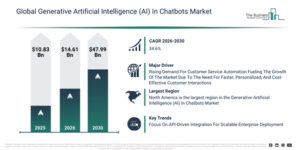
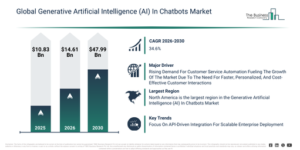
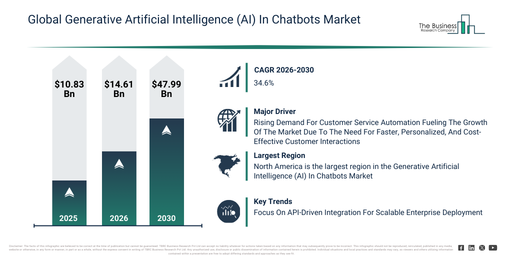
The generative artificial intelligence (AI) in chatbots market size has seen remarkable growth in recent years. This market is set to expand from $10.83 billion in 2025 to $14.61 billion in 2026, demonstrating a compound annual growth rate (CAGR) of 34.9%. Historically, this growth can be ascribed to several factors, including the surge in customer service automation, advancements in natural language processing (NLP) and deep learning, the increase in digital commerce interactions, the requirement for 24×7 support availability, and the rising adoption of cloud AI services.
The generative artificial intelligence (AI) in chatbots market size is projected for substantial expansion over the upcoming years. It is anticipated to reach $47.99 billion in 2030, exhibiting a compound annual growth rate (CAGR) of 34.6%. This growth during the forecast period is driven by factors such as the adoption of large language model (LLM) copilots by enterprises, the increasing need for secure and compliant AI chatbots, the expansion into multilingual and voice-enabled capabilities, integration with workflow automation tools, and the rise of conversational commerce. Key developments expected in this period encompass LLM-powered conversational interfaces, the emergence of multimodal chatbot experiences, enhanced enterprise-grade guardrails and governance, the delivery of personalized and contextual conversations, and a consolidation of conversational AI platforms.
Access Free Sample Pages From The Generative Artificial Intelligence (AI) In Chatbots Market Report 2026:
Understanding The Main Driver Of The Generative Artificial Intelligence (AI) In Chatbots Market
The increasing need for automation in customer service is projected to boost the expansion of the generative artificial intelligence (AI) in chatbots market moving ahead. Customer service automation involves leveraging technology, such as AI and software utilities, to manage customer engagements, inquiries, and support functions with little human involvement. This rising demand stems from businesses aiming for quicker responses, round-the-clock assistance, and uniform, tailored customer experiences, alongside lowering operating expenses. Within customer service automation, generative AI in chatbots is vital for delivering immediate, customized replies and processing numerous customer inquiries effectively. As an illustration, in June 2023, the Consumer Financial Protection Bureau, a US-based government agency, reported that over 98 million people, representing approximately 37% of the U.S. population, utilized a banking chatbot in 2022, a figure anticipated to climb to about 110.9 million users by 2026. Consequently, the escalating requirement for automation in customer service is fueling the expansion of the generative artificial intelligence (AI) in chatbots market.
Generative Artificial Intelligence (AI) In Chatbots Market Segment Mapping For 2026 And Beyond
The generative artificial intelligence (AI) in chatbots market covered in this report is segmented –
1) By Technology: Natural Language Processing, Machine Learning And Deep Learning, Automatic Speech Recognition, Other Technologies
2) By Deployment: On-Premise, Cloud
3) By Business Function: Sales And Marketing, Supply Chain And Operations, Finance And Accounting, Human Resource, Information Technology Service Management
4) By Application: Customer Service, Electronic-Commerce And Sales, Virtual Assistants, Information Retrieval, Social Media And Messaging Platforms
5) By Industries: Banking, Financial Services And Insurance (BFSI), Information Technology (IT) And Telecommunications, Retail And Electronic-Commerce, Healthcare, Government And Public Sector, Media And Entertainment, Education, Other Industries
Subsegments:
1) By Natural Language Processing: Sentiment Analysis, Named Entity Recognition, Intent Detection, Text Classification, Contextual Understanding, Language Translation, Text Summarization, Part Of Speech Tagging
2) By Machine Learning And Deep Learning: Supervised Learning, Unsupervised Learning, Reinforcement Learning, Neural Network Modeling, Transfer Learning, Generative Adversarial Networks, Convolutional Neural Networks, Recurrent Neural Networks
3) By Automatic Speech Recognition: Speaker Identification, Voice Command Recognition, Speech To Text Conversion, Accent And Dialect Recognition, Keyword Spotting, Emotion Recognition, Noise Reduction Modeling
4) By Other Technologies: Computer Vision Integration, Predictive Analytics, Knowledge Graph Processing, Contextual Recommendation Systems, Multimodal Interaction, Conversational Flow Automation, Data Augmentation Techniques
What Key Trend Is Expected To Shape The Generative Artificial Intelligence (AI) In Chatbots Market Over The Forecast Period?
Leading firms within the generative artificial intelligence (AI) chatbot market are prioritizing the creation of API-driven integration to facilitate scalable enterprise deployments, thereby improving flexibility, reliability, and customization. This type of integration enables businesses to incorporate generative artificial intelligence directly into their proprietary applications, utilizing dedicated infrastructure to guarantee quicker responses, customized operational flows, and scalability at the enterprise level. For example, in March 2023, OpenAI, a US-based artificial intelligence company, introduced the ChatGPT API, which includes dedicated capacity options specifically for enterprises. This offering grants developers on-demand entry to GPT models via a programmable interface, assists organizations by reserving throughput to ensure steady performance during peak usage, and permits tailored scaling to fulfill diverse enterprise needs.
Generative Artificial Intelligence (AI) In Chatbots Market Major Players And Industry Competition Overview
Major companies operating in the generative artificial intelligence (AI) in chatbots market are Amazon.com Inc., Google LLC, Microsoft Corp., Meta Platforms Inc., IBM Corp., Salesforce Inc., OpenAI LLC, LivePerson Inc., Anthropic PBC, Yellow.ai, Dialpad Inc., Intercom, Ada Support, Kore.ai, AI21 Labs, Avaamo Inc., Master of Code Global, BotsCrew, Botsify Inc., Lindy.ai, Writesonic Inc., Replika, Chatfuel, Rasa, Botpress Inc.
Full Generative Artificial Intelligence (AI) In Chatbots Market Report: Market Size, Trends, Segments And Key Players:
Generative Artificial Intelligence (AI) In Chatbots Market Geographic Segmentation: Regions Covered In The Report
North America was the largest region in the generative artificial intelligence (AI) in chatbots market in 2025. Asia-Pacific is expected to be the fastest-growing region in the forecast period. The regions covered in the generative artificial intelligence (AI) in chatbots market report are Asia-Pacific, South East Asia, Western Europe, Eastern Europe, North America, South America, Middle East, Africa.
Reach Out To Our Team:
The Business Research Company: https://www.thebusinessresearchcompany.com/
Americas: +1 310-496-7795
Asia: +44 7882 955267 & +91 8897263534
Europe: +44 7882 955267
Email us at: marketing@tbrc.info
Follow us on:
LinkedIn: https://in.linkedin.com/company/the-business-research-company
YouTube: https://www.youtube.com/channel/UC24_fI0rV8cR5DxlCpgmyFQ
Global Market Model: https://www.thebusinessresearchcompany.com/global-market-model

Wasay has over a decade of experience in market research, data modelling, and analytics, with prior experience at GlobalData and Decision Tree Consulting Services. At The Business Research Company , he leads research operations across syndicated studies, customized consulting engagements, and the Global Market Model platform. His professional experience includes supporting organizations such as Boston Consulting Group, KPMG, and Ernst & Young. Wasay holds a degree in Electronics and Communications Engineering, postgraduate management qualifications from International Management Institute Belgium and Indian School of Business and Entrepreneurship, and completed the Integrated Program in Business Analytics from Indian Institute of Management Indore.