Market attractiveness scoring, total addressable market sizing, company benchmarking matrices, interactive Excel dashboards, deeper supply chain intelligence, emerging startup tracking, and granular product-level insights are among the key offerings featured in The Business Research Company’s 2026 market reports, designed to deliver more actionable and strategically valuable research.
Machine Translation Market Size Estimate For 2026 And Revenue Forecast Through 2030
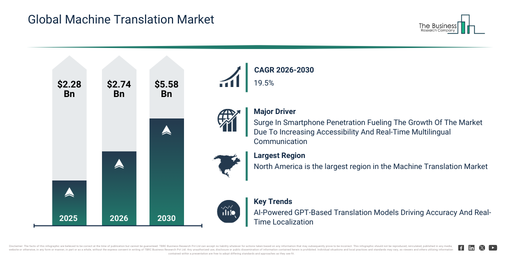
The machine translation market size has experienced rapid growth in recent years. It is projected to expand from $2.28 billion in 2025 to $2.74 billion in 2026, demonstrating a compound annual growth rate (CAGR) of 20.2%. The market’s historical expansion can be linked to factors including the rise of global digital content, the increasing prevalence of cross-border e-commerce, growing demands for multilingual communication, the initial adoption of SMT, and enhanced internet penetration.
The machine translation market is anticipated to experience substantial expansion over the coming years. Projections indicate it will reach $5.58 billion by 2030, demonstrating a compound annual growth rate (CAGR) of 19.5%. This projected growth is driven by several factors, including the need for real-time multilingual communication, the increasing number of remote global workers, the proliferation of cloud-based translation platforms, rising localization demands, and the adoption of multilingual virtual assistants. Key trends during this period are expected to encompass context-aware language translation, real-time speech and text translation capabilities, customized enterprise-specific translation models, broader translation support for low-resource languages, and integrated translation solutions within existing workflows.
Free Machine Translation Market Report Sample Available For Download:
Why Is Demand In The Machine Translation Market Expected To Keep Rising?
The increasing penetration of smartphones is projected to accelerate the expansion of the machine translation market. Smartphone connections refer to the total count of active mobile subscriptions linked to smartphones, which enable users to access voice, messaging, and internet services. The uptick in smartphone connections is fueled by widening internet access, establishing mobile devices as the primary entry point to digital services and boosting global adoption and connectivity. Smartphones enhance the applicability of machine translation by empowering users to quickly translate text, speech, or images anywhere, facilitating smooth communication across languages for travel, business, education, and real-time multilingual interactions without the need for a computer. For example, according to the Mobility Report published by Ericsson, a Sweden-based telecommunications company, global smartphone subscriptions reached 6.93 billion in 2023 and further rose to 7.13 billion in 2024. Hence, the growing smartphone penetration is a significant driver for the growth of the machine translation market.
How Is The Machine Translation Market Divided Across Segments And Subsegments?
The machine translation market covered in this report is segmented –
1) By Type: Rule-Based Machine Translation (RBMT), Statistical Machine Translation (SMT), Example-Based Machine Translation (EBMT), Hybrid Machine Translation (HMT), Neural Machine Translation (NMT)
2) By Language Pairs: English-Chinese, English-Spanish, English-French, English-Japanese, English-German
3) By Deployment Type: On-Premises, Cloud
4) By Application: E-Commerce And Retail, Travel And Hospitality, Legal And Government, Manufacturing And Automotive, Healthcare
Subsegments:
1) By Rule-Based Machine Translation: Direct Translation, Transfer-Based Translation, Interlingua-Based Translation
2) By Statistical Machine Translation: Phrase-Based Translation, Syntax-Based Translation, Word-Based Translation
3) By Example-Based Machine Translation: Template-Based Translation, Memory-Based Translation, Analogical Translation
4) By Hybrid Machine Translation: Rule-Statistical Hybrid, Example-Statistical Hybrid, Neural-Rule Hybrid
5) By Neural Machine Translation: Recurrent Neural Network-Based Translation, Convolutional Neural Network-Based Translation, Transformer-Based Translation
Machine Translation Market Trends Reshaping Customer Demand And Business Strategies
Leading companies operating in the machine translation market are primarily focusing on developing advanced solutions, such as GPT-based translation models, to significantly improve translation accuracy and deliver more nuanced, human-like interpretations across multiple languages. A GPT-based translation model is an AI system that employs a generative pre-trained transformer architecture to translate text between languages with high precision and contextual understanding, thereby offering smooth, fluent, and reliable translations for various applications. As an illustration, in March 2023, Lilt Inc., a US-based AI-powered translation and localization company, launched its Contextual AI Engine for Translation. This GPT-based model is specifically designed for verified, enterprise-level translation and demonstrates superior accuracy and performance when compared to GPT-4 and Google Translate. This new engine utilizes in-context learning to rapidly adjust to feedback from human translators and context-specific data, resulting in high-quality translations tailored for diverse industries such as legal, marketing, and product localization. It surpasses Google Translate and GPT-4 by offering greater accuracy, reduced latency, and substantially lower computing costs. The solution is specifically optimized for real-time translation workflows, combining human verification with advanced AI to consistently enhance translation quality.
Machine Translation Market Major Players: Companies At The Forefront Of The Industry
Major companies operating in the machine translation market are Google LLC, Microsoft Corporation, Alibaba Group, Meta Platforms Inc., Amazon Web Services Inc., Tencent Holdings Limited, International Business Machines Corporation, Oracle Corporation, SAP SE, DeepL SE, Lionbridge Technologies Inc., Welocalize Inc., Appen Limited, RWS Holdings plc, iFLYTEK Co. Ltd., Ling024 Ltd., AppTek LLC, Lighthouse IP Group BV, Lilt Inc., Pangeanic SL
Read More About The Machine Translation Market In The Full Report:
Machine Translation Market Regional Share Analysis For 2025
North America was the largest region in the machine translation market in 2025. Asia-Pacific is expected to be the fastest-growing region in the forecast period. The regions covered in the machine translation market report are Asia-Pacific, South East Asia, Western Europe, Eastern Europe, North America, South America, Middle East, Africa.
Reach Out To Our Team:
The Business Research Company: https://www.thebusinessresearchcompany.com/
Americas: +1 310-496-7795
Asia: +44 7882 955267 & +91 8897263534
Europe: +44 7882 955267
Email us at: marketing@tbrc.info
Follow us on:
LinkedIn: https://in.linkedin.com/company/the-business-research-company
YouTube: https://www.youtube.com/channel/UC24_fI0rV8cR5DxlCpgmyFQ
Global Market Model: https://www.thebusinessresearchcompany.com/global-market-model

Wasay has over a decade of experience in market research, data modelling, and analytics, with prior experience at GlobalData and Decision Tree Consulting Services. At The Business Research Company , he leads research operations across syndicated studies, customized consulting engagements, and the Global Market Model platform. His professional experience includes supporting organizations such as Boston Consulting Group, KPMG, and Ernst & Young. Wasay holds a degree in Electronics and Communications Engineering, postgraduate management qualifications from International Management Institute Belgium and Indian School of Business and Entrepreneurship, and completed the Integrated Program in Business Analytics from Indian Institute of Management Indore.