The Business Research Company’s 2026 market reports are designed to deliver research that is more actionable and strategically valuable. Key offerings include market attractiveness scoring, total addressable market sizing, company benchmarking matrices, interactive Excel dashboards, deeper supply chain intelligence, emerging startup tracking, and granular product-level insights.
Which Factors Will Shape The Generative Artificial Intelligence (AI) In Virtual Reality Market Size Through 2030?
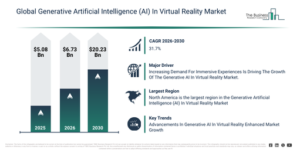
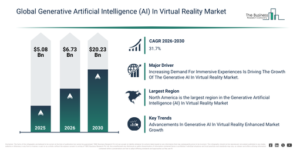
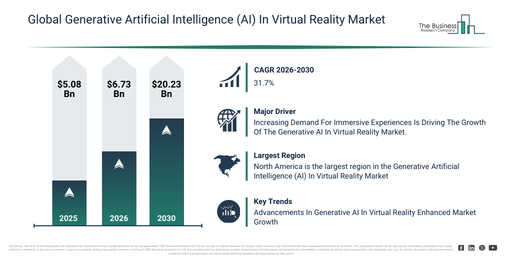
The generative artificial intelligence (AI) in virtual reality market size has experienced significant expansion in recent years. This market is forecasted to expand from $5.08 billion in 2025 to $6.73 billion in 2026, achieving a compound annual growth rate (CAGR) of 32.3%. The growth observed in the past can be credited to the increase in gaming and entertainment VR, advancements in VR hardware, the implementation of simulation-based training, the broadening of digital content creation, and rising investments in immersive technologies.
The generative artificial intelligence (AI) in virtual reality market is projected to experience substantial growth over the coming years. This market is anticipated to reach $20.23 billion in 2030, exhibiting a compound annual growth rate (CAGR) of 31.7%. Factors contributing to this growth during the forecast period include the incorporation of generative AI into VR platforms, the increasing need for tailored virtual experiences, the expansion of enterprise VR applications, the evolution of metaverse ecosystems, and advancements in real-time rendering technologies. Key trends expected within the forecast timeframe encompass AI-generated virtual environments, procedural content creation in VR, customized immersive experiences, AI-driven real-time rendering, and the broadening of virtual training and simulation applications.
Request A Free Generative Artificial Intelligence (AI) In Virtual Reality Market Sample To Support Your Strategic Planning:
What Is Propelling The Generative Artificial Intelligence (AI) In Virtual Reality Market Toward $20.23 Billion By 2030?
A growing need for immersive experiences is anticipated to boost the expansion of generative artificial intelligence (AI) within the virtual reality market in the future. These experiences represent highly engaging settings where physical and digital realms are combined, typically utilizing technologies like virtual reality (VR), augmented reality (AR), and mixed reality (MR), to give users a feeling of being present and a sense of reality. The call for immersive experiences is escalating due to progress in VR and AR technologies, which facilitate more lifelike interactions, along with consumers’ increasing desire for tailored, memorable experiences in both entertainment and educational contexts. Generative AI improves virtual reality immersive experiences by generating dynamic, interactive environments and content instantly, thereby enabling highly customized and adaptable experiences that react to user input in real-time. For example, in November 2024, the University of Birmingham, a UK-based public research university, projected that immersive entertainment would grow by 36% over the coming decade, indicating no decrease in audience interest. Consequently, the increasing demand for immersive experiences fuels the expansion of generative artificial intelligence (AI) within the virtual reality market.
What Are The Key Segments And Subsegments In The Generative Artificial Intelligence (AI) In Virtual Reality Market?
The generative artificial intelligence (AI) in virtual reality market covered in this report is segmented –
1) By Component: Software, Hardware
2) By Application: Entertainment And Gaming, Healthcare, Education And Training, Retail And E-Commerce, Manufacturing And Design, Other Applications
3) By End-User: Enterprises, Individuals
Subsegments:
1) By Software: AI-Powered VR Content Creation Tools, AI-Driven Virtual Environments and Simulations, VR-Based AI Training and Education Software, AI-Based VR Interaction And User Experience (UX) Tools, AI-Powered Real-Time Rendering Software
2) By Hardware: AI-Enhanced VR Headsets, AI-Powered Motion Controllers, AI-Driven Haptic Feedback Devices, VR Sensors And Tracking Systems With AI Integration, AI-Based VR Processing Units
Generative Artificial Intelligence (AI) In Virtual Reality Market Trends Behind The 31.7% CAGR Forecast
Leading companies in the generative artificial intelligence (AI) in virtual reality market are actively developing sophisticated solutions, specifically generative AI-powered No-Code authoring omni-platforms. These platforms aim to streamline the creation of immersive and interactive virtual environments without requiring extensive programming knowledge. Generative AI-powered No-Code authoring omni-platforms are defined as advanced software tools that leverage generative artificial intelligence to enable users to create, design, and customize virtual environments or applications without writing code. For example, in June 2024, ARuVR, a UK-based developer of a digital multimedia platform, launched the ARuVR GenAI Suite. This new platform is engineered to simplify the creation of augmented reality (AR), virtual reality (VR), and mixed reality (MR) content. It provides tools for generating digital 3D models from 2D videos, crafting immersive 360° images, and designing detailed 2D visuals. Additionally, the suite incorporates a text-to-speech function, allowing users to add customizable voiceovers with various voices and adjustable speech speeds. The GenAI Suite, seamlessly integrating with ARuVR’s No-Code authoring omni-platform, ultimately makes developing interactive training and spatial learning experiences more straightforward.
Major Companies Profiled In The Generative Artificial Intelligence (AI) In Virtual Reality Market Report
Major companies operating in the generative artificial intelligence (AI) in virtual reality market are Google LLC, Microsoft Corporation, Meta Platforms Inc., Siemens AG, International Business Machines Corporation, Qualcomm Incorporated, NVIDIA Corporation, Adobe Inc., Rockwell Automation Inc., Autodesk Inc., Roblox Corporation, Unity Technologies Inc., DeepMind Technologies Limited, Magic Leap Inc., Epic Games Inc., Oculus VR LLC, Cerebras Systems Inc., HTC Corporation, Matterport Inc., Synthesia Ltd., Strivr Labs Inc., Groove Jones Inc.
Explore The Business Research Company’s Complete Generative Artificial Intelligence (AI) In Virtual Reality Market Report:
Where Does The Generative Artificial Intelligence (AI) In Virtual Reality Market Generate The Most Revenue?
North America was the largest region in the generative artificial intelligence (AI) in virtual reality market in 2025. The regions covered in the generative artificial intelligence (AI) in virtual reality market report are Asia-Pacific, South East Asia, Western Europe, Eastern Europe, North America, South America, Middle East, Africa.
Reach Out To Our Team:
The Business Research Company: https://www.thebusinessresearchcompany.com/
Americas: +1 310-496-7795
Asia: +44 7882 955267 & +91 8897263534
Europe: +44 7882 955267
Email us at: marketing@tbrc.info
Follow us on:
LinkedIn: https://in.linkedin.com/company/the-business-research-company
YouTube: https://www.youtube.com/channel/UC24_fI0rV8cR5DxlCpgmyFQ
Global Market Model: https://www.thebusinessresearchcompany.com/global-market-model

Wasay has over a decade of experience in market research, data modelling, and analytics, with prior experience at GlobalData and Decision Tree Consulting Services. At The Business Research Company , he leads research operations across syndicated studies, customized consulting engagements, and the Global Market Model platform. His professional experience includes supporting organizations such as Boston Consulting Group, KPMG, and Ernst & Young. Wasay holds a degree in Electronics and Communications Engineering, postgraduate management qualifications from International Management Institute Belgium and Indian School of Business and Entrepreneurship, and completed the Integrated Program in Business Analytics from Indian Institute of Management Indore.