The Business Research Company’s 2026 market reports are designed to deliver research that is more actionable and strategically valuable. Key offerings include market attractiveness scoring, total addressable market sizing, company benchmarking matrices, interactive Excel dashboards, deeper supply chain intelligence, emerging startup tracking, and granular product-level insights.
Data Center Virtualization Market Size 2026: Valuation, Growth Rate And Forecast To 2030
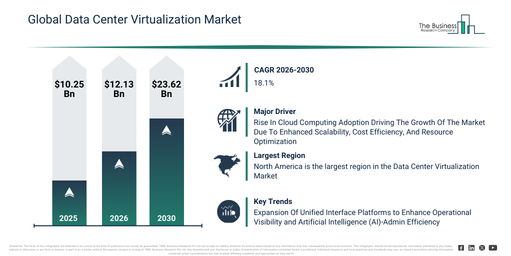
The data center virtualization market size has experienced swift expansion in recent times. This market is projected to expand from $10.25 billion in 2025 to $12.13 billion in 2026, demonstrating a compound annual growth rate (CAGR) of 18.3%. Historically, this expansion was driven by factors such as the growth in enterprise server consolidation, the increasing adoption of cloud computing, rising data center operational costs, a heightened demand for scalable IT infrastructure, and the adoption of various virtualization management platforms.
The data center virtualization market is projected to experience substantial expansion over the coming years. Its valuation is anticipated to reach $23.62 billion by 2030, exhibiting a compound annual growth rate (CAGR) of 18.1%. This projected growth stems from several factors, including the increasing spread of hybrid cloud architectures, the growing embrace of container orchestration tools, the rise in software-defined networking applications, greater investments in digital transformation initiatives, and the surging need for adaptable computing environments. Key developments anticipated during this period encompass the adoption of software-defined data centers, the deployment of hybrid virtual infrastructures, the expansion of containerization-based workloads, the integration of hyper-converged infrastructure, and automated virtual resource management.
Get A Free Sample Of The Data Center Virtualization Market Report 2026:
What Is Driving The Growth Of The Data Center Virtualization Market?
The increasing adoption of cloud computing services is anticipated to propel the growth of the data center virtualization market going forward. Cloud computing services involve the delivery of computing resources such as servers, storage, databases, networking, and software over the internet, allowing users to access scalable and cost-effective solutions without needing on-premises infrastructure. The embrace of cloud computing services is rising as it enables businesses to seamlessly scale their IT resources based on fluctuating demand, ensuring optimal performance and cost efficiency without significant upfront investment in physical infrastructure. Cloud computing supports data center virtualization by allowing virtual servers, storage, and networks to be managed and scaled online, minimizing dependence on physical hardware and enhancing resource efficiency. For instance, in March 2025, according to the Office for National Statistics, a UK-based national statistical institute, in 2023, cloud-based computing systems and applications were adopted by 69% of businesses, and these adopters recorded 11.3 log points or approximately 12% higher turnover per worker compared with non-adopters. Therefore, the growing adoption of cloud computing services is driving the expansion of the data center virtualization market.
How Is The Data Center Virtualization Market Segmented?
The data center virtualization market covered in this report is segmented –
1) By Type: Server, Storage, Network, Desktop, Application, Other Types
2) By Deployment Type: On-Premises, Cloud-Based, Hybrid
3) By Organization Size: Small And Medium-Sized Enterprises (SMEs), Large Enterprises
4) By End-Use: Banking, Financial Services, And Insurance (BFSI), Information Technology (IT) And Telecommunication, Manufacturing And Automotive, Government, Healthcare, Education, Retail And Supply Chain Management, Media And Entertainment, Other End Users
Subsegments:
1) By Server: Virtual Machines, Blade Servers, Rack Servers, Tower Servers, Hyper-Converged Infrastructure
2) By Storage: Storage Area Network (SAN), Network Attached Storage (NAS), Direct Attached Storage (DAS), Virtual Storage Area Network, Cloud Storage
3) By Network: Software-Defined Networking (SDN), Network Function Virtualization (NFV), Virtual Private Network (VPN), Virtual LAN (VLAN), Overlay Networks
4) By Desktop: Virtual Desktop Infrastructure (VDI), Remote Desktop Services (RDS), Desktop-As-A-Service (DaaS), Session-Based Desktops
5) By Application: Application Virtualization, Containerization, Middleware Virtualization, Remote Application Delivery
6) By Other Types: Data Center Infrastructure Management (DCIM), Load Balancing Virtualization, Security Virtualization, Backup And Disaster Recovery Virtualization
What Are The Latest Trends In The Data Center Virtualization Market?
Major companies in the data center virtualization market are focusing on developing advanced platforms, such as unified management interfaces, to enhance operational visibility, simplify cloud operations, and improve information technology (IT) admin efficiency. A unified interface for cloud administrators is defined as a single pane-of-glass console that offers holistic visibility into private cloud operations, including provisioning, governance, policy enforcement, cost management, and lifecycle tasks, across on-premises, edge, and hybrid environments. For instance, in June 2025, Broadcom Inc., a United States–based enterprise infrastructure provider, announced VMware Cloud Foundation (VCF) 9.0. This update introduces a unified interface for cloud administrators that consolidates fleet-wide health, patching, compliance, cost management, identity and access management, and log analytics into a single console. It accelerates innovation by providing out-of-the-box self-service capabilities, freeing development teams to concentrate on applications rather than infrastructure. The platform also offers deep visibility into resource usage, thereby enabling optimized cloud spending and cost control.
Who Are The Key Players In The Data Center Virtualization Market?
Major companies operating in the data center virtualization market are Google LLC, Microsoft Corporation, Alibaba Group, AT&T Inc., Dell Technologies Inc., Amazon Web Services Inc., Huawei Technologies Co. Ltd., Tencent Holdings Ltd., International Business Machines Corporation, Cisco Systems Inc., Oracle Corporation, SAP SE, Hewlett Packard Enterprise Company, Fujitsu Limited, Telefonaktiebolaget LM Ericsson, NEC Corporation, HCL Technologies Limited, Inspur Group Co. Ltd., Citrix Systems Inc., Nutanix Inc., Konverge Digital Solutions Corporation.
Read The Complete Data Center Virtualization Market Report 2026:
Which Region Is The Largest In The Data Center Virtualization Market?
North America was the largest region in the data center virtualization market in 2025. Asia-Pacific is expected to be the fastest-growing region in the forecast period. The regions covered in the data center virtualization market report are Asia-Pacific, South East Asia, Western Europe, Eastern Europe, North America, South America, Middle East, Africa.
Reach Out To Our Team:
The Business Research Company: https://www.thebusinessresearchcompany.com/
Americas: +1 310-496-7795
Asia: +44 7882 955267 & +91 8897263534
Europe: +44 7882 955267
Email us at: marketing@tbrc.info
Follow us on:
LinkedIn: https://in.linkedin.com/company/the-business-research-company
YouTube: https://www.youtube.com/channel/UC24_fI0rV8cR5DxlCpgmyFQ
Global Market Model: https://www.thebusinessresearchcompany.com/global-market-model

Wasay has over a decade of experience in market research, data modelling, and analytics, with prior experience at GlobalData and Decision Tree Consulting Services. At The Business Research Company , he leads research operations across syndicated studies, customized consulting engagements, and the Global Market Model platform. His professional experience includes supporting organizations such as Boston Consulting Group, KPMG, and Ernst & Young. Wasay holds a degree in Electronics and Communications Engineering, postgraduate management qualifications from International Management Institute Belgium and Indian School of Business and Entrepreneurship, and completed the Integrated Program in Business Analytics from Indian Institute of Management Indore.