With a focus on actionable insights and strategic value, The Business Research Company’s 2026 market reports include market attractiveness scoring, total addressable market sizing, company benchmarking matrices, interactive Excel dashboards, deeper supply chain intelligence, emerging startup tracking, and granular product-level insights.
How Large Could The Service Provider Network Infrastructure Market Become By 2030 At A 7.1% CAGR?
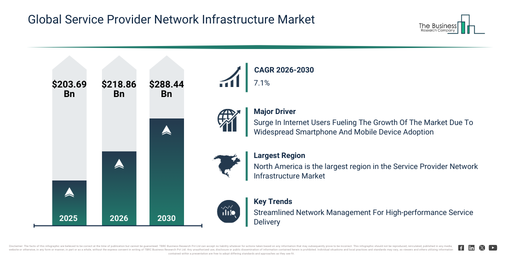
The service provider network infrastructure market has experienced robust growth in recent years. This market is projected to expand from $203.69 billion in 2025 to $218.86 billion in 2026, demonstrating a compound annual growth rate (CAGR) of 7.4%. Historically, this growth has stemmed from increased broadband connectivity demand, the expansion of mobile network deployments, escalating data traffic volumes, the embrace of fiber optic infrastructure, and a surge in cloud service consumption.
The service provider network infrastructure market is projected to experience substantial expansion in the coming years. Its valuation is anticipated to reach $288.44 billion by 2030, demonstrating a compound annual growth rate (CAGR) of 7.1%. This projected growth throughout the forecast period stems from factors such as the increasing rollout of 5G networks, the growing embrace of edge computing, the proliferation of hyperscale data centers, the demand for ultra low latency connectivity, and investments in intelligent network automation. Key developments expected during this period include the uptake of software-defined networking, the implementation of network function virtualization, the expansion of high-capacity optical transport, the integration of edge network infrastructure, and the deployment of automated network management systems.
Get A Free Service Provider Network Infrastructure Market Sample With 2030 Forecast Insights:
Service Provider Network Infrastructure Market Outlook: Key Driver Supporting Long-Term Growth
An expanding base of internet users is projected to boost the service provider network infrastructure market in the future. These users are individuals who frequently engage with the internet for various purposes including web browsing, communication, social networking, utilizing online services, and accessing information. This surge in internet users is attributed to the widespread adoption of smartphones and mobile devices, which offer convenient, cost-effective, and continuous access to online content and services. The service provider network infrastructure facilitates internet usage by supplying dependable, rapid, and adaptable connectivity, thus guaranteeing uninterrupted access to online services, communication platforms, and digital content. As an illustration, the International Telecommunication Union, a Switzerland-based agency, reported in November 2024 that approximately 5.5 billion people were online, representing an increase of 227 million from the previous year, 2023. Consequently, the growing population of internet users is a primary factor fueling the expansion of the service provider network infrastructure market.
Segmentation Of The Service Provider Network Infrastructure Market: Key Categories Explained
The service provider network infrastructure market covered in this report is segmented –
1) By Infrastructure Type: Packet Optical Transport, Internet Protocol And Multi-protocol Label Switching Networks, Software-Defined Networking, Network Function Virtualization, Cellular Backhaul
2) By Technology: Broadband Access And Optical Transport, Carrier Internet Protocol Telephony, Microwave Transmission And Mobile Backhaul, Routers And Switches, Wireless Packet Core
3) By Enterprise Size: Large Enterprises, Small And Medium Enterprises
4) By Application: Enterprise Networking, Cloud Computing, Video Delivery, Mobile Backhaul, Fixed Broadband Access
5) By Industry: Banking, Financial Services And Insurance, Government And Defense, Healthcare, Information Technology And Telecommunications, Manufacturing, Retail And Ecommerce, Other Industries
Subsegments:
1) By Packet Optical Transport: Dense Wavelength Division Multiplexing, Optical Transport Network, Coarse Wavelength Division Multiplexing
2) By Internet Protocol And Multi-protocol Label Switching Networks: Layer Two Networks, Layer Three Networks, Virtual Private Networks
3) By Software-Defined Networking: Network Virtualization, Centralized Network Control, Automated Network Management
4) By Network Function Virtualization: Virtual Router, Virtual Firewall, Virtual Load Balancer
5) By Cellular Backhaul: Microwave Backhaul, Fiber Optic Backhaul, Copper Backhaul
Service Provider Network Infrastructure Market Evolving Trends: What Businesses Should Know
Leading companies operating within the service provider network infrastructure market are concentrating on advanced innovation, such as network management systems, to boost operational efficiency, ensure continuous uptime, and deliver scalable, secure, and automated solutions that address the evolving demands of enterprises and service providers. Network management systems refer to software and tools that monitor, control, and optimize the performance, security, and reliability of network infrastructure. For instance, in June 2025, Opengear Inc., a US-based networking and IT infrastructure company, launched its Integrated Support Platform, which aims to enhance the reliability of critical network systems. The platform is engineered to guarantee always-on infrastructure, providing continuous network availability for enterprises and service providers. It incorporates monitoring, management, and automated support tools to streamline network operations and reduce downtime. By offering centralized visibility and proactive issue resolution, it assists organizations in maintaining high-performance service delivery. This launch highlights Opengear’s dedication to strengthening network resilience and operational efficiency in the continually evolving service provider network infrastructure market.
Who Competes In The Service Provider Network Infrastructure Market? Major Companies Listed
Major companies operating in the service provider network infrastructure market are Dell Technologies Inc., Huawei Technologies Co. Ltd., Cisco Systems Inc., Broadcom Inc., Hewlett Packard Enterprise Company, Telefonaktiebolaget LM Ericsson, Nokia Corporation, ZTE Corporation, Corning Incorporated, Arista Networks Inc., CommScope Holding Company Inc., Ciena Corporation, Fujitsu Network Communications Inc., Extreme Networks Inc., ADTRAN Networks SE, Calix Inc., Viavi Solutions Inc., Ribbon Communications Inc., Aviat Networks Inc., RailTel Corporation of India Ltd.
Read The Complete Service Provider Network Infrastructure Market Forecast Report Through 2030:
Service Provider Network Infrastructure Market Regional Ranking: Which Geography Comes First?
North America was the largest region in the service provider network infrastructure market in 2025. Asia-Pacific is expected to be the fastest-growing region in the forecast period. The regions covered in the service provider network infrastructure market report are Asia-Pacific, South East Asia, Western Europe, Eastern Europe, North America, South America, Middle East, Africa.
Reach Out To Our Team:
The Business Research Company: https://www.thebusinessresearchcompany.com/
Americas: +1 310-496-7795
Asia: +44 7882 955267 & +91 8897263534
Europe: +44 7882 955267
Email us at: marketing@tbrc.info
Follow us on:
LinkedIn: https://in.linkedin.com/company/the-business-research-company
YouTube: https://www.youtube.com/channel/UC24_fI0rV8cR5DxlCpgmyFQ
Global Market Model: https://www.thebusinessresearchcompany.com/global-market-model

Wasay has over a decade of experience in market research, data modelling, and analytics, with prior experience at GlobalData and Decision Tree Consulting Services. At The Business Research Company , he leads research operations across syndicated studies, customized consulting engagements, and the Global Market Model platform. His professional experience includes supporting organizations such as Boston Consulting Group, KPMG, and Ernst & Young. Wasay holds a degree in Electronics and Communications Engineering, postgraduate management qualifications from International Management Institute Belgium and Indian School of Business and Entrepreneurship, and completed the Integrated Program in Business Analytics from Indian Institute of Management Indore.