The Business Research Company’s 2026 market reports are designed to deliver research that is more actionable and strategically valuable. Key offerings include market attractiveness scoring, total addressable market sizing, company benchmarking matrices, interactive Excel dashboards, deeper supply chain intelligence, emerging startup tracking, and granular product-level insights.
Smart City ICT Infrastructure Market Historical Growth Vs. Forecast Growth: How Do The Numbers Compare?
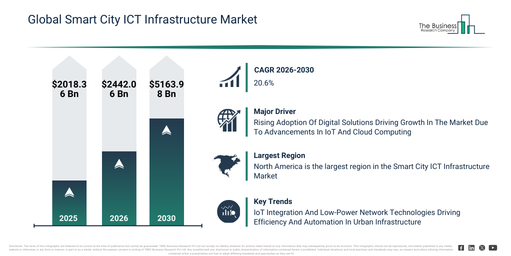
The smart city ICT infrastructure market has witnessed substantial growth in recent years. Looking ahead, it is projected to expand from $2018.36 billion in 2025 to $2442.06 billion in 2026, representing a compound annual growth rate (CAGR) of 21.0%. Historically, this expansion has been driven by factors such as urban population growth, early smart city pilot programs, the broadening of broadband infrastructure, government digitization initiatives, and the adoption of IoT sensors.
The smart city ICT infrastructure market size is projected to experience substantial expansion in the coming years. This market is anticipated to reach $5163.98 billion by 2030, demonstrating a compound annual growth rate (CAGR) of 20.6%. The factors contributing to this anticipated growth during the forecast period encompass smart governance initiatives, the increasing development of connected infrastructure, the need for data-driven urban planning, the rise of cybersecurity-centric city platforms, and the pursuit of sustainable urban development objectives. Key developments expected in this period involve integrated urban data solutions, systems for real-time city oversight, AI-powered urban analytical tools, cloud-based city frameworks, and interconnected public services.
Start With A Free Sample Of The Smart City ICT Infrastructure Market Research Report:
The Leading Growth Driver In The Smart City ICT Infrastructure Market Explained
The smart city ICT infrastructure market is projected to grow, driven by the escalating embrace of digital solutions. These solutions encompass technology-based systems, platforms, and tools that leverage software, data, and connectivity to streamline operations, enhance user experiences, and foster innovation across diverse sectors. The increasing adoption of digital solutions stems from their capacity to facilitate automation, provide real-time data access, and improve resource management, all contributing to smoother and more efficient operations. Smart city information and communication technology (ICT) Infrastructure offers the foundational connectivity, real-time data processing, and integrated platforms essential for the seamless deployment and scalability of digital solutions throughout urban environments. For instance, in December 2023, according to the European Commission (EC), the Belgium-based executive body of the European Union (EU), the adoption of cloud-based solutions in 2023 in the European Union increased by 4.2 percentage points, with 45.2% of enterprises purchasing cloud computing services, showcasing a notable rise compared to 2021. Consequently, the expanding uptake of digital solutions propels the smart city ICT infrastructure market.
Key Segments Shaping The Smart City ICT Infrastructure Market Landscape
The smart city ict infrastructure market covered in this report is segmented –
1) By Type: Smart Grid, Smart Building, Smart Water Network, Smart Healthcare, Smart Education, Smart Security, Smart Transport
2) By Components: Hardware, Software, Services
3) By Deployment Type: On-Premises, Cloud-Based, Hybrid Solutions
4) By Technology: Internet Of Things, Artificial Intelligence, Big Data Analytics, Cloud Computing
5) By Application: Communications Industry, Transportation Industry, Express Industry, Government, Education, Other Applications
Subsegments:
1) By Smart Grid: Advanced Metering Infrastructure (AMI), Distribution Management System (DMS), Energy Management Systems (EMS), Demand Response, Supervisory Control And Data Acquisition (SCADA)
2) By Smart Building: Building Automation Systems, Energy Management Systems, Smart Lighting, HVAC Control, Security And Access Control Systems
3) By Smart Water Network: Smart Meters, Leak Detection Systems, Pressure Management, Water Quality Monitoring, Advanced Analytics
4) By Smart Healthcare: Remote Patient Monitoring, Electronic Health Records (EHR), Telemedicine, Health Information Systems, Smart Medical Devices
5) By Smart Education: Virtual Classrooms, Learning Management Systems (LMS), Interactive Whiteboards, Smart Content, Student Information Systems
6) By Smart Security: Video Surveillance, Biometric Access Control, Emergency Response Systems, Cybersecurity Solutions, Intrusion Detection Systems
7) By Smart Transport: Intelligent Transportation Systems (ITS), Traffic Management Systems, Smart Parking, Connected Vehicles, Public Transit Management
Smart City ICT Infrastructure Market Trend Spotlight: Key Shifts Shaping Future Demand
Leading companies within the smart city ICT infrastructure market are prioritizing the integration of IoT, particularly through low-power network technologies aimed at improving urban connectivity and automation. Such technologies facilitate the streamlined management of smart city infrastructure, thereby minimizing the need for manual oversight and enhancing overall operational effectiveness. An example of this is seen in February 2024, when British Telecommunications plc, a telecommunications firm based in the UK, rolled out a countrywide Narrowband Internet of Things (NB-IoT) network. This launch was intended to bolster the growth and extension of smart city programs throughout the nation. This specific low-power, wide-area network now reaches 97% of the United Kingdom population and has been engineered to link assets requiring minimal data, like street lighting and underground water sensors. This design promotes automation, extended battery life, and economical operations. It is projected that the network will considerably boost efficiency across various sectors by facilitating real-time observation, lessening manual involvement, and establishing the digital groundwork for extensive Internet of Things (IoT) implementations in smart cities and other environments.
Smart City ICT Infrastructure Market Competitive Analysis: Who Are The Main Competitors?
Major companies operating in the smart city ict infrastructure market are Microsoft Corporation, Verizon Communications, AT&T Inc., Deutsche Telekom AG, Huawei Technologies Co. Ltd., Siemens AG, Hitachi Ltd., Accenture, International Business Machines Corporation (IBM), Cisco Systems Inc., Vodafone Group Plc., Oracle Corporation, Telefonica SA, Schneider Electric, Honeywell International Inc., ABB Group, Tata Consultancy Services (TCS), Telefonaktiebolaget LM Ericsson, Nokia Corp., NTT Communications
Find The Complete Smart City ICT Infrastructure Market Outlook In The Full Report:
Mapping The Smart City ICT Infrastructure Market: Regional Leadership And Global Reach
North America was the largest region in the smart city ICT infrastructure market in 2025. Asia-Pacific is expected to be the fastest-growing region in the forecast period. The regions covered in the smart city ict infrastructure market report are Asia-Pacific, South East Asia, Western Europe, Eastern Europe, North America, South America, Middle East, Africa.
Reach Out To Our Team:
The Business Research Company: https://www.thebusinessresearchcompany.com/
Americas: +1 310-496-7795
Asia: +44 7882 955267 & +91 8897263534
Europe: +44 7882 955267
Email us at: marketing@tbrc.info
Follow us on:
LinkedIn: https://in.linkedin.com/company/the-business-research-company
YouTube: https://www.youtube.com/channel/UC24_fI0rV8cR5DxlCpgmyFQ
Global Market Model: https://www.thebusinessresearchcompany.com/global-market-model

Wasay has over a decade of experience in market research, data modelling, and analytics, with prior experience at GlobalData and Decision Tree Consulting Services. At The Business Research Company , he leads research operations across syndicated studies, customized consulting engagements, and the Global Market Model platform. His professional experience includes supporting organizations such as Boston Consulting Group, KPMG, and Ernst & Young. Wasay holds a degree in Electronics and Communications Engineering, postgraduate management qualifications from International Management Institute Belgium and Indian School of Business and Entrepreneurship, and completed the Integrated Program in Business Analytics from Indian Institute of Management Indore.