The Business Research Company’s 2026 market reports combine market attractiveness scoring, total addressable market sizing, company benchmarking matrices, interactive Excel dashboards, deeper supply chain intelligence, emerging startup tracking, and granular product-level insights to deliver research that is more actionable and strategically valuable.
What Is The Smart Pillow Market Growth Rate? A 22.1% CAGR Outlook Through 2030
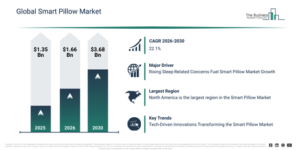
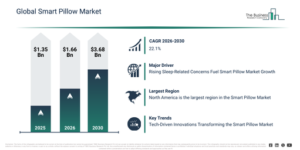
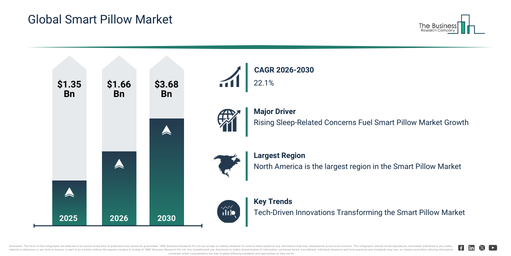
The smart pillow market size has experienced rapid growth in recent years. It is anticipated to expand from $1.35 billion in 2025 to $1.66 billion in 2026, achieving a compound annual growth rate (CAGR) of 22.5%. This expansion during the preceding period can be attributed to heightened consumer awareness regarding sleep health, increased adoption of both wearable and non-wearable sleep tracking devices, a surge in wellness-focused lifestyles, wider integration of smart home technologies, and increased expenditure on premium bedding products.
The smart pillow market is poised for significant expansion in the coming years. Its valuation is projected to reach $3.68 billion by 2030, demonstrating a compound annual growth rate (CAGR) of 22.1%. This expansion during the forecast period is driven by several factors, including a heightened demand for tailored wellness solutions, greater incorporation of AI-powered sleep analysis, the spread of intelligent home healthcare monitoring, wider acceptance of interconnected bedroom environments, and an intensified focus on non-invasive health oversight. Key trends anticipated during the same period encompass the growing uptake of sleep tracking sensor technologies, an escalating need for customized sleep comfort options, broader implementation of intelligent temperature and firmness settings, an increase in health monitoring features within bedding items, and a more pronounced emphasis on user-focused sleep analytics.
Access A Free Sample Of The Latest Smart Pillow Market Analysis:
Why Is The Smart Pillow Market Growing? The Key Demand Driver Explained
The rising prevalence of sleep-related issues is projected to boost the smart pillow market moving forward. Sleep-related problems involve a variety of challenges and conditions that impede an individual’s ability to achieve sufficient and restorative sleep. Modern living often includes erratic sleep patterns, long working hours, and increased screen time, all of which can interfere with natural sleep-wake cycles and contribute to sleep difficulties. Smart pillows provide various functionalities such as tracking sleep cycles, offering personalized advice, adjusting firmness or temperature, and facilitating improved sleep. For instance, in November 2023, data from an NHS Digital UK-based mental health of children and young people (MHCYP) report indicated that in 2023, sleep problems among young people in England remained elevated, with 64.9% of those aged 17–23 reporting difficulties three or more times over the preceding seven nights, marking a slight increase from 64.0% in 2022. Young women were disproportionately affected (74.7%) compared to young men (55.7%). Among children aged 8–16, 37.8% reported frequent sleep problems in 2023, an increase from 34.0% in 2022, showing a modest rise. Thus, the growth of the smart pillow market is being driven by the increase in sleep-related problems.
What Are The Main Segments Of The Smart Pillow Market?
The smart pillow market covered in this report is segmented –
1) By Product Type: Anti-Snoring Smart Pillows, Sleep-Tracking Smart Pillows, Thermo-Regulating Smart Pillows, Audio-Enabled Smart Pillows, Multifunctional Smart Pillows
2) By Technology And Feature Set: Embedded Sensors, AI-Based Sleep Analytics And Personalization, Connectivity-Enabled, Adaptive Adjustment, Sound And Vibration Therapy Technology
3) By Material Type: Memory Foam–Based Smart Pillows, Latex-Based Smart Pillows, Gel-Infused And Cooling Smart Materials, Hybrid Smart Materials
4) By Distribution Channel: Online Distribution Channel, Offline Distribution Channels
5) By Application: Residential, Hospital And Clinical Sleep Monitoring, Hospitality And Wellness
Subsegments:
1) By Anti-Snoring Smart Pillows: Motion-Sensing Anti-Snoring Pillows, Breathing & Snore Detection Pillows, Automatic Position-Adjustment Pillows, Vibration-Based Snore Intervention Pillows
2) By Sleep-Tracking Smart Pillows: Sleep Cycle & Movement Tracking Pillows, Breathing & Sleep Pattern Monitoring Pillows, Vital-Sign Tracking Pillows (heart rate, respiration), App-Connected Sleep Analytics Pillows
3) By Thermo-Regulating Smart Pillows: Active Temperature-Control Pillows, Climate-Adaptive Cooling & Heating Pillows, Smart Gel-Based Cooling Pillows, App-Controlled Thermal Regulation Pillows
4) By Audio-Enabled Smart Pillows: Built-In Speaker Sleep Sound Pillows, White Noise & Relaxation Audio Pillows, Bone-Conduction Audio Pillows, Smart Alarm & Wake-Up Sound Pillows
5) By Multifunctional Smart Pillows: Sleep Tracking + Anti-Snoring Pillows, Thermo-Regulating + Sleep Monitoring Pillows, Audio-Enabled + Sleep Coaching Pillows, Fully Integrated Smart Pillows
Smart Pillow Market Trend Analysis: Where Leading Companies Are Focusing
Major companies operating in the smart pillow sector are developing innovative smart pillows leveraging AI algorithms to achieve a competitive edge. These pillows offer users essential details regarding their sleep condition, including a sleep score, and require power for continuous monitoring. For example, in January 2024, Motion Pillow, a China-based sleep technology company, debuted its AI-powered smart pillow, the Motion Pillow, at CES 2024. This inflatable memory foam pillow system, equipped with sensors and AI, is designed to mitigate snoring. The system is composed of three elements: a “Motion System” unit placed beside the bed, the smart pillow itself, and an associated mobile application. When the pillow identifies a snoring incident (using AI capable of distinguishing snores from other sounds), it gently inflates to prompt the sleeper’s head to turn sideways, thereby opening the airway and diminishing snoring. Users can adjust the inflation height through the app and access data on snoring duration and intervention frequency. Clinical trials have revealed that nearly 94% of participants experienced reduced snoring while utilizing the pillow.
Which Companies Are Major Players In The Smart Pillow Market?
Major companies operating in the smart pillow market are Eight Sleep, Sleepace, Smart Nora, MOONA, Sunrise Smart Pillow, Dreampad, REM-Fit, Advanced Sleep Technology, iSense, Nitetronic, Pillow Talk Sleep, ZEEQ Smart Pillow, Hooti Smart Pillow, Motion Pillow, Somnox, ReST Performance, Sleep Number, Kokoon, SleepScore Labs, Bryte
Get The Complete Smart Pillow Market Analysis Here:
Which Region Held The Largest Share Of The Smart Pillow Market In 2025?
North America was the largest region in the smart pillow market in 2025. The regions covered in the smart pillow market report are Asia-Pacific, South East Asia, Western Europe, Eastern Europe, North America, South America, Middle East, Africa.
Reach Out To Our Team:
The Business Research Company: https://www.thebusinessresearchcompany.com/
Americas: +1 310-496-7795
Asia: +44 7882 955267 & +91 8897263534
Europe: +44 7882 955267
Email us at: marketing@tbrc.info
Follow us on:
LinkedIn: https://in.linkedin.com/company/the-business-research-company
YouTube: https://www.youtube.com/channel/UC24_fI0rV8cR5DxlCpgmyFQ
Global Market Model: https://www.thebusinessresearchcompany.com/global-market-model

Wasay has over a decade of experience in market research, data modelling, and analytics, with prior experience at GlobalData and Decision Tree Consulting Services. At The Business Research Company , he leads research operations across syndicated studies, customized consulting engagements, and the Global Market Model platform. His professional experience includes supporting organizations such as Boston Consulting Group, KPMG, and Ernst & Young. Wasay holds a degree in Electronics and Communications Engineering, postgraduate management qualifications from International Management Institute Belgium and Indian School of Business and Entrepreneurship, and completed the Integrated Program in Business Analytics from Indian Institute of Management Indore.