The Business Research Company’s 2026 market reports combine market attractiveness scoring, total addressable market sizing, company benchmarking matrices, interactive Excel dashboards, deeper supply chain intelligence, emerging startup tracking, and granular product-level insights to deliver research that is more actionable and strategically valuable.
Is The Quantum-Safe Remote Management Interface Market Expanding? Latest Size Estimates And 2030 Projections
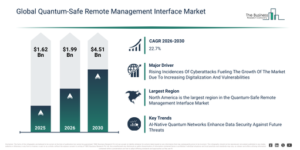
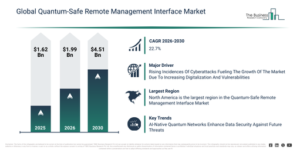
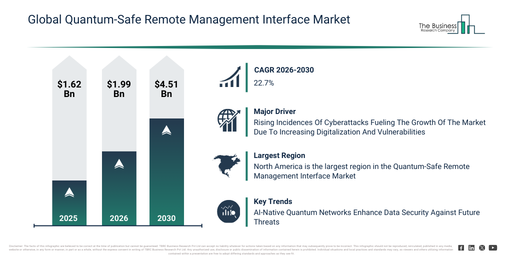
The quantum-safe remote management interface market has seen significant expansion in recent years. This market is expected to expand from $1.62 billion in 2025 to $1.99 billion in 2026, demonstrating a compound annual growth rate (CAGR) of 22.8%. Historically, this growth has been fueled by factors including an increase in remote IT administration, the broadening of cloud infrastructure management, a rise in cybersecurity breach incidents, enterprise network modernization efforts, and the widespread adoption of regulatory compliance measures.
The market for quantum-safe remote management interfaces is projected to experience substantial growth over the coming years. Its value is anticipated to reach $4.51 billion in 2030, exhibiting a compound annual growth rate (CAGR) of 22.7%. This expansion during the forecast period is fueled by factors such as the adoption of post-quantum cryptography, the broadening of secure remote operations, increasing demand for industrial IoT management, the implementation of zero-trust security frameworks, and government investments in digital infrastructure. Key trends identified for this period encompass post-quantum remote access authentication, zero-trust approaches to device management, automated encrypted session management, hybrid cloud remote administration solutions, and enhanced multi-factor administrator verification.
Free Quantum-Safe Remote Management Interface Market Sample: Market Size, Growth Drivers And Competitive Landscape:
Quantum-Safe Remote Management Interface Market Drivers Explained: What Is Supporting A 22.7% CAGR?
The increasing occurrences of cyberattacks are anticipated to boost the expansion of the quantum-safe remote management interface market going forward. Cyberattacks refer to deliberate attempts to gain unauthorized access, disrupt, or damage computer systems, networks, or digital data. The surge in cyberattack frequency stems from growing digitalization, which generates a greater number of targets and avenues for attackers to exploit weaknesses. A quantum-safe remote management interface offers defense against cyberattacks through its incorporation of advanced quantum-resistant encryption, rendering it suitable for enterprises and cloud-based infrastructures. This interface minimizes security threats by facilitating real-time oversight and centralized command over network systems, thereby enhancing operational safety and safeguarding data. As an example, in July 2024, Check Point Software Technologies Ltd., an Israel-based cybersecurity company, reported an increase in cyberattacks targeting corporate networks, showing a 30% rise in weekly attacks during the second quarter of 2024 compared to the corresponding period in 2023, and a 25% increase from the first quarter of 2024. Consequently, the increased frequency of cyberattacks is propelling the expansion of the quantum-safe remote management interface market.
Quantum-Safe Remote Management Interface Market Segment Guide: Main Divisions And Subsegments
The quantum-safe remote management interface market covered in this report is segmented –
1) By Component: Hardware, Software, Services
2) By Deployment Mode: On-Premises, Cloud-Based, Hybrid
3) By Organization Size: Large Enterprises, Small And Medium Enterprises
4) By Application: Network Security, Data Protection, Identity And Access Management, Secure Communications, Other Applications
5) By End-User: Banking, Financial Services and Insurance (BFSI), Government, Healthcare, Information Technology And Telecommunications, Energy And Utilities, Manufacturing, Other End-Users
Subsegments:
1) By Hardware: Quantum-Safe Encryption Modules, Hardware Security Modules (HSMs), Secure Network Interface Cards (NICs), Quantum-Safe Communication Devices, Tamper-Proof Authentication Devices
2) By Software: Quantum-Resistant Encryption Software, Key Management Software, Secure Remote Access Platforms, Quantum-Safe Network Monitoring Tools, Identity And Access Management (IAM) Software
3) By Services: Integration And Deployment Services, Consulting And Advisory Services, Managed Security Services, Training And Support Services, Maintenance And Upgradation Services
Quantum-Safe Remote Management Interface Market Trends And Opportunities For 2026–2030
Key players within the quantum-safe remote management interface market are concentrating on creating advanced technological solutions, including AI-native quantum-based networks, aimed at safeguarding data, facilitating real-time oversight, and defending against upcoming quantum vulnerabilities. Specifically, AI-native quantum-based networks are defined as network infrastructures that merge artificial intelligence (AI) with quantum-safe technologies, allowing the network to dynamically enhance performance, identify threats instantly, and protect data through quantum-resistant encryption. An example of this is Quantum Xchange Inc., a US-based quantum-technology company, which introduced the initial AI-native, quantum-safe virtual private network (VPN) in June 2024, integrating sophisticated artificial intelligence networking with quantum-resistant encryption technology. This novel VPN, built upon Phio TX version 4.0, provides secure site-to-site and remote access VPN options designed to shield communications from the nascent dangers posed by quantum computing. It guarantees long-term security by protecting data from quantum attacks capable of compromising conventional encryption, thus representing a crucial advancement for securing enterprise and remote workforce networks in the quantum era.
Which Major Players Are Active In The Quantum-Safe Remote Management Interface Market?
Major companies operating in the quantum-safe remote management interface market are Google LLC, Microsoft Corporation, Dell Technologies Inc., International Business Machines Corporation, Cisco Systems Inc., Honeywell International Inc., BT Group plc, Nokia Corporation, Toshiba Corporation, Thales Group, Atos SE, Palo Alto Networks Inc., Fortinet Inc., Check Point Software Technologies Ltd., Rambus Inc., QNu Labs, ID Quantique SA, ISARA Corporation, Arqit Quantum Inc., CryptoNext Security Inc., Quantum Xchange Inc.
Unlock The Complete Quantum-Safe Remote Management Interface Market Report With Company Benchmarking:
Quantum-Safe Remote Management Interface Market World Regions Compared: Which Leads In Revenue?
North America was the largest region in the quantum-safe remote management interface market in 2025. The regions covered in the quantum-safe remote management interface market report are Asia-Pacific, South East Asia, Western Europe, Eastern Europe, North America, South America, Middle East, Africa.
Reach Out To Our Team:
The Business Research Company: https://www.thebusinessresearchcompany.com/
Americas: +1 310-496-7795
Asia: +44 7882 955267 & +91 8897263534
Europe: +44 7882 955267
Email us at: marketing@tbrc.info
Follow us on:
LinkedIn: https://in.linkedin.com/company/the-business-research-company
YouTube: https://www.youtube.com/channel/UC24_fI0rV8cR5DxlCpgmyFQ
Global Market Model: https://www.thebusinessresearchcompany.com/global-market-model

Wasay has over a decade of experience in market research, data modelling, and analytics, with prior experience at GlobalData and Decision Tree Consulting Services. At The Business Research Company , he leads research operations across syndicated studies, customized consulting engagements, and the Global Market Model platform. His professional experience includes supporting organizations such as Boston Consulting Group, KPMG, and Ernst & Young. Wasay holds a degree in Electronics and Communications Engineering, postgraduate management qualifications from International Management Institute Belgium and Indian School of Business and Entrepreneurship, and completed the Integrated Program in Business Analytics from Indian Institute of Management Indore.