With a focus on actionable insights and strategic value, The Business Research Company’s 2026 market reports include market attractiveness scoring, total addressable market sizing, company benchmarking matrices, interactive Excel dashboards, deeper supply chain intelligence, emerging startup tracking, and granular product-level insights.
Robotic Vision Sensor Market Size Analysis: Historical Growth And Future Revenue Projections
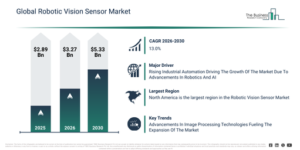
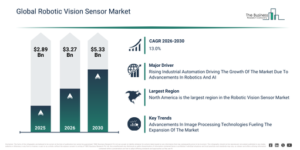
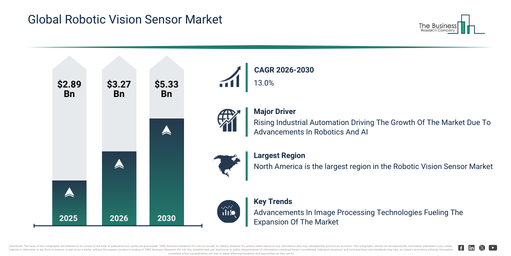
The robotic vision sensor market has witnessed substantial expansion in recent years. Its valuation is anticipated to climb from $2.89 billion in 2025 to $3.27 billion in 2026, achieving a compound annual growth rate (CAGR) of 13.1%. This historical upward trend can be ascribed to several factors, including the increasing adoption of industrial robotics, the development of early machine vision systems, a heightened demand for automated quality inspection, the spread of manufacturing automation, and continuous enhancements in camera sensor technology.
The robotic vision sensor market is anticipated to experience substantial expansion over the upcoming years. It will grow to $5.33 billion in 2030 at a compound annual growth rate (CAGR) of 13.0%. This expansion during the projection period stems from factors such as the incorporation of AI into robotic vision, an increase in autonomous mobile robots, the escalating need for smart factories, progress in 3D vision sensors, and the wider adoption of vision-guided robotics. Key developments foreseen in the forecast timeframe encompass AI-powered machine vision, 3D vision-centric automation, precise visual inspection methods, vision systems for autonomous robot navigation, and edge-based vision processing.
Preview The Robotic Vision Sensor Market Report With A Free Sample:
Robotic Vision Sensor Market Drivers: What Is Fueling Demand Through 2030?
The surge in industrial automation is projected to propel the expansion of the robotic vision sensor market. This automation involves integrating advanced technologies such as robotics, artificial intelligence, and machine systems across various industries, aiming for consistent quality with reduced human involvement. The demand for automation is increasing as it enables companies to execute operations more swiftly, without interruptions or fatigue, thereby significantly enhancing overall productivity. Robotic vision sensors enhance automation by facilitating accurate object identification and placement, which improves the efficiency of industrial processes. Illustratively, in September 2024, the International Federation of Robotics, a non-profit organization based in Germany, reported that the global operational inventory of industrial robots climbed to 4,281,585 units, marking a considerable 10% rise from the preceding year. Consequently, the growing adoption of automation in industries is a key driver for the robotic vision sensor market’s growth.
Robotic Vision Sensor Market Segmentation Analysis: Core Categories And Subcategories
The robotic vision sensor market covered in this report is segmented –
1) By Component: Hardware, Software, Services
2) By Technology: 2D Vision, 3D Vision, Infrared Vision, Other Technologies
3) By Application: Quality Inspection, Guidance And Navigation, Measurement And Gauging, Object Recognition, Autonomous Mobile Robots (AMRs)
4) By End-User Industry: Automotive, Electronics, Healthcare, Aerospace And Defense, Other End-User Industry
Subsegments:
1) By Hardware Type: Vision Cameras, Sensors, Processors, Illumination Systems, Optics And Lenses
2) By Software Type: Image Processing Software, Machine Learning Algorithms, AI-Based Vision Systems, Calibration And Optimization Software, Data Analytics Tools
3) By Services Type: Installation And Integration Services, Maintenance And Support Services, Consulting And Training Services, Customization Services, Remote Monitoring And Upgrades
Which Trends Will Define The Robotic Vision Sensor Market Through 2030?
Leading firms in the robotic vision sensor market are focusing on innovation by developing advanced image processing technologies to boost the performance of robotic vision systems. These technologies involve methods and algorithms that refine, analyze, and manipulate images captured by sensors or cameras, allowing systems to extract crucial information for tasks such as object recognition, pattern detection, and data interpretation. For instance, in April 2024, OMNIVISION Technologies, a US-based semiconductor manufacturer, unveiled a 9-megapixel global shutter image sensor, the OG09A10, specifically engineered for industrial machine vision cameras. This sensor features a 1-inch optical format and a 3.45 µm pixel size, delivering high-quality images of fast-moving objects, with advanced technologies like Nyxel NIR and DCG HDR to ensure clear, low-noise images in low-light or challenging conditions. CMOS image sensors are progressively replacing CCDs, which simplifies the complexity of industrial cameras and makes them more compact for diverse industrial applications.
Robotic Vision Sensor Market Major Companies And Industry Participants
Major companies operating in the robotic vision sensor market are Sony Corporation, Intel Corporation, ABB Robotics, STMicroelectronics, Keyence Corporation, Omron Corporation, FANUC Corporation, Zebra Technologies, KUKA Robotics, Yaskawa Electric Corporation, SICK AG, Cognex Corporation, Epson Robots, Universal Robots, Teledyne DALSA, ISRA Vision, Micro-Epsilon, Basler AG, Allied Vision, LMI Technologies
Buy The Full Robotic Vision Sensor Global Market Report 2026:
Robotic Vision Sensor Market Geographic Analysis: Which Region Accounts For The Biggest Share?
North America was the largest region in the robotic vision sensor market in 2025. Asia-Pacific is expected to be the fastest-growing region in the forecast period. The regions covered in the robotic vision sensor market report are Asia-Pacific, South East Asia, Western Europe, Eastern Europe, North America, South America, Middle East, Africa.
Reach Out To Our Team:
The Business Research Company: https://www.thebusinessresearchcompany.com/
Americas: +1 310-496-7795
Asia: +44 7882 955267 & +91 8897263534
Europe: +44 7882 955267
Email us at: marketing@tbrc.info
Follow us on:
LinkedIn: https://in.linkedin.com/company/the-business-research-company
YouTube: https://www.youtube.com/channel/UC24_fI0rV8cR5DxlCpgmyFQ
Global Market Model: https://www.thebusinessresearchcompany.com/global-market-model

Wasay has over a decade of experience in market research, data modelling, and analytics, with prior experience at GlobalData and Decision Tree Consulting Services. At The Business Research Company , he leads research operations across syndicated studies, customized consulting engagements, and the Global Market Model platform. His professional experience includes supporting organizations such as Boston Consulting Group, KPMG, and Ernst & Young. Wasay holds a degree in Electronics and Communications Engineering, postgraduate management qualifications from International Management Institute Belgium and Indian School of Business and Entrepreneurship, and completed the Integrated Program in Business Analytics from Indian Institute of Management Indore.