The Business Research Company’s 2026 market reports are designed to deliver research that is more actionable and strategically valuable. Key offerings include market attractiveness scoring, total addressable market sizing, company benchmarking matrices, interactive Excel dashboards, deeper supply chain intelligence, emerging startup tracking, and granular product-level insights.
Quantum Computing In Automotive Market Historical Growth Vs. Forecast Growth: How Do The Numbers Compare?
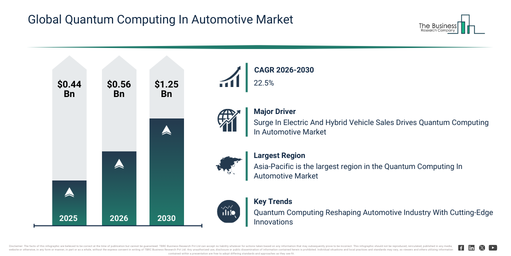
The quantum computing in automotive market size has seen substantial growth in recent years. This market is forecast to increase from $0.44 billion in 2025 to $0.56 billion in 2026, exhibiting a compound annual growth rate (CAGR) of 25.4%. The expansion in the past period was largely due to the escalating complexity of automotive systems, a growing embrace of simulation-based vehicle design, the development of electric vehicle programs, increased data intensity in mobility systems, and initial research collaborations with quantum providers.
The quantum computing in automotive market is projected to experience substantial expansion in the coming years, reaching $1.25 billion by 2030, driven by a compound annual growth rate (CAGR) of 22.5%. This anticipated growth stems from several factors, including heightened investments in autonomous vehicle technologies, a surging need for advanced battery optimization, the broadening of connected vehicle ecosystems, the increasing accessibility of cloud-based quantum services, and a greater emphasis on computational efficiency within automotive manufacturing processes. Key trends anticipated during this period encompass the expanded deployment of quantum algorithms for optimizing autonomous driving, the growing application of quantum computing in modeling battery performance, a rising uptake of quantum simulations for new material discovery, the proliferation of quantum-assisted production planning systems, and an intensified focus on optimizing complex routes.
Start With A Free Sample Of The Quantum Computing In Automotive Market Research Report:
The Leading Growth Driver In The Quantum Computing In Automotive Market Explained
The anticipated growth of quantum computing within the automotive market is being propelled by the increasing sales of electric and hybrid electric vehicles. Electric vehicles (EVs) are automobiles powered solely by electricity, relying on electric motors for propulsion and rechargeable battery packs as their primary energy source. Hybrid electric vehicles (HEVs), conversely, integrate an internal combustion engine, commonly gasoline-fueled, with an electric propulsion system. This rise in electric and hybrid electric vehicle sales is attributed to the appeal of sustainable and efficient transportation options, alongside the demand for advanced computational power to optimize vehicle design, battery management, and autonomous driving systems. Quantum computing offers unmatched capabilities in processing complex simulations and algorithms far quicker than traditional computers, which is crucial for enhancing the performance and efficiency of electric and hybrid vehicles. For instance, in April 2024, statistics released by Zapmap, a UK-based mapping service, revealed that electric car sales in 2023 surged by 3.5 million vehicles compared to the prior year, representing a significant 35% year-on-year increase. Consequently, the increasing sales of electric and hybrid electric vehicles are driving the growth of quantum computing in the automotive market.
Key Segments Shaping The Quantum Computing In Automotive Market Landscape
The quantum computing in automotive market covered in this report is segmented –
1) By Component: Hardware, Services, Software
2) By Technology: Quantum Annealing, Superconducting Qubits, Topological And Photonic, Trapped Ions
3) By Deployment Type: On-Cloud, On-Premise
4) By Application: Autonomous And Connected Vehicle, Battery Optimization, Material Research, Production Planning And Scheduling, Route Planning And Traffic Management
5) By End-User: Original Equipment Manufacturer (OEM), Warehousing And Distribution
Subsegments:
1) By Hardware: Quantum Processors, Quantum Chips, Cryostats
2) By Services: Consulting Services, Training And Support Services, Cloud-Based Quantum Computing Services
3) By Software: Quantum Algorithms, Simulation Software, Quantum Programming Tools
Quantum Computing In Automotive Market Trend Spotlight: Key Shifts Shaping Future Demand
Leading companies involved in quantum computing within the automotive market are collaborating to advance sustainable mobility solutions rapidly, including the implementation of hybrid quantum-classical workflows leveraging advanced quantum computers. This workflow represents a computational strategy that combines quantum computing with traditional classical computing, enabling the resolution of intricate problems with greater efficiency than either technology could achieve independently. As an example, in August 2023, BMW Group, an automotive firm located in Germany, Airbus, an aircraft corporation based in Netherland, and Quantinuum, a quantum computing enterprise from the US, formed a partnership to create a hybrid quantum-classical workflow aimed at speeding up research through quantum computers. The joint effort is concentrating on simulating the oxygen reduction reaction (ORR) when it occurs on platinum-based catalysts, which are components utilized in fuel cells. The ORR is an essential chemical process within fuel cells, responsible for transforming hydrogen and oxygen into water and electricity; however, its speed is relatively low, and it demands substantial quantities of costly platinum catalysts.
Quantum Computing In Automotive Market Competitive Analysis: Who Are The Main Competitors?
Major companies operating in the quantum computing in automotive market are Amazon.com Inc., Volkswagen AG, Google LLC, Microsoft Corporation, Ford Motor Company, General Motors Company, Bayerische Motoren Werke AG (BMW), Robert Bosch GmbH, Accenture Plc, IBM Corporation, Denso Corporation, Honeywell International Inc., AISIN Corporation, Fujitsu Limited, NEC Corporation, Rigetti And Co LLC, Atos SE, Booz Allen Hamilton, Quantinuum, Xanadu Quantum Technologies Inc., IonQ Inc., QC Ware Corporation, D-Wave Systems Inc., Classiq Technologies Ltd.
Find The Complete Quantum Computing In Automotive Market Outlook In The Full Report:
Mapping The Quantum Computing In Automotive Market: Regional Leadership And Global Reach
Asia-Pacific was the largest region in the quantum computing in automotive market in 2025. North America is expected to be the fastest-growing region in the forecast period. The regions covered in the quantum computing in automotive market report are Asia-Pacific, South East Asia, Western Europe, Eastern Europe, North America, South America, Middle East, Africa.
Reach Out To Our Team:
The Business Research Company: https://www.thebusinessresearchcompany.com/
Americas: +1 310-496-7795
Asia: +44 7882 955267 & +91 8897263534
Europe: +44 7882 955267
Email us at: marketing@tbrc.info
Follow us on:
LinkedIn: https://in.linkedin.com/company/the-business-research-company
YouTube: https://www.youtube.com/channel/UC24_fI0rV8cR5DxlCpgmyFQ
Global Market Model: https://www.thebusinessresearchcompany.com/global-market-model

Wasay has over a decade of experience in market research, data modelling, and analytics, with prior experience at GlobalData and Decision Tree Consulting Services. At The Business Research Company , he leads research operations across syndicated studies, customized consulting engagements, and the Global Market Model platform. His professional experience includes supporting organizations such as Boston Consulting Group, KPMG, and Ernst & Young. Wasay holds a degree in Electronics and Communications Engineering, postgraduate management qualifications from International Management Institute Belgium and Indian School of Business and Entrepreneurship, and completed the Integrated Program in Business Analytics from Indian Institute of Management Indore.