With a focus on actionable insights and strategic value, The Business Research Company’s 2026 market reports include market attractiveness scoring, total addressable market sizing, company benchmarking matrices, interactive Excel dashboards, deeper supply chain intelligence, emerging startup tracking, and granular product-level insights.
Quantum War Fare Market Size Analysis: Historical Growth And Future Revenue Projections
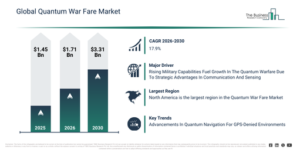
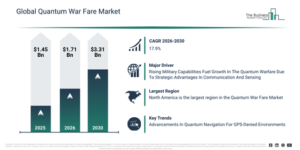
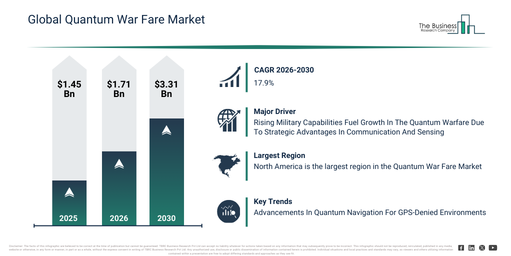
The quantum warfare market size has experienced rapid growth in recent years. It is forecast to expand from $1.45 billion in 2025 to $1.71 billion in 2026, achieving a compound annual growth rate (CAGR) of 18.3%. The drivers behind this historical growth include military modernization programs, advancements in cryptography, initial funding for quantum research, the increasing need for secure communications, and geopolitical security concerns.
The quantum war fare market is poised for significant expansion in the coming years. It is projected to reach $3.31 billion by 2030, growing at a compound annual growth rate (CAGR) of 17.9%. This growth in the forecast period can be attributed to the deployment of quantum communication networks, the adoption of quantum PNT systems, increased defense spending, the race for quantum supremacy, and the integration with autonomous defense platforms. Major trends expected during this period include quantum-secure military communication, quantum radar and sensing systems, quantum-enabled navigation and timing, advanced cryptography and encryption, and high-speed strategic decision systems.
Preview The Quantum War Fare Market Report With A Free Sample:
Quantum War Fare Market Drivers: What Is Fueling Demand Through 2030?
The growing military capabilities are anticipated to propel the expansion of the quantum warfare market in the future. Military capabilities denote a nation’s capacity to effectively deploy and sustain armed forces by utilizing its personnel, equipment, technology, strategy, and resources to fulfill defense and strategic objectives. The enhancement of these capabilities, driven by the necessity for advanced defense technologies to counteract emerging digital threats, is pushing nations to invest in quantum warfare solutions that offer superior data security, faster communication, and strategic advantages in contemporary combat scenarios. Augmented military capabilities help deter potential threats by indicating to adversaries that any aggression would be met with strong resistance. Quantum warfare bolsters military capabilities by enabling ultra-secure communications, sophisticated sensing, and more rapid data processing, providing forces a strategic edge in detection, decision-making, and defense. For example, in April 2024, the Stockholm International Peace Research Institute (SIPRI), a Sweden-based non-government organization, reported that global military spending reached $2,443 billion in 2023, marking a 6.8% increase in real terms from 2022. Therefore, the increase in military capabilities will stimulate the quantum warfare market. The escalating incidence of cybercrimes is expected to fuel the growth of the quantum warfare market moving forward. Cybercrime is defined as any unlawful activity that involves the use of computers, networks, or digital systems to perpetrate or facilitate offenses such as hacking, fraud, data theft, or online harassment. Cybercrimes are on the rise due to increasing digital dependency, as the reliance on online platforms for work, banking, communication, and data storage provides more entry points and valuable targets for cybercriminals to exploit. Quantum warfare enables advanced capabilities in data interception and decryption, thereby potentially empowering cybercriminals by undermining traditional encryption methods and facilitating the exploitation of critical digital infrastructures. For instance, in November 2023, according to the Department of Defense Australia, an Australia-based government department, the Australian Cyber Security Centre received over 94,000 reports of cybercrime during the financial year 2022-2023. Consequently, the rising cybercrimes act as a driver for the quantum warfare market.
Quantum War Fare Market Segmentation Analysis: Core Categories And Subcategories
The quantum war fare market covered in this report is segmented –
1) By Component: Antenna, Clock, Magnetometer, Radar, Sensor, Other Components
2) By Technology: Quantum Communication And Cryptography, Quantum Computing And Simulations, Quantum Sensing And Metrology
3) By Quantum PNT: Navigation, Positioning, Precision Timing, Geolocation
4) By Application: Land, Naval, Airborne, Space-Based
Subsegments:
1) By Antenna: Quantum Radio Frequency Antennas, Quantum-Enhanced Phased Array Antennas, Quantum Radar Antennas
2) By Clock: Chip-Scale Atomic Clocks (CSACs), Quantum Atomic Clocks, Optical Lattice Clocks
3) By Magnetometer: Optically Pumped Magnetometers, Spin-Exchange Relaxation-Free (SERF) Magnetometers, SQUID-Based Magnetometers
4) By Radar: Quantum Radar Systems, LIDAR Enhanced With Quantum Sensing, Quantum Imaging Radar
5) By Sensor: Quantum Gyroscopes, Quantum Accelerometers, Gravimeters, Quantum Positioning Sensors
6) By Other Components: Quantum Communication Devices, Quantum Cryptographic Modules, Quantum Processors And Control Units
Which Trends Will Define The Quantum War Fare Market Through 2030?
Major companies operating in the quantum warfare market are focusing on developing technological advancements, such as navigation technology, to improve positioning precision in GPS-denied environments, enhance secure communication systems, and strengthen electronic warfare capabilities. Navigation technology in quantum warfare refers to the utilization of quantum-based systems, including inertial sensors and atomic clocks, to facilitate precise positioning and movement tracking where GPS signals are unavailable. For instance, in March 2025, Q-CTRL, an Australia-based quantum technology company, partnered with AOSense Inc., a US-based company that manufactures atom-optic sensors, to create a cutting-edge quantum-enabled Inertial Navigation System (QuINS). This system provides exceptional accuracy and independence from GPS, rendering it ideal for military and civilian uses in contested environments. Its resilience and sustained reliability enhance national security and support critical infrastructure by decreasing reliance on vulnerable GPS systems.
Quantum War Fare Market Major Companies And Industry Participants
Major companies operating in the quantum war fare market are Lockheed Martin Corporation, RTX Corporation, The Boeing Company, International Business Machines Corporation, Northrop Grumman Corporation, IonQ Inc., QinetiQ Group plc, PsiQuantum Corp., ColdQuanta Inc., Quantum Brilliance Pty. Ltd., SandboxAQ Inc., ID Quantique SA, Q-CTRL Pty. Ltd., Rigetti Computing Inc., Zapata Computing Inc., D-Wave Quantum Inc., QuintessenceLabs Pty. Ltd., Arqit Quantum Inc., Aliro Technologies Inc., Crypta Labs Ltd.
Buy The Full Quantum War Fare Global Market Report 2026:
Quantum War Fare Market Geographic Analysis: Which Region Accounts For The Biggest Share?
North America was the largest region in the quantum war fare market in 2025. Asia-Pacific is expected to be the fastest-growing region in the forecast period. The regions covered in the quantum war fare market report are Asia-Pacific, South East Asia, Western Europe, Eastern Europe, North America, South America, Middle East, Africa.
Reach Out To Our Team:
The Business Research Company: https://www.thebusinessresearchcompany.com/
Americas: +1 310-496-7795
Asia: +44 7882 955267 & +91 8897263534
Europe: +44 7882 955267
Email us at: marketing@tbrc.info
Follow us on:
LinkedIn: https://in.linkedin.com/company/the-business-research-company
YouTube: https://www.youtube.com/channel/UC24_fI0rV8cR5DxlCpgmyFQ
Global Market Model: https://www.thebusinessresearchcompany.com/global-market-model

Wasay has over a decade of experience in market research, data modelling, and analytics, with prior experience at GlobalData and Decision Tree Consulting Services. At The Business Research Company , he leads research operations across syndicated studies, customized consulting engagements, and the Global Market Model platform. His professional experience includes supporting organizations such as Boston Consulting Group, KPMG, and Ernst & Young. Wasay holds a degree in Electronics and Communications Engineering, postgraduate management qualifications from International Management Institute Belgium and Indian School of Business and Entrepreneurship, and completed the Integrated Program in Business Analytics from Indian Institute of Management Indore.