Designed to make market research more actionable and strategically valuable, The Business Research Company’s 2026 market reports feature market attractiveness scoring, total addressable market sizing, company benchmarking matrices, interactive Excel dashboards, deeper supply chain intelligence, emerging startup tracking, and granular product-level insights.
What Is The Projected CAGR Of The Quantum-Artificial intelligence (AI) Volatility Surfaces Generation Market Through 2030?
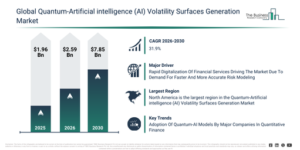
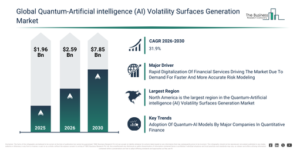
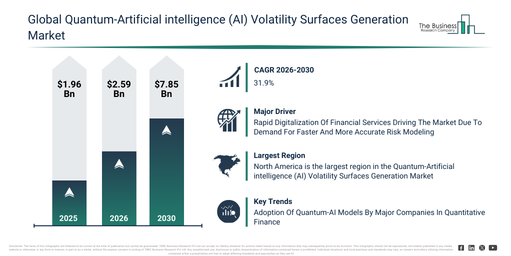
The quantum-artificial intelligence (AI) volatility surfaces generation market has seen substantial growth over the past few years. It is projected to increase from $1.96 billion in 2025 to $2.59 billion in 2026, exhibiting a compound annual growth rate (CAGR) of 32.2%. This historical expansion can be linked to factors such as the rising intricacy of financial derivatives, a greater need for risk management tools, the incorporation of AI into financial modeling, the broadening scope of hedge funds and asset management firms, and advancements in high-performance computing infrastructure.
The quantum-artificial intelligence (AI) volatility surfaces generation market size is expected to undergo significant expansion in the coming years. It will grow to $7.85 billion in 2030 at a compound annual growth rate (CAGR) of 31.9%. This projected growth during the forecast period can be attributed to the rising adoption of quantum computing, an increasing need for real-time volatility analysis, a heightened focus on AI-driven financial decision-making, the proliferation of cloud-based quantum platforms, and regulatory directives for advanced risk management. Key trends anticipated in the forecast period encompass quantum-enhanced volatility modeling, AI-powered risk prediction, high-speed asset pricing computation, cloud-based quantum financial platforms, and hybrid quantum-classical computing systems.
Claim Your Free Quantum-Artificial intelligence (AI) Volatility Surfaces Generation Market Sample Report With Key Data And Trends:
Quantum-Artificial intelligence (AI) Volatility Surfaces Generation Market Demand Analysis: The Driving Force Behind Expansion
The swift digitalization of financial services is anticipated to fuel the expansion of the quantum-artificial intelligence (AI) volatility surfaces generation market moving forward. Digitalization in financial services encompasses the application of digital technologies to provide banking, investment, insurance, and payment solutions more efficiently, conveniently, and securely to customers. The rise in digital financial services is driven by increasing consumer demand for faster, more convenient, and accessible banking and payment options. Quantum-AI volatility surface generation empowers financial institutions to model market risks quickly and accurately, thereby enhancing automated trading, risk management, and decision-making within progressively digitalized financial ecosystems. For instance, in April 2024, data from UK Finance, a UK-based trade association representing the banking and financial services industry, indicated that approximately 86% of UK adults, equating to around 46 million people, utilize online banking. Additionally, the adoption of digital-only bank accounts significantly increased from 24% in 2023 to 36% this year, underscoring a strong move towards fully digital financial services. Therefore, the rapid digitalization of financial services has contributed to the growth of the quantum-artificial intelligence (AI) volatility surfaces generation market.
Breaking Down The Quantum-Artificial intelligence (AI) Volatility Surfaces Generation Market By Segment
The quantum-artificial intelligence (AI) volatility surfaces generation market covered in this report is segmented –
1) By Component: Software, Hardware, Services
2) By Deployment Mode: On-Premises, Cloud
3) By Application: Financial Institutions, Hedge Funds, Asset Management Firms, Trading Platforms, Other Applications
4) By End-User: Banking Finance Services And Insurances (BFSI), Investment Firms, Research Organizations, Other End-Users
Subsegments:
1) By Software: Platforms, Algorithms, Analytics And Modeling Tools, Risk Management Applications
2) By Hardware: Quantum Processors, Classical-Quantum Hybrid Systems, High-Performance Computing Infrastructure, Cloud-Based Quantum Hardware
3) By Services: Consulting And Advisory, Integration And Deployment, Training And Education, Managed Services
Top Trend Influencing The Quantum-Artificial intelligence (AI) Volatility Surfaces Generation Market Outlook
Leading firms within the quantum-artificial intelligence (AI) volatility surfaces generation market are innovating cutting-edge technologies to boost financial modeling, speed up risk assessments, and refine the calibration of intricate volatility structures. An example of this is Google LLC’s announcement in January 2025 regarding the incorporation of SandboxAQ’s Large Quantitative Models (LQMs) into its cloud services. These LQMs are engineered to process vast numerical datasets and perform complex computations, thereby supporting applications like financial modeling, data analytics, and various other quantitative assignments. Although not solely dedicated to volatility surface generation, the implementation of these quantum-AI models illustrates the increasing integration of sophisticated AI and quantum computing solutions across quantitative finance, holding the promise of advancing options pricing, risk evaluation, and other intricate financial computations. SandboxAQ, a US-based technology firm, is known for its expertise in quantum computing, artificial intelligence, and advanced simulations; this partnership represents progress in making advanced quantitative AI tools more available to businesses.
Quantum-Artificial intelligence (AI) Volatility Surfaces Generation Market Competitive Landscape And Major Players
Major companies operating in the quantum-artificial intelligence (AI) volatility surfaces generation market are Microsoft Corporation, Amazon Web Services Inc. (AWS), International Business Machines Corporation (IBM), Bloomberg L.P., Atos SE, London Stock Exchange Group plc (LSEG), Murex S.A.S., Xanadu Quantum Technologies Inc., Numerix LLC, Terra Quantum AG, 1QBit Information Technologies Inc., PASQAL SAS, SpiderRock Technology LLC, OpenGamma Limited, Rigetti Computing Inc., Multiverse Computing S.L., D-Wave Systems Inc., QC Ware Corp., Zapata Computing Inc., Vola Dynamics LLC
Read The Full Quantum-Artificial intelligence (AI) Volatility Surfaces Generation Market Report By The Business Research Company:
Where Is The Quantum-Artificial intelligence (AI) Volatility Surfaces Generation Market Largest? Key Regional Insights
North America was the largest region in the quantum-artificial intelligence (AI) volatility surfaces generation market in 2025. Asia-Pacific is expected to be the fastest-growing region in the forecast period. The regions covered in the quantum-artificial intelligence (AI) volatility surfaces generation market report are Asia-Pacific, South East Asia, Western Europe, Eastern Europe, North America, South America, Middle East, Africa.
Reach Out To Our Team:
The Business Research Company: https://www.thebusinessresearchcompany.com/
Americas: +1 310-496-7795
Asia: +44 7882 955267 & +91 8897263534
Europe: +44 7882 955267
Email us at: marketing@tbrc.info
Follow us on:
LinkedIn: https://in.linkedin.com/company/the-business-research-company
YouTube: https://www.youtube.com/channel/UC24_fI0rV8cR5DxlCpgmyFQ
Global Market Model: https://www.thebusinessresearchcompany.com/global-market-model

Wasay has over a decade of experience in market research, data modelling, and analytics, with prior experience at GlobalData and Decision Tree Consulting Services. At The Business Research Company , he leads research operations across syndicated studies, customized consulting engagements, and the Global Market Model platform. His professional experience includes supporting organizations such as Boston Consulting Group, KPMG, and Ernst & Young. Wasay holds a degree in Electronics and Communications Engineering, postgraduate management qualifications from International Management Institute Belgium and Indian School of Business and Entrepreneurship, and completed the Integrated Program in Business Analytics from Indian Institute of Management Indore.