The Business Research Company’s 2026 market reports combine market attractiveness scoring, total addressable market sizing, company benchmarking matrices, interactive Excel dashboards, deeper supply chain intelligence, emerging startup tracking, and granular product-level insights to deliver research that is more actionable and strategically valuable.
Virtual Extensible Local-Area Network (VXLAN) Market Size Review: What Shaped Past Growth And What Will Drive Future Expansion?
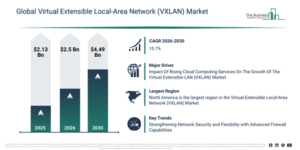
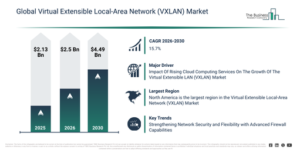
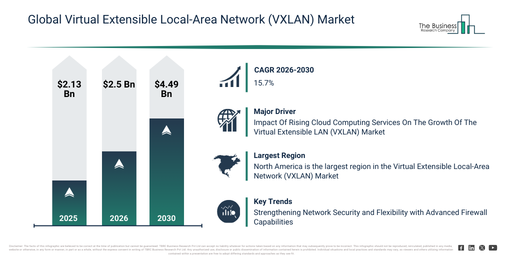
The virtual extensible local-area network (vxlan) market size has demonstrated rapid expansion in recent years. This market is projected to expand from $2.13 billion in 2025 to $2.5 billion in 2026, exhibiting a compound annual growth rate (CAGR) of 17.7%. Historically, this growth can be attributed to factors such as the increasing expansion of large-scale data center infrastructure, wider adoption of cloud computing, the inherent limitations of traditional VLAN scalability, the growing virtualization of enterprise networks, and the proliferation of hyperscale environments.
The virtual extensible local-area network (vxlan) market is projected to experience substantial expansion over the coming years. Its valuation is forecast to reach $4.49 billion by 2030, exhibiting a compound annual growth rate (CAGR) of 15.7%. This projected growth is primarily driven by factors such as increased investments in cloud-native networking, a surging demand for high-performance virtual networks, the broadening adoption of hybrid and multi-cloud environments, a heightened emphasis on network automation and orchestration, and the rising uptake of software-defined data centers. Key trends anticipated during this period encompass the growing embrace of network virtualization architectures, the escalating deployment of vxlan within data centers, deeper integration with SDN and NFV frameworks, the proliferation of multi-tenant cloud networking solutions, and an increased focus on scalable network segmentation.
Access Free Sample Pages From The Virtual Extensible Local-Area Network (VXLAN) Market Report 2026:
Understanding The Main Driver Of The Virtual Extensible Local-Area Network (VXLAN) Market
The increasing adoption of cloud computing services is anticipated to propel the virtual extensible local area network (VXLAN) market forward. Cloud computing services entail the delivery of computing assets, including servers, storage, databases, networking, software, and analytics, through the internet. The surge in these services stems from their scalability, flexibility, and cost-effectiveness, enabling businesses to access and utilize advanced technology solutions without the necessity of on-premises infrastructure management. Cloud computing services leverage VXLAN to enhance network scalability, flexibility, and efficiency by establishing isolated virtual networks over existing IP infrastructure, supporting dynamic and secure multi-tenant environments, and integrating seamlessly with advanced network technologies. For instance, in April 2025, according to the American Bar Association, a U.S.-based professional organization, approximately 75% of attorneys reported using cloud computing for work-related tasks, an increase from 69% in 2023 and about 70% in 2022. Therefore, the growth in cloud computing services will drive the virtual extensible LAN (VXLAN) market.
Virtual Extensible Local-Area Network (VXLAN) Market Segment Mapping For 2026 And Beyond
The virtual extensible local-area network (vxlan) market covered in this report is segmented –
1) By Component: Hardware, Software, Services
2) By Application: Multi-Tenancy, Workload Mobility, Software-Defined Networking (SDN) Overlays, Network Function Virtualization (NFV), Other Applications
3) By Enterprise Size: Large Enterprises, Small And Medium-Sized Enterprises (SMEs)
4) By End-User: Manufacturing, Healthcare, Banking, Financial Services, And Insurance (BFSI), Retail, Media And Entertainment, Government, Information Technology (IT) And Information Technology Enabled Services (ITeS), Telecommunications, Other End-Users
Subsegments:
1) By Hardware: VXLAN-Enabled Network Switches, VXLAN Routers, Network Interface Cards (NICs), Hardware Accelerators
2) By Software: VXLAN Management And Orchestration Software, Network Virtualization Software, Security Software For VXLAN, VXLAN Gateways And Controllers
3) By Services: Professional Services (Consulting, Integration, And Support Services), Managed Services (Monitoring And Optimization), Cloud-Based VXLAN Deployment Services
What Key Trend Is Expected To Shape The Virtual Extensible Local-Area Network (VXLAN) Market Over The Forecast Period?
Leading firms in the virtual extensible local area network (VXLAN) market are concentrating on creating sophisticated solutions, including advanced VXLAN-compatible firewalls, with the aim of boosting security, improving traffic management, and offering adaptable virtual network segmentation. These next-generation VXLAN-enabled firewalls are defined as devices that facilitate micro-segmentation and secure overlay deployments within virtualized network infrastructures, empowering organizations to segregate traffic, implement uniform security policies, and effectively handle encrypted information. An example of this is seen in June 2023, when Cisco Systems Inc., a US-based digital communications technology company, introduced the Secure Firewall 4200 Series. This next-generation firewall product line, engineered for hybrid work and cloud-centric networks, delivers improved encryption acceleration, cluster modularity, and support for high-speed interfaces. These features enable streamlined branch routing, micro-segmentation, and secure overlay deployment within settings like VXLAN fabrics.
Virtual Extensible Local-Area Network (VXLAN) Market Major Players And Industry Competition Overview
Major companies operating in the virtual extensible local-area network (vxlan) market are Microsoft Corporation, Alibaba Cloud, Dell Technologies Inc., Huawei Technologies Co. Ltd., Intel Corporation, Cisco Systems Inc., Oracle Corporation, Broadcom Inc., NVIDIA Corporation, Hewlett Packard Enterprise Company, Nokia Corporation, VMware LLC, Keysight Technologies, Juniper Networks Inc., Fortinet Inc., Red Hat Inc., Arista Networks Inc., Extreme Networks, Ribbon Communications Inc., Spirent Communications, FS.com Inc., Arrcus Inc., Pica8 Software Inc., IP Infusion, Asterfusion Data Technologies Inc.
Full Virtual Extensible Local-Area Network (VXLAN) Market Report: Market Size, Trends, Segments And Key Players:
Virtual Extensible Local-Area Network (VXLAN) Market Geographic Segmentation: Regions Covered In The Report
North America was the largest region in the virtual extensible local-area network (VXLAN) market in 2025. Asia-Pacific is expected to be the fastest-growing region in the forecast period. The regions covered in the virtual extensible local-area network (vxlan) market report are Asia-Pacific, South East Asia, Western Europe, Eastern Europe, North America, South America, Middle East, Africa.
Reach Out To Our Team:
The Business Research Company: https://www.thebusinessresearchcompany.com/
Americas: +1 310-496-7795
Asia: +44 7882 955267 & +91 8897263534
Europe: +44 7882 955267
Email us at: marketing@tbrc.info
Follow us on:
LinkedIn: https://in.linkedin.com/company/the-business-research-company
YouTube: https://www.youtube.com/channel/UC24_fI0rV8cR5DxlCpgmyFQ
Global Market Model: https://www.thebusinessresearchcompany.com/global-market-model

Wasay has over a decade of experience in market research, data modelling, and analytics, with prior experience at GlobalData and Decision Tree Consulting Services. At The Business Research Company , he leads research operations across syndicated studies, customized consulting engagements, and the Global Market Model platform. His professional experience includes supporting organizations such as Boston Consulting Group, KPMG, and Ernst & Young. Wasay holds a degree in Electronics and Communications Engineering, postgraduate management qualifications from International Management Institute Belgium and Indian School of Business and Entrepreneurship, and completed the Integrated Program in Business Analytics from Indian Institute of Management Indore.