The Business Research Company’s 2026 market reports combine market attractiveness scoring, total addressable market sizing, company benchmarking matrices, interactive Excel dashboards, deeper supply chain intelligence, emerging startup tracking, and granular product-level insights to deliver research that is more actionable and strategically valuable.
What Is The Virtual Reality Box Glasses Market Growth Rate? A 17.3% CAGR Outlook Through 2030
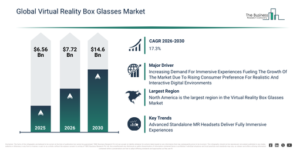
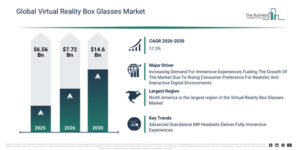
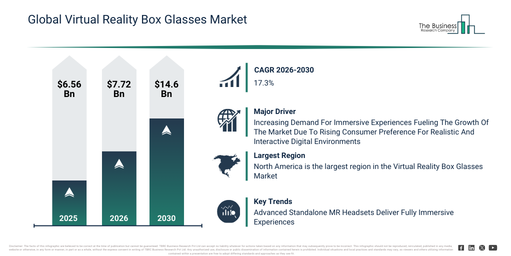
The virtual reality box glasses market has experienced rapid expansion in recent years. It is projected to expand from $6.56 billion in 2025 to $7.72 billion in 2026, demonstrating a compound annual growth rate (CAGR) of 17.6%. Historically, this growth was driven by factors such as the increasing popularity of mobile VR gaming, the initial uptake of PC-tethered VR headsets in entertainment, the expansion of VR in educational and training sectors, the need for immersive retail experiences, and growing recognition of VR’s role in healthcare applications.
The virtual reality box glasses market is anticipated to undergo significant expansion in the near future. By 2030, its valuation is set to reach $14.6 billion, demonstrating a compound annual growth rate (CAGR) of 17.3%. This predicted growth will be driven by several factors, including the increasing deployment of enterprise VR solutions for training and collaborative purposes, the proliferation of mixed reality and AR combination devices, the uptake of foldable and portable VR headsets, the incorporation of AI-powered motion tracking, and the escalating need for immersive experiences enhanced by 3D audio. Key trends anticipated during this period encompass smartphone-compatible VR glasses, premium gaming VR headsets, foldable mobile VR headsets, standalone VR glasses designed for businesses, and the integration of 3D audio along with motion sensing.
Access A Free Sample Of The Latest Virtual Reality Box Glasses Market Analysis:
Why Is The Virtual Reality Box Glasses Market Growing? The Key Demand Driver Explained
The rising demand for immersive experiences is anticipated to drive the future expansion of the virtual reality box glasses market. Immersive experiences are fully engaging digital environments designed to make users feel present within a virtual or augmented world. The heightened consumer interest in these experiences stems from a growing desire for realistic, engaging, and interactive digital settings that closely mimic real-life sensations. Virtual reality box glasses significantly enhance immersive experiences by providing fully engrossing virtual environments, making them well-suited for applications in gaming, education, and entertainment. They improve user interaction by delivering realistic visuals and spatial audio, thereby boosting overall digital engagement. For instance, in August 2024, according to the United States Government Accountability Office, a US-based government agency, in 2022 and 2023, 17 out of 23 civilian agencies engaged in activities utilizing immersive technologies, with 13 agencies acknowledging benefits from their use. Consequently, the increasing demand for immersive experiences is fueling the growth of the virtual reality box glasses market.
What Are The Main Segments Of The Virtual Reality Box Glasses Market?
The virtual reality box glasses market covered in this report is segmented –
1) By Product Type: Standalone Virtual Reality Glasses, Mobile Virtual Reality Glasses, Personal Computer-Tethered Virtual Reality Glasses, Augmented Reality (AR) Combos, Mixed Reality Headsets
2) By Technology: Optical Tracking, Positional Tracking, Mobile Technology, 3D Audio Technology, Motion Sensing Technology
3) By Application: Gaming, Education And Training, Healthcare, Real Estate, Retail, Other Applications
4) By Distribution Channel: Online Stores, Specialty Stores, Supermarkets Or Hypermarkets, Other Distribution Channels
5) By End-User: Consumer, Commercial, Industrial
Subsegments:
1) By Standalone Virtual Reality Glasses: Basic Standalone Headsets, Premium Standalone Headsets, Gaming Focused Standalone Headsets, Enterprise Focused Standalone Headsets
2) By Mobile Virtual Reality Glasses: Smartphone Compatible Glasses, Lightweight Mobile Headsets, Foldable Mobile Headsets, Portable Gaming Headsets
3) By Personal Computer-Tethered Virtual Reality Glasses: High-End Gaming Headsets, Professional Simulation Headsets, Multi-Sensor Tracking Headsets
4) By Augmented Reality Combos: Augmented Reality Assisted Gaming Glasses, Enterprise Augmented Reality Glasses, Education Focused Augmented Reality Glasses
5) By Mixed Reality Headsets: Immersive Mixed Reality Headsets, Enterprise Mixed Reality Headsets, Industrial Mixed Reality Headsets, Consumer Mixed Reality Headsets
Virtual Reality Box Glasses Market Trend Analysis: Where Leading Companies Are Focusing
Leading companies in the virtual reality box glasses market are concentrating on developing advanced products, such as standalone mixed reality (MR) headsets, to deliver fully immersive experiences without requiring external devices. A standalone mixed reality (MR) headset is a self-contained unit that merges virtual and real-world elements, operating independently without needing a PC or smartphone connection. For instance, in September 2024, Meta Platforms Inc., a US-based technology company, unveiled the Quest 3S VR headset, designed to offer an affordable yet deeply engaging virtual reality experience. This mixed reality headset provides robust performance with a Qualcomm Snapdragon XR2 Gen 2 processor and 8GB of RAM. It features a single LCD display with Fresnel lenses, delivering a resolution of 1832 × 1920 pixels per eye and a 96° horizontal and 90° vertical field of view, while also supporting full-color passthrough for mixed reality experiences. The headset further offers 2.5 hours of battery life, hand tracking, precise controller support, and access to the entire Horizon app store, making it a cost-effective yet highly capable option for VR and mixed reality users.
Which Companies Are Major Players In The Virtual Reality Box Glasses Market?
Major companies operating in the virtual reality box glasses market are Google LLC, Xiaomi Corporation, Samsung Electronics Co. Ltd., Meta Platforms Inc., Huawei Technologies Co. Ltd., Sony Corporation, Lenovo Group Limited., HP Inc., Goertek Inc., Valve Corporation, iQIYI Inc., HTC Corporation, Unity Technologies, Pimax Innovation Inc., Varjo Technologies Oy, Pico Interactive Inc., Quytech, Dongguan Shinecon Industrial Co. Ltd., Vrgineers s.r.o.
Get The Complete Virtual Reality Box Glasses Market Analysis Here:
Which Region Held The Largest Share Of The Virtual Reality Box Glasses Market In 2025?
North America was the largest region in the virtual reality box glasses market in 2025. Asia-Pacific is expected to be the fastest-growing region in the forecast period. The regions covered in the virtual reality box glasses market report are Asia-Pacific, South East Asia, Western Europe, Eastern Europe, North America, South America, Middle East, Africa.
Reach Out To Our Team:
The Business Research Company: https://www.thebusinessresearchcompany.com/
Americas: +1 310-496-7795
Asia: +44 7882 955267 & +91 8897263534
Europe: +44 7882 955267
Email us at: marketing@tbrc.info
Follow us on:
LinkedIn: https://in.linkedin.com/company/the-business-research-company
YouTube: https://www.youtube.com/channel/UC24_fI0rV8cR5DxlCpgmyFQ
Global Market Model: https://www.thebusinessresearchcompany.com/global-market-model

Wasay has over a decade of experience in market research, data modelling, and analytics, with prior experience at GlobalData and Decision Tree Consulting Services. At The Business Research Company , he leads research operations across syndicated studies, customized consulting engagements, and the Global Market Model platform. His professional experience includes supporting organizations such as Boston Consulting Group, KPMG, and Ernst & Young. Wasay holds a degree in Electronics and Communications Engineering, postgraduate management qualifications from International Management Institute Belgium and Indian School of Business and Entrepreneurship, and completed the Integrated Program in Business Analytics from Indian Institute of Management Indore.