With a focus on actionable insights and strategic value, The Business Research Company’s 2026 market reports include market attractiveness scoring, total addressable market sizing, company benchmarking matrices, interactive Excel dashboards, deeper supply chain intelligence, emerging startup tracking, and granular product-level insights.
How Much Will The Virtual Training And Simulation Market Be Worth By 2030?
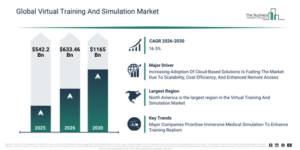
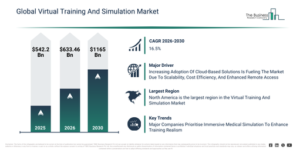
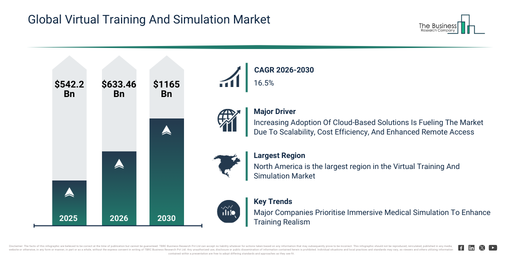
The virtual training and simulation market has experienced substantial growth in recent years. This market is projected to expand from $542.2 billion in 2025 to $633.46 billion in 2026, exhibiting a compound annual growth rate (CAGR) of 16.8%. Historically, this growth can be attributed to the early adoption of flight simulators, the utilization of digital training tools, increasing corporate training needs, the expansion of e-learning platforms, and a strong demand for safety-focused training.
The virtual training and simulation market is anticipated to experience substantial expansion over the coming years. Its valuation is projected to reach $1165 billion by 2030, exhibiting a compound annual growth rate (CAGR) of 16.5%.
This projected growth during the forecast period is driven by several factors, including the increasing spread of metaverse-based educational approaches, a rise in the uptake of virtual reality headsets, the need for economical training options, the expansion of remote operational models, and the incorporation of AI analytics into training programs.
Key developments expected in the forecast period encompass immersive platforms for skill-based training, learning environments that are risk-free due to simulations, AI-driven adaptive training modules, training solutions for remote and geographically dispersed workforces, and assessment of performance through data analysis.
Get Access To A Free Virtual Training And Simulation Market Report Sample:
The Key Driver Behind The Virtual Training And Simulation Market’s 16.5% CAGR
The future expansion of the virtual training and simulation market is anticipated to be driven by the rising uptake of cloud-based solutions. These solutions involve services, software, or systems hosted remotely and accessed via the internet, as opposed to being installed directly on individual hardware. The growing preference for cloud-based solutions stems mainly from their capacity to provide scalable infrastructure, enabling organizations to dynamically allocate resources according to demand, which in turn lowers operational expenses and boosts efficiency. Virtual training and simulation complement cloud solutions by offering scalable, real-time entry to engaging learning settings, which leads to enhanced performance, cost reductions, and better remote collaborative efforts. As an illustration, Eurostat, a government agency located in Luxembourg, reported that in December 2023, the proportion of businesses utilizing cloud computing services within the European Union saw an increase of 4.2 percentage points during 2023. Consequently, the expanding use of cloud-based solutions is fueling the development of the virtual training and simulation market.
Virtual Training And Simulation Market Classification: Main Segments And Detailed Subsegments
The virtual training and simulation market covered in this report is segmented –
1) By Component: Hardware, Software, Services
2) By Technology: Virtual Reality (VR), Augmented Reality (AR), Mixed Reality (MR), Artificial Intelligence (AI)
3) By Application: Corporate Training, Military Training, Aviation Training, Healthcare Training, Education And Academia
4) By End-user: Enterprises, Government And Defense, Educational Institutions, Healthcare Providers
Subsegments:
1) By Hardware: Head-Mounted Displays (HMDs), Motion Tracking Devices, Projectors And Display Walls, Simulators, Input Devices, Audio Devices, Haptic Devices
2) By Software: Simulation Software, Training Management Systems, Content Creation Software, Game Engines, Scenario Generation Software, Analytics And Reporting Tools
3) By Services: Training And Education Services, System Integration And Deployment, Consulting Services, Support And Maintenance Services, Managed Services
Virtual Training And Simulation Market Strategic Shifts: What Leading Players Are Prioritizing
Leading companies in the global virtual training and simulation market are concentrating on improving training efficacy through highly immersive VR simulation, particularly in virtual reality (VR) medical settings, to achieve a competitive edge. This fully immersive VR simulation describes training systems that recreate authentic, interactive 3D environments, enabling users to practice critical medical scenarios within a secure and managed space. The demand for immersive simulation is spurred by organizations’ desire for training that is repeatable, cost-efficient, and realistic. For example, in January 2023, SimX, a U.S.-based simulation company, released its VALOR Virtual Reality Medical Simulation System (VRMSS) under a U.S. Space Force contract. This system allows for high-fidelity astronaut recovery and space medicine training using wireless VR (HTC Focus 3), provides repeatable mission-specific medical scenarios, and facilitates multiplayer team training. As a result, immersive VR simulation is a significant driver of growth in the virtual training market.
Virtual Training And Simulation Market Company Analysis: Major Industry Participants
Major companies operating in the virtual training and simulation market are Raytheon Technologies Corporation, The Boeing Company, Lockheed Martin Corporation, International Business Machines Corporation (IBM), Oracle Corporation, BAE Systems, Thales Group, L3Harris Technologies Inc. (L3 Link Simulation & Training – Subsidiary), Rockwell Collins Inc., Rheinmetall AG, Elbit Systems Ltd., Saab AB, CAE Inc., QinetiQ Group plc, FlightSafety International Inc., Kratos Defense & Security Solutions Inc., Laerdal Medical Corporation, ON24 Inc., BMC Software Inc., The DiSTI Corporation, Cubic Corporation
Get Full Access To The Virtual Training And Simulation Market Report 2026:
Virtual Training And Simulation Market Global Regional Breakdown: Key Regions Analyzed
North America was the largest region in the virtual training and simulation market in 2025. Asia-Pacific is expected to be the fastest-growing region in the forecast period. The regions covered in the virtual training and simulation market report are Asia-Pacific, South East Asia, Western Europe, Eastern Europe, North America, South America, Middle East, Africa.
Reach Out To Our Team:
The Business Research Company: https://www.thebusinessresearchcompany.com/
Americas: +1 310-496-7795
Asia: +44 7882 955267 & +91 8897263534
Europe: +44 7882 955267
Email us at: marketing@tbrc.info
Follow us on:
LinkedIn: https://in.linkedin.com/company/the-business-research-company
YouTube: https://www.youtube.com/channel/UC24_fI0rV8cR5DxlCpgmyFQ
Global Market Model: https://www.thebusinessresearchcompany.com/global-market-model

Wasay has over a decade of experience in market research, data modelling, and analytics, with prior experience at GlobalData and Decision Tree Consulting Services. At The Business Research Company , he leads research operations across syndicated studies, customized consulting engagements, and the Global Market Model platform. His professional experience includes supporting organizations such as Boston Consulting Group, KPMG, and Ernst & Young. Wasay holds a degree in Electronics and Communications Engineering, postgraduate management qualifications from International Management Institute Belgium and Indian School of Business and Entrepreneurship, and completed the Integrated Program in Business Analytics from Indian Institute of Management Indore.