With a focus on actionable insights and strategic value, The Business Research Company’s 2026 market reports include market attractiveness scoring, total addressable market sizing, company benchmarking matrices, interactive Excel dashboards, deeper supply chain intelligence, emerging startup tracking, and granular product-level insights.
How Large Could The Wi-Fi as a Service Market Become By 2030 At A 19.5% CAGR?
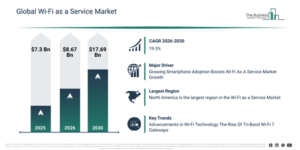
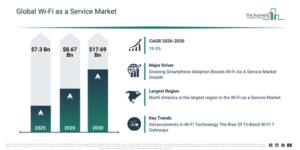
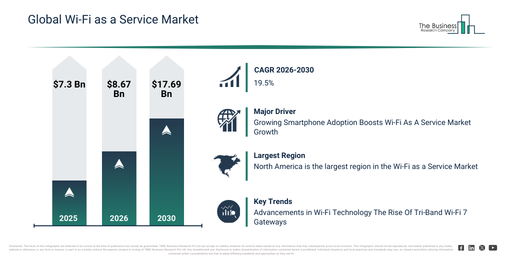
The wi-fi as a service market size has witnessed rapid expansion in recent years. This market is set to expand from $7.3 billion in 2025 to $8.67 billion in 2026, demonstrating a compound annual growth rate (CAGR) of 18.8%. The growth observed in previous periods is attributable to factors such as the increasing demand for managed network services, the rising adoption of cloud solutions by enterprises, a growing need for network security and compliance, the expansion of telecommunications and IT infrastructure, and the early implementation of remote network management tools.
The wi-fi as a service market size is anticipated to undergo significant expansion in the coming years. It is projected to increase to $17.69 billion in 2030, achieving a compound annual growth rate (CAGR) of 19.5%. This growth throughout the forecast period can be linked to the rise of subscription-based networking models, the expanding implementation of smart campuses and buildings, the increasing adoption of AI-enabled network management, the broadening of managed services offerings, and elevated demand from the education and healthcare sectors. Prominent trends for the forecast period include subscription-based wi-fi solutions, strengthened network security and compliance, cloud-integrated network management, remote monitoring and support services, and efficient wi-fi deployment at a lower cost.
Get A Free Wi-Fi as a Service Market Sample With 2030 Forecast Insights:
Wi-Fi as a Service Market Outlook: Key Driver Supporting Long-Term Growth
The expansion of the Wi-Fi-as-a-service market is expected to be driven by the rising adoption of smartphones. This refers to the increasing global usage of smartphones by both individuals and organizations. In smartphones, Wi-Fi as a service offers benefits such as faster internet speeds, cost-effectiveness, longer battery life, personal hotspots, and managed Wi-Fi services. For example, a report from February 2023 by the GSM Association (GSMA), a UK-based industry organization representing mobile network operators, projects a significant increase in smartphone penetration in sub-Saharan Africa, reaching 87% by 2030, compared to 51% in 2022. Therefore, the greater adoption of smartphones is a primary catalyst for the Wi-Fi-as-a-service market’s growth.
Segmentation Of The Wi-Fi as a Service Market: Key Categories Explained
The wi-fi as a service market covered in this report is segmented –
1) By Component: Professional Services, Managed Services
2) By Location Type: Indoor, Outdoor
3) By Enterprise Size: Large Enterprises, Small And Medium Enterprises (SMEs)
4) By End Use Industry: Telecom And IT, BFSI, Education, Healthcare, Hospitality, Transportation, Retail, Other End Users
Subsegments:
1) By Professional Services: Consulting And Design Services, Implementation And Deployment Services, Training Services
2) By Managed Services: Network Management, Monitoring And Support Services, Maintenance And Optimization Services
Wi-Fi as a Service Market Evolving Trends: What Businesses Should Know
Leading companies in the Wi-Fi as a service market are concentrating on developing tri-band Wi-Fi 7 gateways to enhance network performance, provide faster data speeds, and improve connectivity for multiple devices. Tri-band Wi-Fi 7 gateways refer to networking hardware that support three distinct frequency bands for wireless communication, typically including one 2.4 GHz band and two 5 GHz or 6 GHz bands. These devices are built on open industry standards and support TR-369 for management, ensuring compatibility with various devices and services. For instance, in October 2024, Nokia Oyj, an Indian-based telecommunications company, launched the Beacon 19, a new Wi-Fi 7 gateway designed to enhance home connectivity by providing high-capacity mesh networking. The Beacon 19 operates on three frequency bands, allowing it to deliver a maximum Wi-Fi capacity of up to 19 Gbps, which is over three times faster than Wi-Fi 6 devices.
Who Competes In The Wi-Fi as a Service Market? Major Companies Listed
Major companies operating in the wi-fi as a service market are Arista Networks Inc., Hewlett Packard Enterprise Company LP, Cisco Systems Inc., ViaSat Inc., Extreme Networks Inc., Commscope Inc., Aerohive Networks, Inc, Mojo Networks, Inc., Fortinet, Inc., Huawei Technologies Co. Ltd., Ubiquiti Inc., Mist Systems, Cambium Networks Corporation, ADTRAN, Inc., D-Link Corporation, EnGenius Technologies, Inc., Firetide, Inc., Motorola Solutions, Inc., NETGEAR, Inc., Proxim Wireless Corporation, Redline Communications Group Inc., Siemens AG, SonicWall Inc., WatchGuard Technologies Inc., Zebra Technologies Corporation, Zyxel Communications Corporation, Nokia Corporation, Allied Telesis, Inc., Avaya Inc., Brocade Communications Systems, Inc., Dell Technologies Inc.
Read The Complete Wi-Fi as a Service Market Forecast Report Through 2030:
Wi-Fi as a Service Market Regional Ranking: Which Geography Comes First?
North America was the largest region in the Wi-Fi as a service market in 2025. The regions covered in the wi-fi as a service market report are Asia-Pacific, South East Asia, Western Europe, Eastern Europe, North America, South America, Middle East, Africa.
Reach Out To Our Team:
The Business Research Company: https://www.thebusinessresearchcompany.com/
Americas: +1 310-496-7795
Asia: +44 7882 955267 & +91 8897263534
Europe: +44 7882 955267
Email us at: marketing@tbrc.info
Follow us on:
LinkedIn: https://in.linkedin.com/company/the-business-research-company
YouTube: https://www.youtube.com/channel/UC24_fI0rV8cR5DxlCpgmyFQ
Global Market Model: https://www.thebusinessresearchcompany.com/global-market-model

Wasay has over a decade of experience in market research, data modelling, and analytics, with prior experience at GlobalData and Decision Tree Consulting Services. At The Business Research Company , he leads research operations across syndicated studies, customized consulting engagements, and the Global Market Model platform. His professional experience includes supporting organizations such as Boston Consulting Group, KPMG, and Ernst & Young. Wasay holds a degree in Electronics and Communications Engineering, postgraduate management qualifications from International Management Institute Belgium and Indian School of Business and Entrepreneurship, and completed the Integrated Program in Business Analytics from Indian Institute of Management Indore.