Market attractiveness scoring, total addressable market sizing, company benchmarking matrices, interactive Excel dashboards, deeper supply chain intelligence, emerging startup tracking, and granular product-level insights are among the key offerings featured in The Business Research Company’s 2026 market reports, designed to deliver more actionable and strategically valuable research.
Wi-Fi Thermostat Market Growth Outlook: How Much Bigger Will The Market Be By 2030?
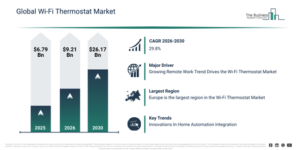
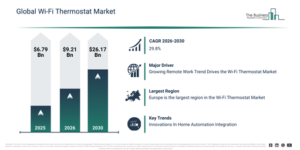
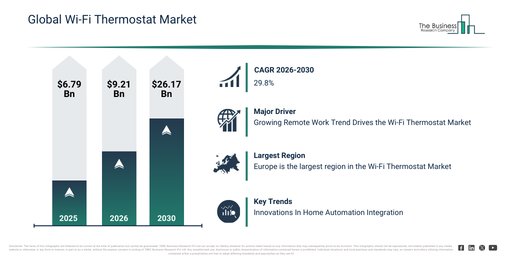
The wi-fi thermostat market has shown substantial growth in recent years. This market is anticipated to expand from $6.79 billion in 2025 to $9.21 billion in 2026, exhibiting a compound annual growth rate (CAGR) of 35.7%. The expansion observed historically can be ascribed to several factors, including the increasing integration of smart home devices, a rise in residential HVAC system installations, heightened consumer consciousness regarding energy management, the proliferation of broadband internet, and the accessibility of mobile-based control platforms.
The wi-fi thermostat market is predicted to undergo significant expansion over the next few years, with projections indicating it will reach $26.17 billion in 2030, expanding at a compound annual growth rate (CAGR) of 29.8%. This growth during the forecast period is fueled by a heightened emphasis on energy conservation, the increasing adoption of smart building solutions, broader integration with voice assistants, the expansion of IoT-enabled home automation, and rising demand from commercial facilities. Noteworthy trends anticipated in this period include the increased uptake of remote HVAC control systems, a growing need for energy-efficient temperature management, wider use of app-based climate control interfaces, the evolution of learning and adaptive thermostat features, and enhanced integration with smart home ecosystems.
Request A Free Wi-Fi Thermostat Market Sample From The Business Research Company:
How Is The Key Growth Driver Influencing The Wi-Fi Thermostat Market?
The increasing prevalence of remote work is anticipated to fuel the expansion of the Wi-Fi thermostat market. Remote work is characterized as a flexible employment arrangement where individuals perform their job duties from a location outside their employer’s main office. This growing adoption of remote work is driven by advancements in digital communication and collaboration tools, which enable employees to work efficiently from anywhere, thereby enhancing flexibility and productivity. A Wi-Fi thermostat aids remote work by allowing users to remotely control and schedule their home or office temperature, thus ensuring a comfortable environment that supports focus and productivity. For instance, according to reports from the U.S. Bureau of Labor Statistics, published by Forbes Media LLC in June 2023, 34.0 million people aged 25 and older worked from home or teleworked for pay in the first quarter of 2024. This marked an increase of 5.0 million compared to the previous year and represented 24.9% of all working individuals aged 25 and older, up from 21.5% a year earlier. Therefore, the expanding adoption of remote work is a significant driver for the growth of the Wi-Fi thermostat market.
Wi-Fi Thermostat Market Segmentation By Category: What Does The 2026 Report Cover?
The wi-fi thermostat market covered in this report is segmented –
1) By Type: Learning, Non-Learning
2) By Technology: Wired, Wireless
3) By Application: Residential, Commercial
Subsegments:
1) By Learning: Self-learning Thermostats, App-Controlled Learning Thermostats
2) By Non-Learning: Manual Control Thermostats, Programmable Non-learning Thermostats
How Are Industry Players Changing The Wi-Fi Thermostat Market Landscape?
Leading firms within the Wi-Fi Thermostat market are concentrating on creating advanced solutions, particularly smart thermostats. These innovations aim to boost energy efficiency, enable remote climate management, connect with existing home automation setups, and deliver tailored user experiences through artificial intelligence-powered learning and mobile application access. Defined as a sophisticated heating, ventilation, and air conditioning (HVAC) unit, a smart thermostat enables individuals to remotely manage and schedule their home or building’s temperature, achievable through various internet-enabled devices like smartphones, tablets, or personal computers. As an illustration, in January 2025, Resideo Technologies, a US-headquartered company specializing in home automation and smart technology, introduced the Honeywell Home X2S Smart Thermostat. This inventive product significantly improves both domestic comfort and energy stewardship. The Honeywell Home X2S is equipped with an easy-to-use touchscreen interface, compatibility with widely used voice assistants, automatic scheduling capabilities, and sophisticated algorithms designed for energy conservation. Furthermore, it offers remote oversight and operation via a dedicated mobile application, empowering users to efficiently regulate energy use and effortlessly keep their desired indoor temperatures. Tailored for residential use, this device delivers increased convenience, economic advantages through cost savings, and superior energy efficiency when contrasted with traditional thermostat models.
Wi-Fi Thermostat Market Global Key Players And Competitive Overview
Major companies operating in the wi-fi thermostat market are Google LLC, Robert Bosch GmbH, Siemens AG, Schneider Electric SE, Honeywell International Inc., Johnson Controls International PLC, Carrier Global Corporation, Trane Technologies, Emerson Electric Co., Resideo Technologies, Alarm.com, Ecobee Inc., GridPoint Inc, Thermokon Sensortechnik GmbH, Tado GmbH, Warmup plc, Mysa Innovation Private Limited, Rointe, Lux Products Corporation, Salus Controls PLC, Heatmiser UK Ltd, Sinopé Technologies, Cielo WiGle Inc, Radio Thermostat Company of America, Zen Ecosystems Inc., Secure Meters (UK) Limited, Climote
Explore Comprehensive Wi-Fi Thermostat Market Coverage In The Full Report:
Regional Analysis Of The Wi-Fi Thermostat Market: Where Is The Industry Concentrated?
Europe was the largest region in the Wi-Fi thermostat market in 2025. Asia-Pacific is expected to be the fastest-growing region in the forecast period. The regions covered in the wi-fi thermostat market report are Asia-Pacific, South East Asia, Western Europe, Eastern Europe, North America, South America, Middle East, Africa.
Reach Out To Our Team:
The Business Research Company: https://www.thebusinessresearchcompany.com/
Americas: +1 310-496-7795
Asia: +44 7882 955267 & +91 8897263534
Europe: +44 7882 955267
Email us at: marketing@tbrc.info
Follow us on:
LinkedIn: https://in.linkedin.com/company/the-business-research-company
YouTube: https://www.youtube.com/channel/UC24_fI0rV8cR5DxlCpgmyFQ
Global Market Model: https://www.thebusinessresearchcompany.com/global-market-model

Wasay has over a decade of experience in market research, data modelling, and analytics, with prior experience at GlobalData and Decision Tree Consulting Services. At The Business Research Company , he leads research operations across syndicated studies, customized consulting engagements, and the Global Market Model platform. His professional experience includes supporting organizations such as Boston Consulting Group, KPMG, and Ernst & Young. Wasay holds a degree in Electronics and Communications Engineering, postgraduate management qualifications from International Management Institute Belgium and Indian School of Business and Entrepreneurship, and completed the Integrated Program in Business Analytics from Indian Institute of Management Indore.