The Business Research Company’s 2026 market reports are designed to deliver research that is more actionable and strategically valuable. Key offerings include market attractiveness scoring, total addressable market sizing, company benchmarking matrices, interactive Excel dashboards, deeper supply chain intelligence, emerging startup tracking, and granular product-level insights.
Virtual Influencers Market Revenue Projected To Rise To $62.67 Billion By 2030
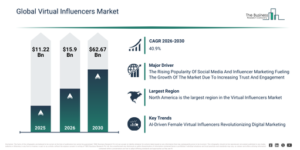
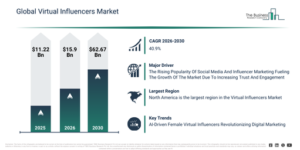
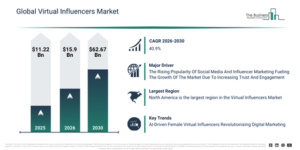
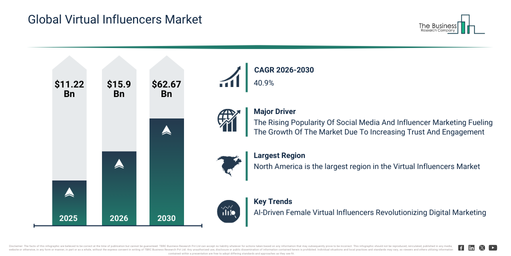
The virtual influencers market has witnessed substantial growth in recent times. Its value is projected to rise from $11.22 billion in 2025 to $15.9 billion in 2026, achieving a compound annual growth rate (CAGR) of 41.7%. Key factors contributing to its past expansion include the early adoption of digital marketing strategies, the proliferation of social media platforms, a rise in influencer marketing investments, enhanced consumer engagement metrics, and advancements in 3D modeling and animation tools.
The virtual influencers market is anticipated to experience substantial expansion over the next few years. It is projected to reach $62.67 billion by 2030, exhibiting a compound annual growth rate (CAGR) of 40.9%. This growth during the forecast period can be attributed to factors such as the proliferation of AI-powered avatars, their integration with immersive technologies, the rise of e-commerce personalization, increasing adoption of virtual customer service, and greater brand investments in digital experiences. Key trends expected in this period encompass the development of social media engagement strategies, the emergence of brand-managed digital personas, the expansion of virtual entertainment platforms, the incorporation of AI-generated content into marketing, and a growing consumer acceptance of non-human influencers.
Want Deeper Virtual Influencers Market Insights? Get A Free Sample Report:
Primary Growth Driver Shaping The Virtual Influencers Market Outlook
The increasing popularity of social media and influencer marketing is projected to drive the expansion of the virtual influencers market moving forward. This strategy encompasses utilizing social media platforms and influential individuals to endorse products, services, or brands. Its growth is largely due to consumers placing more trust in influencers’ opinions compared to traditional advertisements, thereby increasing their propensity to purchase. Virtual influencers enhance social media and influencer marketing by giving brands full command over their messaging, ensuring content consistency, and enabling audience engagement free from the common risks linked with human influencers. Consequently, the rising prominence of social media and influencer marketing is a key driver for the virtual influencers market.
Virtual Influencers Market Structure: A Detailed Look At Segments And Subsegments
The virtual influencers market covered in this report is segmented –
1) By Type: Virtual Humans, Animated Characters, Artificial Intelligence-Driven Avatars
2) By Deployment: Social Media Platforms, Brand Websites, E-Commerce Platforms
3) By Application: Product Marketing, Customer Service, Brand Storytelling, Entertainment
4) By End User: Consumer Goods And Retail, Fashion And Beauty, Technology And Software, Travel And Hospitality
Subsegments:
1) By Virtual Humans: AI-Powered Digital Models, Social Media Personalities, Brand Ambassadors, Digital Customer Service Representatives
2) By Animated Characters: 2D Animated Influencers, 3D CGI Characters, Cartoon-Style Avatars, Fantasy And Sci-Fi Characters
3) By Artificial Intelligence-Driven Avatars: Conversational AI Avatars, Virtual Brand Representatives, Interactive Gaming Avatars, Personalized AI Assistants
Virtual Influencers Market Innovation And Strategy Trends Among Leading Companies
Major companies within the virtual influencers market are prioritizing advancements in artificial intelligence and machine learning, such as the development of female virtual influencers, to elevate realism, engagement, and interactivity. This enables the creation of more personalized and adaptive content for marketing and brand collaborations. A female virtual influencer refers to an AI-powered, computer-generated digital character designed to resemble a human female.
Top Companies Competing In The Virtual Influencers Market
Major companies operating in the virtual influencers market are Meta Platforms Inc., LG Uplus Corp., Magazine Luiza S.A., SM Entertainment Co. Ltd., Balmain S.A., The Diigitals, Hololive Production, Superplastic Inc., Aww Inc., UneeQ Limited, Brud Inc., FUTR Studios Ltd., InfluencerFarm, AvatarOS, SynthLife, Virtual Humans Inc., Genies Inc., Soul Machines Ltd., Pinscreen Inc., Wolf3D OÜ, Hour One AI Ltd., Ready Player Me
View The Complete Virtual Influencers Market Study With Segment And Regional Data:
Virtual Influencers Market Regional Outlook Across Major Geographies
North America was the largest region in the virtual influencers market in 2025. Asia-Pacific is expected to be the fastest-growing region in the forecast period. The regions covered in the virtual influencers market report are Asia-Pacific, South East Asia, Western Europe, Eastern Europe, North America, South America, Middle East, Africa.
Reach Out To Our Team:
The Business Research Company: https://www.thebusinessresearchcompany.com/
Americas: +1 310-496-7795
Asia: +44 7882 955267 & +91 8897263534
Europe: +44 7882 955267
Email us at: marketing@tbrc.info
Follow us on:
LinkedIn: https://in.linkedin.com/company/the-business-research-company
YouTube: https://www.youtube.com/channel/UC24_fI0rV8cR5DxlCpgmyFQ
Global Market Model: https://www.thebusinessresearchcompany.com/global-market-model

Wasay has over a decade of experience in market research, data modelling, and analytics, with prior experience at GlobalData and Decision Tree Consulting Services. At The Business Research Company , he leads research operations across syndicated studies, customized consulting engagements, and the Global Market Model platform. His professional experience includes supporting organizations such as Boston Consulting Group, KPMG, and Ernst & Young. Wasay holds a degree in Electronics and Communications Engineering, postgraduate management qualifications from International Management Institute Belgium and Indian School of Business and Entrepreneurship, and completed the Integrated Program in Business Analytics from Indian Institute of Management Indore.