With a focus on actionable insights and strategic value, The Business Research Company’s 2026 market reports include market attractiveness scoring, total addressable market sizing, company benchmarking matrices, interactive Excel dashboards, deeper supply chain intelligence, emerging startup tracking, and granular product-level insights.
How Much Will The Vertical Market Be Worth By 2030?
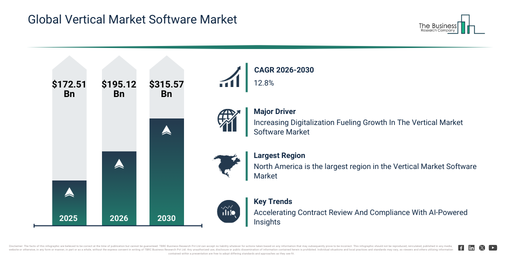
The vertical market software market size has seen rapid expansion in recent years. It is anticipated to increase from $172.51 billion in 2025 to $195.12 billion in 2026, achieving a compound annual growth rate (CAGR) of 13.1%. This historical growth can be attributed to several factors, including the proliferation of sector-specific regulatory requirements, the accelerating digital transformation across diverse industries, a heightened demand for bespoke enterprise solutions, the broader adoption of cloud computing, and elevated investments in enterprise software.
The vertical market software market is projected to experience substantial expansion in the coming years. By 2030, its size is anticipated to reach $315.57 billion, exhibiting a compound annual growth rate (CAGR) of 12.8%. This projected growth during the forecast period is primarily driven by several factors, including the rising demand for scalable vertical software platforms, the increasing embrace of data-driven decision tools, the proliferation of AI-powered industry applications, a heightened emphasis on interoperability with existing legacy systems, and growing financial commitments to industry-specific digital ecosystems. Key trends identified for this period encompass a surge in demand for industry-specific SaaS solutions, the increasing uptake of cloud-based vertical platforms, the expanding integration of AI-driven workflows across industries, the development of compliance-focused software solutions, and a stronger emphasis on automating processes for specialized industries.
Get Access To A Free Vertical Market Report Sample:
The Key Driver Behind The Vertical Market’s 12.8% CAGR
The increasing digitization is anticipated to drive the vertical software market growth moving forward. Digitalization is characterized as the application of digital technologies to transform various processes, activities, or assets into a digital format. Its expansion stems from its capability to streamline operations, boost efficiency, enhance accessibility, and create new avenues for innovation and growth across diverse sectors. Digitalization empowers vertical market software by enabling more efficient processes, advanced data analytics, and improved customer engagement to effectively address specific industry requirements. For instance, in September 2024, the United Nations Department of Economic and Social Affairs (UN DESA), a US-based international organization responsible for monitoring global digital government development, reported that the percentage of the global population lagging in digital government development decreased from 45.0% in 2022 to 22.4% in 2024. Consequently, the rising digitization is fueling the growth of the vertical market software market.
Vertical Market Classification: Main Segments And Detailed Subsegments
The vertical market software market covered in this report is segmented –
1) By Software Type: Banking Software, Education Software, Legal Software, Agriculture Software, Alumni Management Software, Amusement Park Software, Apparel Software, Architecture Software, Other Software Types
2) By Deployment: Cloud-Based, On-Premise
3) By Enterprise Size: Small And Medium Enterprises, Large Enterprises
4) By Industry Vertical: Banking, Financial Services And Insurance (BFSI), Manufacturing, Retail, Healthcare, Information Technology (IT) And Telecommunication, Other Industry Verticals
Subsegments:
1) By Banking Software: Core Banking Software, Mobile Banking Software, Loan Management Software, Payment Processing Software, Risk Management Software, Fraud Detection Software, Trading And Investment Software
2) By Education Software: Learning Management Systems (LMS), Student Information Systems (SIS), Virtual Classroom Software, Exam Management Software, E-Learning Content Software, School Administration Software
3) By Legal Software: Case Management Software, Document Management Software, Legal Research Software, Billing And Invoicing Software, Time Tracking Software, Contract Management Software
4) By Agriculture Software: Farm Management Software, Crop Management Software, Livestock Management Software, Agricultural Supply Chain Management Software, Precision Farming Software, Irrigation Management Software
5) By Alumni Management Software: Alumni Database Management Software, Event Management Software, Fundraising And Donation Software, Alumni Engagement Platforms, Networking Software
6) By Amusement Park Software: Ticketing And Reservation Software, Visitor Management Software, Ride Management Software, Queue Management Software, Park Operations Software
7) By Apparel Software: Fashion Design Software, Apparel Manufacturing Software, Inventory Management Software, Supply Chain Management Software, Retail POS Software
8) By Architecture Software: Computer-Aided Design (CAD) Software, Building Information Modeling (BIM) Software, 3D Modeling Software, Project Management Software, Structural Analysis Software
9) By Other Software Types: Healthcare Software, Real Estate Software, Automotive Software, Energy And Utilities Software, Hospitality Management Software, Retail Management Software, Hr Management Software
Vertical Market Strategic Shifts: What Leading Players Are Prioritizing
Major companies operating in the vertical software market are increasingly focusing on deploying innovative technologies such as artificial intelligence-based automation and analytics to optimize industry-specific workflows and improve decision-making processes. Artificial intelligence-based automation and analytics involves utilizing AI to autonomously execute routine operations and analyze data, which helps businesses conserve time, minimize inaccuracies, and arrive at more intelligent, prompt decisions. A relevant example occurred in March 2024, when Wolters Kluwer N.V., a professional software provider based in the Netherlands, launched enhanced AI-powered contract-management capabilities for Legisway. This advanced functionality automates contract evaluations, facilitates natural-language querying, identifies risks, and integrates audit workflows alongside collaboration features, thereby enabling legal teams to manage their contract portfolios more efficiently.
Vertical Market Company Analysis: Major Industry Participants
Major companies operating in the vertical market software market are McKesson Corporation, Siemens AG, IBM, Oracle Corporation, SAP SE, Salesforce Inc., Intuit Inc., Constellation Software, Dassault Systèmes SE, Autodesk Inc., Paychex Inc., Epic Systems Corporation, Sage Group plc, Verisk Analytics Inc., Veeva Systems Inc., Tyler Technologies Inc., Infor, Aptean, Epicor Software, Wolters Kluwer, SYSPRO Corp, Granular Inc, ROLLER Software, Guidewire Software, Procore Technologies Inc.
Get Full Access To The Vertical Market Report 2026:
Vertical Market Global Regional Breakdown: Key Regions Analyzed
North America was the largest region in the vertical market software market in 2025. Asia-Pacific is expected to be the fastest-growing region in the forecast period. The regions covered in the vertical market software market report are Asia-Pacific, South East Asia, Western Europe, Eastern Europe, North America, South America, Middle East, Africa.
Reach Out To Our Team:
The Business Research Company: https://www.thebusinessresearchcompany.com/
Americas: +1 310-496-7795
Asia: +44 7882 955267 & +91 8897263534
Europe: +44 7882 955267
Email us at: marketing@tbrc.info
Follow us on:
LinkedIn: https://in.linkedin.com/company/the-business-research-company
YouTube: https://www.youtube.com/channel/UC24_fI0rV8cR5DxlCpgmyFQ
Global Market Model: https://www.thebusinessresearchcompany.com/global-market-model

Wasay has over a decade of experience in market research, data modelling, and analytics, with prior experience at GlobalData and Decision Tree Consulting Services. At The Business Research Company , he leads research operations across syndicated studies, customized consulting engagements, and the Global Market Model platform. His professional experience includes supporting organizations such as Boston Consulting Group, KPMG, and Ernst & Young. Wasay holds a degree in Electronics and Communications Engineering, postgraduate management qualifications from International Management Institute Belgium and Indian School of Business and Entrepreneurship, and completed the Integrated Program in Business Analytics from Indian Institute of Management Indore.