Designed to make market research more actionable and strategically valuable, The Business Research Company’s 2026 market reports feature market attractiveness scoring, total addressable market sizing, company benchmarking matrices, interactive Excel dashboards, deeper supply chain intelligence, emerging startup tracking, and granular product-level insights.
What Is The Projected CAGR Of The Automotive 3D Printing Market Through 2030?
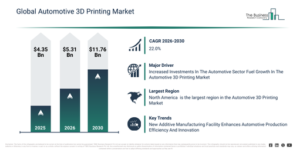
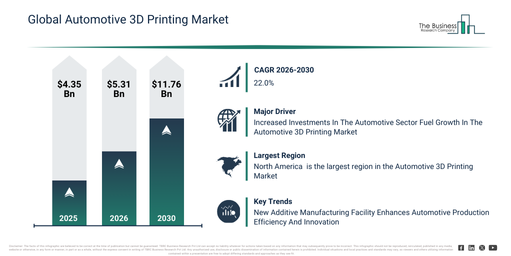
The automotive 3d printing market has seen substantial growth in recent years. Its valuation is expected to rise from $4.35 billion in 2025 to $5.31 billion in 2026, achieving a compound annual growth rate (CAGR) of 21.9%. This past expansion can be linked to factors such as the increase in automotive prototyping, a heightened demand for design versatility, the growth of motorsport and performance vehicle manufacturing, the implementation of rapid tooling, and the initial integration of additive manufacturing technologies.
The automotive 3d printing market is projected to experience substantial expansion in the coming years. This market is predicted to reach $11.76 billion by 2030, exhibiting a compound annual growth rate (CAGR) of 22.0%. This anticipated growth during the forecast period stems from factors such as increased investments in electric vehicle manufacturing, a surging need for lightweight vehicle components, the broadening of digital manufacturing approaches, the expanding use of metal 3D printing, and an intensified focus on supply chain resilience. Key trends expected over this period involve a greater embrace of additive manufacturing for functional components, the growing utilization of designs for lightweight and intricate parts, the increasing integration of 3D printing into production processes, the expansion of on-demand and localized manufacturing capabilities, and an elevated emphasis on rapid prototyping and tooling.
Claim Your Free Automotive 3D Printing Market Sample Report With Key Data And Trends:
Automotive 3D Printing Market Demand Analysis: The Driving Force Behind Expansion
The increasing financial allocations within the automotive sector are anticipated to fuel the expansion of the automotive 3D printing market moving forward. These investments involve dedicating capital or financial assets into various segments of the automotive industry, with the goal of generating financial returns. Such allocations benefit automotive 3D printing by enhancing the demand for 3D printed components, providing funds for research and development in 3D printing technology, and leveraging its advantages, ranging from customization to sustainability and cost-efficiency.
Breaking Down The Automotive 3D Printing Market By Segment
The automotive 3d printing market covered in this report is segmented –
1) By Component: Interior components, Exterior components
2) By Vehicle Type: ICE vehicles, Electric vehicles
3) By Material: Metals, Plastic, Composites and Resins
4) By Application: Prototyping And Tooling, Research, Development And Innovation, Manufacturing Complex Components
5) By Technology: Stereolithography (SLA), Selective Laser Sintering (SLS), Electron Beam Melting (EBM), Fused Deposition Modeling (FDM), Laminated Object Manufacturing (LOM), Three-Dimensional Inject Printing
Subsegments:
1) By Interior Components: Dashboard Components, Seating Components, Trim and Paneling, Console Parts, HVAC Ducts
2) By Exterior Components: Body Panels, Bumpers, Grilles, Mirror Housings, Lighting Fixtures
Top Trend Influencing The Automotive 3D Printing Market Outlook
Key players in the automotive 3D printing market are prioritizing the development of innovative advancements, such as specialized automotive 3D printing facilities. These facilities are designed to optimize production workflows, improve customization options, and support the manufacturing of future electric vehicles. An automotive 3D printing facility serves as a dedicated hub, employing additive manufacturing techniques to precisely and efficiently design and produce custom components, tools, and production aids while optimizing material use.
Automotive 3D Printing Market Competitive Landscape And Major Players
Major companies operating in the automotive 3d printing market are 3D Systems Corporation, Desktop Metal Inc., Electro Optical Systems (EOS) GmbH, General Electric Company, EnvisionTEC GmbH, Stratasys Ltd., Materialise NV, Ultimaker BV, Voxeljet AG, Hoganas AB, SLM Solutions Group AG, Renishaw plc, Arcam AB, Optomec Inc., Carbon Inc., Hewlett-Packard Incorporated, Markforged Inc., Prodways Group, Beijing Long Yuan Automated Fabrication System Co. Ltd., Concept Laser GmbH, CRP Technology S.r.l., DWS Systems S.r.l., ExOne Company
Read The Full Automotive 3D Printing Market Report By The Business Research Company:
Where Is The Automotive 3D Printing Market Largest? Key Regional Insights
North America was the largest region in the automotive 3D printing market in 2025 and North America is expected to be the fastest-growing region in the automotive 3D printing market share forecast period. The regions covered in the automotive 3d printing market report are Asia-Pacific, South East Asia, Western Europe, Eastern Europe, North America, South America, Middle East, Africa
Reach Out To Our Team:
The Business Research Company: https://www.thebusinessresearchcompany.com/
Americas: +1 310-496-7795
Asia: +44 7882 955267 & +91 8897263534
Europe: +44 7882 955267
Email us at: marketing@tbrc.info
Follow us on:
LinkedIn: https://in.linkedin.com/company/the-business-research-company
YouTube: https://www.youtube.com/channel/UC24_fI0rV8cR5DxlCpgmyFQ
Global Market Model: https://www.thebusinessresearchcompany.com/global-market-model

Wasay has over a decade of experience in market research, data modelling, and analytics, with prior experience at GlobalData and Decision Tree Consulting Services. At The Business Research Company , he leads research operations across syndicated studies, customized consulting engagements, and the Global Market Model platform. His professional experience includes supporting organizations such as Boston Consulting Group, KPMG, and Ernst & Young. Wasay holds a degree in Electronics and Communications Engineering, postgraduate management qualifications from International Management Institute Belgium and Indian School of Business and Entrepreneurship, and completed the Integrated Program in Business Analytics from Indian Institute of Management Indore.