Designed to make market research more actionable and strategically valuable, The Business Research Company’s 2026 market reports feature market attractiveness scoring, total addressable market sizing, company benchmarking matrices, interactive Excel dashboards, deeper supply chain intelligence, emerging startup tracking, and granular product-level insights.
Solid Rocket Booster Market Revenue Expansion Outlook For The 2026–2030 Forecast Period
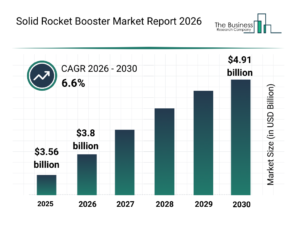
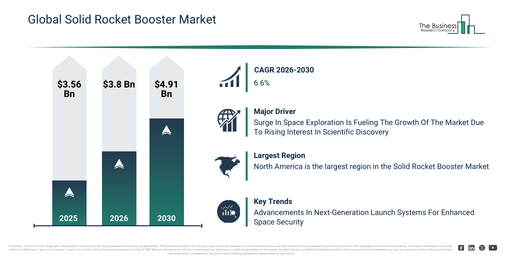
The solid rocket booster market has experienced strong expansion in recent years. This market is set to increase from $3.56 billion in 2025 to $3.8 billion in 2026, exhibiting a compound annual growth rate (CAGR) of 6.7%. The growth observed in the past can be ascribed to a number of factors, including the rising deployment of solid rocket boosters for delivering high initial thrust in key launch systems, the creation of advanced solid propellant formulations that enhance energy density and burn stability, the introduction of robust booster casings for improved structural resilience, developments in nozzle design leading to better thrust efficiency and thermal resistance, and the integration of thrust vector control systems to enhance launch vehicle steering capabilities.
The solid rocket booster market size is projected to undergo significant expansion in the coming years, with expectations to reach $4.91 billion in 2030, exhibiting a compound annual growth rate (CAGR) of 6.6%. This anticipated growth over the forecast period is primarily driven by several factors, including the expansion of commercial and government space launch programs, which is consequently increasing the demand for high-thrust boosters. Additionally, innovation in reusable booster technologies is reducing lifecycle costs and improving performance, while advancements in automated booster assembly are enhancing manufacturing precision. Rising investment in heavy-lift launch vehicles necessitates more powerful and scalable solid rocket booster (SRB) configurations, and the development of environmentally improved solid propellants supports sustainability and regulatory compliance. Prominent trends throughout the forecast period include advancements in high-energy composite propellants, the proliferation of commercial launch providers, an increasing shift toward reusable booster architectures, growing demand for precision thrust vector control technologies, and escalating government investment in national space programs.
Download A Free Sample For In-Depth Solid Rocket Booster Market Intelligence:
Solid Rocket Booster Market Demand Driver: How It Is Shaping Industry Growth
The expanding scope of space exploration is anticipated to boost the growth of the solid rocket booster market in the foreseeable future. Space exploration encompasses governmental and private ventures beyond Earth’s atmosphere, such as deploying satellites, undertaking lunar missions, and embarking on interplanetary voyages, all of which demand sophisticated propulsion systems. The surge in these missions is driven by a growing fascination with scientific discovery, pushing the boundaries of knowledge and technology. Solid rocket boosters are essential for providing the powerful initial thrust needed to launch spacecraft into orbit during space exploration, effectively overcoming Earth’s gravitational pull. For instance, in November 2023, the US International Trade Commission, a US-based federal government agency, reported that the number of annual global space launches peaked at 186 in 2022 and further increased in 2023, reaching a total of 197 launches. Therefore, the rise in space exploration is significantly contributing to the expansion of the solid rocket booster market.
Solid Rocket Booster Market Segmentation Overview: Detailed Category Analysis
The solid rocket booster market covered in this report is segmented –
1) By Type: Reusable, Expendable
2) By Propellant Type: Composite Propellant, Double-Base Propellant, Other Propellants
3) By Application: Space Launch Vehicles, Military Applications, Research And Development, Commercial Launches
4) By End-User: Government, Private Sector, Defense Contractors, Space Agencies
Subsegments:
1) By Reusable: Space Shuttle Boosters, Space Launch System Boosters, Commercial Reusable Boosters, Military Reusable Boosters
2) By Expendable: Satellite Launch Boosters, Ballistic Missile Boosters, Interplanetary Mission Boosters, Tactical Missile Boosters
Top Solid Rocket Booster Market Trends And Recent Industry Developments
Leading companies within the Solid Rocket Booster market are concentrating on developing innovative solutions, such as the next-generation Vulcan rocket, to improve launch efficiency, expand payload capacity, and enhance overall mission reliability for both commercial and defense space operations. The next-generation Vulcan rocket is a heavy-lift launch vehicle developed by United Launch Alliance (ULA), incorporating advanced solid rocket boosters, a reusable first-stage engine system, and expanded payload capabilities to deliver superior performance, cost efficiency, and mission flexibility for space launches. For instance, in August 2025, United Launch Alliance (ULA), a US-based launch services provider, successfully launched the USSF-106 mission for the United States Space Force using the Vulcan rocket equipped with advanced solid rocket boosters. The mission placed the Navigation Technology Satellite-3 (NTS-3) and a classified payload into geosynchronous orbit for the U.S. Space Force. NTS-3 is an advanced navigation satellite designed to test resilient, reprogrammable signals, electronically steerable antennas, and next-generation timekeeping technologies, aiming to enhance satellite navigation accuracy and resistance to interference. This mission marked the first national security space launch utilizing the Vulcan rocket, demonstrating its capability to support critical defense operations and reduce U.S. dependence on foreign engines, thereby strengthening national space security.
Solid Rocket Booster Market Company Landscape: Key Players To Watch
Major companies operating in the solid rocket booster market are The Boeing Company, Lockheed Martin Corporation, RTX Corporation, China Aerospace Science and Technology Corporation, Northrop Grumman Corporation, Mitsubishi Heavy Industries Ltd., Safran S.A., Thales S.A., Space Exploration Technologies Corp., Elbit Systems Ltd., Blue Origin LLC, Rafael Advanced Defense Systems Ltd., ArianeGroup SAS, Korea Aerospace Industries Ltd., Defence Research and Development Organisation, Sierra Nevada Corporation, Nammo AS, General Dynamics Ordnance and Tactical Systems Inc., United Launch Alliance LLC, Avio S.p.A., ISRO Propulsion Complex, Tata Advanced Systems Limited, Antrix Corporation Limited.
Explore The Solid Rocket Booster Global Market Report For Full Insights:
Solid Rocket Booster Market Region-Wise Analysis: Largest Regional Market Identified
North America was the largest region in the solid rocket booster market in 2025. The regions covered in the solid rocket booster market report are Asia-Pacific, South East Asia, Western Europe, Eastern Europe, North America, South America, Middle East, Africa.
Reach Out To Our Team:
The Business Research Company: https://www.thebusinessresearchcompany.com/
Americas: +1 310-496-7795
Asia: +44 7882 955267 & +91 8897263534
Europe: +44 7882 955267
Email us at: marketing@tbrc.info
Follow us on:
LinkedIn: https://in.linkedin.com/company/the-business-research-company
YouTube: https://www.youtube.com/channel/UC24_fI0rV8cR5DxlCpgmyFQ
Global Market Model: https://www.thebusinessresearchcompany.com/global-market-model

Wasay has over a decade of experience in market research, data modelling, and analytics, with prior experience at GlobalData and Decision Tree Consulting Services. At The Business Research Company , he leads research operations across syndicated studies, customized consulting engagements, and the Global Market Model platform. His professional experience includes supporting organizations such as Boston Consulting Group, KPMG, and Ernst & Young. Wasay holds a degree in Electronics and Communications Engineering, postgraduate management qualifications from International Management Institute Belgium and Indian School of Business and Entrepreneurship, and completed the Integrated Program in Business Analytics from Indian Institute of Management Indore.