With a focus on actionable insights and strategic value, The Business Research Company’s 2026 market reports include market attractiveness scoring, total addressable market sizing, company benchmarking matrices, interactive Excel dashboards, deeper supply chain intelligence, emerging startup tracking, and granular product-level insights.
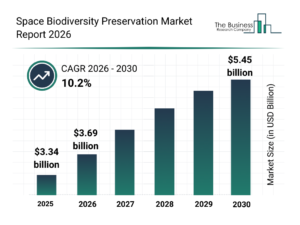
Space Biodiversity Preservation Market Size Outlook: A $5.45 Billion Market By 2030, Growing At 10.2% Annually
The space biodiversity preservation market size has experienced rapid expansion in recent years. It is projected to grow from $3.34 billion in 2025 to $3.69 billion in 2026, at a compound annual growth rate (CAGR) of 10.5%. The growth observed historically can be attributed to the early development of satellite-based biodiversity monitoring systems, advancements in remote sensing technologies for ecological assessment, increased government funding for space-based environmental research, initial experiments focusing on organism adaptation and survival in microgravity environments, and the emergence of geospatial data platforms that supported early conservation planning.
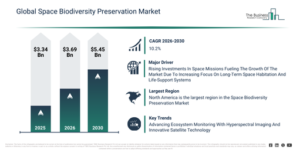
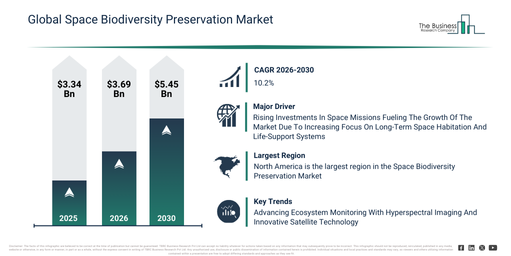
The space biodiversity preservation market is anticipated to experience substantial expansion over the upcoming years. Its valuation is projected to reach $5.45 billion by 2030, growing at a compound annual growth rate (CAGR) of 10.2%. This growth during the forecast period is fueled by several factors, such as the proliferation of satellite constellations dedicated to observing extraterrestrial ecosystems, the integration of artificial intelligence and spatial analytics for effective predictive conservation strategies, increasing investments in initiatives promoting the long-term sustainability of space habitats, the development of advanced equipment for monitoring off-earth environments, and greater collaboration between space agencies and biotechnology firms for research on species adapted to space. Prominent trends expected in this period encompass the broadening of space-based biodiversity observation missions, a rise in funding for extraterrestrial genetic resource banks, the incorporation of both in-situ and ex-situ conservation approaches for space habitats, the standardization of data formats and protocols for space biodiversity, and an increase in public-private partnerships aimed at long-term preservation of off-earth ecosystems.
Make Data-Driven Decisions With A Free Space Biodiversity Preservation Market Sample Report:
Key Demand Driver Expected To Lift Space Biodiversity Preservation Market Revenue
Growing financial commitments to space missions are anticipated to drive the expansion of the space biodiversity preservation market in the future. These missions constitute structured endeavors conducted outside Earth’s atmosphere, utilizing spacecraft or satellites for purposes such as exploration, scientific inquiry, or technological progress. The escalating investments in space missions stem from the quest for sophisticated technologies that enhance national security, foster scientific discoveries, and create economic opportunities. Such expanding investments in space missions support space biodiversity preservation through facilitating the creation of technologies and habitats designed to safeguard and investigate life in extraterrestrial environments. For example, in March 2024, the National Aeronautics and Space Administration, a US-based independent agency, reported that NASA’s budget is projected to increase from $25.384 billion in 2024 to $26.40 billion by 2027. Consequently, the growing investments in space missions are propelling the expansion of the space biodiversity preservation market.
Exploring The Space Biodiversity Preservation Market Through Its Key Segments
The space biodiversity preservation market covered in this report is segmented –
1) By Technology: Cryopreservation, Seed Banks, Genetic Engineering, Other Technologies
2) By Application: Space Missions, Space Colonization, Research And Development, Other Applications
3) By End-User: Government Agencies, Private Space Companies, Research Institutions, Other End Users
Subsegments:
1) By Cryopreservation: Embryo Cryopreservation, Sperm And Egg Cell Preservation, Tissue Cryobanking, Plant Cell And Seed Cryostorage, Cryogenic Freezers And Storage Systems
2) By Seed Banks: Space-Based Seed Storage, Heritage Crop Seed Collections, Genetically Modified Seed Vaults, Automated Seed Retrieval Systems, Climate-Resilient Seed Libraries.
3) By Genetic Engineering: Gene Editing, Synthetic Biology Applications, Transgenic Organism Development, Genomic Data Storage And Analysis, Bioinformatics Platforms For Biodiversity
4) By Other Technologies: Bio-Encapsulation And Biobanking, In Vitro Propagation, Microgravity Biological Preservation Systems, Artificial Intelligence In Biodiversity Management, Robotic Sample Handling Systems
New Trends Redefining Competition In The Space Biodiversity Preservation Market
Leading companies within the space biodiversity preservation market are concentrating on developing sophisticated solutions, such as high-definition hyperspectral cameras, to enhance ecosystem monitoring, refine species-specific data resolution, and support actionable conservation strategies. A high-definition hyperspectral camera is an advanced imaging device that captures data across hundreds to thousands of narrow, contiguous spectral bands, extending far beyond the capabilities of 3-color RGB or typical multispectral sensors. For instance, in August 2024, Lemu, a Chile-based technology company, launched Lemu Nge. This 6U hyperspectral nanosatellite is the first satellite globally designed exclusively to monitor Earth’s biodiversity. Outfitted with a high-definition hyperspectral camera, it provides over 20 times the resolution of traditional Earth observation satellites, enabling detailed analysis of vegetation and land cover. Positioned in Low Earth Orbit (LEO), it collects vital data on ecosystems, land use, and species distribution, playing a crucial role in advancing global conservation efforts and addressing the biodiversity data gap.
Space Biodiversity Preservation Market Competition: Key Players And Industry Participants
Major companies operating in the space biodiversity preservation market are Maxar Technologies Inc., Planet Labs PBC, ICEYE Ltd., EarthDaily Analytics Inc., Spire Global Inc., Pixxel Space Technologies Pvt. Ltd., Satsure Pvt. Ltd., Pachama Inc., GeoVille GmbH, NorthStar Earth & Space Inc., Asterra Inc., Satellogic Inc., SkyWatch Space Inc., Eleaf, Satelligence B.V., Farmonaut Pvt. Ltd., Genvision Geo Pvt. Ltd., PlanetWatchers Ltd., LiveEO Inc., Spottitt GmbH.
Get The Detailed Space Biodiversity Preservation Market Research Report Here:
Space Biodiversity Preservation Market Regional Overview: Largest Market And Global Coverage
North America was the largest region in the space biodiversity preservation market in 2025. The regions covered in the space biodiversity preservation market report are Asia-Pacific, South East Asia, Western Europe, Eastern Europe, North America, South America, Middle East, Africa.
Reach Out To Our Team:
The Business Research Company: https://www.thebusinessresearchcompany.com/
Americas: +1 310-496-7795
Asia: +44 7882 955267 & +91 8897263534
Europe: +44 7882 955267
Email us at: marketing@tbrc.info
Follow us on:
LinkedIn: https://in.linkedin.com/company/the-business-research-company
YouTube: https://www.youtube.com/channel/UC24_fI0rV8cR5DxlCpgmyFQ
Global Market Model: https://www.thebusinessresearchcompany.com/global-market-model

Wasay has over a decade of experience in market research, data modelling, and analytics, with prior experience at GlobalData and Decision Tree Consulting Services. At The Business Research Company , he leads research operations across syndicated studies, customized consulting engagements, and the Global Market Model platform. His professional experience includes supporting organizations such as Boston Consulting Group, KPMG, and Ernst & Young. Wasay holds a degree in Electronics and Communications Engineering, postgraduate management qualifications from International Management Institute Belgium and Indian School of Business and Entrepreneurship, and completed the Integrated Program in Business Analytics from Indian Institute of Management Indore.