With a focus on actionable insights and strategic value, The Business Research Company’s 2026 market reports include market attractiveness scoring, total addressable market sizing, company benchmarking matrices, interactive Excel dashboards, deeper supply chain intelligence, emerging startup tracking, and granular product-level insights.
Energy Efficient Devices Market Size Snapshot: 2026 Valuation, 2030 Projection And Key Growth Factors
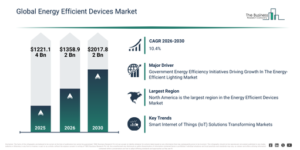
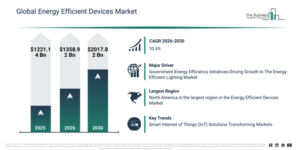
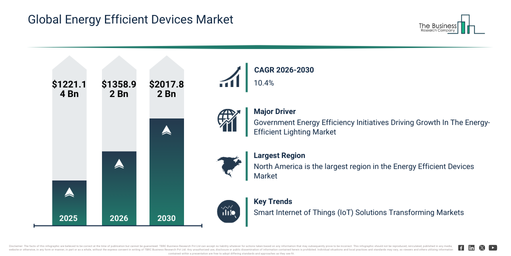
The energy efficient devices market has experienced rapid expansion in recent years. It is projected to grow from $1221.14 billion in 2025 to $1358.92 billion in 2026, achieving a compound annual growth rate (CAGR) of 11.3%. This historic growth can be ascribed to elements such as escalating energy costs across industries, the implementation of energy efficiency regulations, an increase in the deployment of smart building systems, the availability of efficient power electronics, and the overall growth in industrial automation.
The market size for energy efficient devices is anticipated to show significant expansion in the upcoming years. It is projected to reach $2017.82 billion by 2030, exhibiting a compound annual growth rate (CAGR) of 10.4%. This growth during the forecast period can be attributed to the increasing uptake of renewable energy integration, the expansion of smart grid infrastructure, a rising demand for net-zero buildings, growing investments in digital energy platforms, and an increasing focus on carbon footprint reduction. Key trends in the forecast period include the increasing adoption of smart energy management systems, a rising demand for low-power consumption devices, the growing integration of IoT-enabled energy monitoring, the expansion of predictive maintenance solutions, and an enhanced focus on lifecycle energy efficiency.
Get A No-Cost Sample Of The Energy Efficient Devices Market Study:
Major Factor Fueling The Energy Efficient Devices Market Through 2030
Governmental efforts to boost energy efficiency are projected to stimulate the growth of the energy-efficient devices market going forward. These initiatives comprise various programs, policies, or actions aimed at reducing energy consumption and enhancing energy efficiency. Government energy-efficiency initiatives are essential for advancing energy-efficient devices by establishing standards, encouraging adoption, raising awareness, backing research and development, implementing building codes, and fostering cross-sector collaboration. Governmental energy-efficiency initiatives are a primary driver for the energy-efficient devices market.
Energy Efficient Devices Market Segment Landscape: Main Categories And Subcategories Covered
The energy efficient devices market covered in this report is segmented –
1) By Component: Hardware, Software, Services
2) By System Type: Industrial Energy Management Systems (IEMS), Building Energy Management Systems (BEMS), Home Energy Management Systems (HEMS)
3) By Vertical: Residential, Energy And Power, Telecom And Information Technology (IT), Manufacturing, Retail, Healthcare, Other Verticals
Subsegments:
1) By Hardware: Sensors, Actuators, Power Supplies, Controllers, Batteries, LED Lighting, Energy-efficient Appliances
2) By Software: Energy Management Software, Automation Software, Monitoring And Analytics Software, Smart Grid Software, Predictive Maintenance Software
3) By Services: Installation Services, Maintenance And Support Services, Consulting And Advisory Services, Managed Services, System Integration Services
How Are Emerging Trends Influencing The Energy Efficient Devices Market’s Growth Path?
Major companies operating in the energy-efficient devices market are focusing on developing innovative products incorporating advanced technologies, such as smart IoT solutions, to enhance their market profitability. These smart IoT solutions are essential for promoting energy efficiency across various domains, including homes, buildings, industries, and cities, ultimately supporting sustainability and environmental conservation efforts.
Energy Efficient Devices Market Leading Players And Key Industry Participants In 2026
Major companies operating in the energy efficient devices market are Samsung Electronics, Siemens AG, GE Electric, Panasonic Corporation, Mitsubishi Electric Corporation, Schneider Electric SE, Honeywell International Inc., ABB Ltd., Daikin Industries Ltd., Toshiba Corporation, Johnson Controls International plc, Eaton Corporation, Carrier Global Corporation, Koninklijke Philips N.V., Trane Technologies, Emerson Electric Co., Legrand Group, Osram Group, Acuity Brands Inc., Itron Inc., Zumtobel Group, Cree Inc., Crompton Greaves Consumer Electricals Limited, Danfoss Group
Check Out The Full Energy Efficient Devices Market Report 2026:
Energy Efficient Devices Market By Geography: Revenue Leaders Among Global Regions
North America was the largest region in the energy efficient devices market in 2025. Asia-Pacific is expected to be the fastest-growing region in the forecast period. The regions covered in the energy efficient devices market report are Asia-Pacific, South East Asia, Western Europe, Eastern Europe, North America, South America, Middle East, Africa
Reach Out To Our Team:
The Business Research Company: https://www.thebusinessresearchcompany.com/
Americas: +1 310-496-7795
Asia: +44 7882 955267 & +91 8897263534
Europe: +44 7882 955267
Email us at: marketing@tbrc.info
Follow us on:
LinkedIn: https://in.linkedin.com/company/the-business-research-company
YouTube: https://www.youtube.com/channel/UC24_fI0rV8cR5DxlCpgmyFQ
Global Market Model: https://www.thebusinessresearchcompany.com/global-market-model

Wasay has over a decade of experience in market research, data modelling, and analytics, with prior experience at GlobalData and Decision Tree Consulting Services. At The Business Research Company , he leads research operations across syndicated studies, customized consulting engagements, and the Global Market Model platform. His professional experience includes supporting organizations such as Boston Consulting Group, KPMG, and Ernst & Young. Wasay holds a degree in Electronics and Communications Engineering, postgraduate management qualifications from International Management Institute Belgium and Indian School of Business and Entrepreneurship, and completed the Integrated Program in Business Analytics from Indian Institute of Management Indore.