With a focus on actionable insights and strategic value, The Business Research Company’s 2026 market reports include market attractiveness scoring, total addressable market sizing, company benchmarking matrices, interactive Excel dashboards, deeper supply chain intelligence, emerging startup tracking, and granular product-level insights.
How Large Could The Enzyme Stabilizer Market Become By 2030 At A 6.7% CAGR?
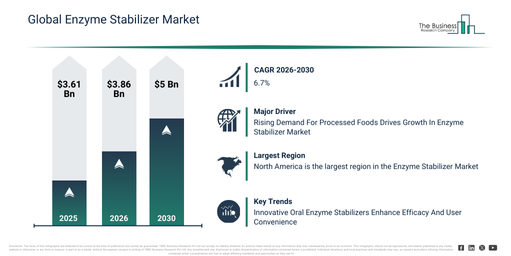
The enzyme stabilizer market has experienced robust growth in recent years. It is projected to expand from $3.61 billion in 2025 to $3.86 billion in 2026, exhibiting a compound annual growth rate (CAGR) of 6.8%. The historical growth of this market can be attributed to the expansion of enzyme-based industrial processes, an increase in the usage of detergent and food enzymes, enhanced adoption within pharmaceuticals, the availability of various stabilizing compounds, and a growing emphasis on product quality.
The enzyme stabilizer market is projected to experience substantial expansion in the coming years. This market is forecast to reach a size of $5 billion by 2030, demonstrating a compound annual growth rate (CAGR) of 6.7%. This anticipated growth during the forecast period is driven by several factors, including the rising demand for specialty enzymes, the expanding scope of biopharmaceutical manufacturing, an intensified focus on environmentally friendly bio-based processes, increased investments in enzyme engineering, and greater implementation in advanced food processing. Key trends anticipated over the forecast timeframe encompass a heightened need for improved enzyme shelf stability, broader application in industrial biotechnology, a stronger emphasis on resistance to temperature and pH variations, the proliferation of encapsulation technologies, and more effective optimization of enzyme performance.
Get A Free Enzyme Stabilizer Market Sample With 2030 Forecast Insights:
Enzyme Stabilizer Market Outlook: Key Driver Supporting Long-Term Growth
The increasing need for processed food items is anticipated to drive the expansion of the enzyme stabilizer market in the future. These foods are products whose natural condition has been altered through methods like canning, freezing, or the addition of preservatives. This demand arises from consumers’ desire for convenience, products with longer shelf lives, and their busy lifestyles. Within processed foods, enzyme stabilizers are employed to preserve enzyme activity throughout production and storage, thereby ensuring consistent product quality and a prolonged shelf life. The rising demand for processed foods is a key factor propelling the expansion of the enzyme stabilizer market.
Segmentation Of The Enzyme Stabilizer Market: Key Categories Explained
The enzyme stabilizer market covered in this report is segmented –
1) By Type: Chemical Stabilizers, Physical Stabilizers, Biological Stabilizers
2) By Stabilization Mechanism: Encapsulation And Microencapsulation, Immobilization Covalent And Non-Covalent, pH And Ionic Strength Control, Thermal Stabilization, Oxidative Protection
3) By Target: Amylases, Proteases, Lipases, Lactases
4) By Application: Enzyme Production, Enzyme Laundry Treatment, Enzyme Detergents, Food Industry
5) By End Use: Food Processing, Animal Nutrition, Pharmaceuticals, Cleaning Agents, Chemical
Subsegments:
1) By Chemical Stabilizers: Polyols, Sugars and Sugar Alcohols, Salts and Buffer Systems, Antioxidants And Preservatives
2) By Physical Stabilizers: Encapsulation Agents, Immobilization Supports, Coating and Matrix Materials
3) By Biological Stabilizers: Protein-Based Stabilizers, Peptide-Based Stabilizers, Compatible Solutes
Enzyme Stabilizer Market Evolving Trends: What Businesses Should Know
Leading companies within the enzyme stabilizer market are concentrating on developing novel solutions, such as oral enzyme stabilizers, to improve both efficacy and user convenience. Oral enzyme stabilizers are compounds that safeguard and maintain the effectiveness of enzymes as they navigate the gastrointestinal tract, thereby ensuring their activity for therapeutic and digestive applications.
Who Competes In The Enzyme Stabilizer Market? Major Companies Listed
Major companies operating in the enzyme stabilizer market are Novozymes A/S, DSM-Firmenich N.V., DuPont de Nemours Inc., BASF SE, Kerry Group plc, Chr. Hansen Holding A/S, AB Enzymes GmbH, Amano Enzyme Inc., Biocatalysts Ltd., Codexis Inc., Specialty Enzymes and Probiotics LLC, Dyadic International Inc., Megazyme Ltd., Enzyme Innovation Inc., Maps Enzymes Ltd., Laffort SA, Sorachim SA, Creative Enzymes Inc., Advanced Enzyme Technologies Ltd., Sunson Industry Group Co. Ltd., Jiangsu Boli Bioproducts Co. Ltd., Enzymatic Solutions Inc., Aumgene Biosciences Inc.
Read The Complete Enzyme Stabilizer Market Forecast Report Through 2030:
Enzyme Stabilizer Market Regional Ranking: Which Geography Comes First?
North America was the largest region in the enzyme stabilizer market in 2025. Asia-Pacific is expected to be the fastest-growing region in the forecast period. The regions covered in the enzyme stabilizer market report are Asia-Pacific, South East Asia, Western Europe, Eastern Europe, North America, South America, Middle East, Africa
Reach Out To Our Team:
The Business Research Company: https://www.thebusinessresearchcompany.com/
Americas: +1 310-496-7795
Asia: +44 7882 955267 & +91 8897263534
Europe: +44 7882 955267
Email us at: marketing@tbrc.info
Follow us on:
LinkedIn: https://in.linkedin.com/company/the-business-research-company
YouTube: https://www.youtube.com/channel/UC24_fI0rV8cR5DxlCpgmyFQ
Global Market Model: https://www.thebusinessresearchcompany.com/global-market-model

Wasay has over a decade of experience in market research, data modelling, and analytics, with prior experience at GlobalData and Decision Tree Consulting Services. At The Business Research Company , he leads research operations across syndicated studies, customized consulting engagements, and the Global Market Model platform. His professional experience includes supporting organizations such as Boston Consulting Group, KPMG, and Ernst & Young. Wasay holds a degree in Electronics and Communications Engineering, postgraduate management qualifications from International Management Institute Belgium and Indian School of Business and Entrepreneurship, and completed the Integrated Program in Business Analytics from Indian Institute of Management Indore.