The Business Research Company’s 2026 market reports combine market attractiveness scoring, total addressable market sizing, company benchmarking matrices, interactive Excel dashboards, deeper supply chain intelligence, emerging startup tracking, and granular product-level insights to deliver research that is more actionable and strategically valuable.
Is The Firefighting Robots Market Expanding? Latest Size Estimates And 2030 Projections
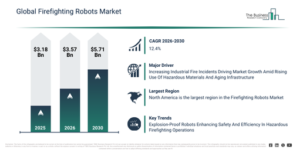
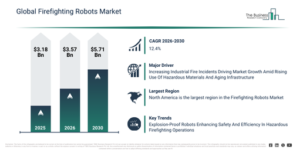
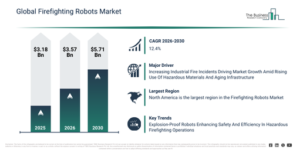
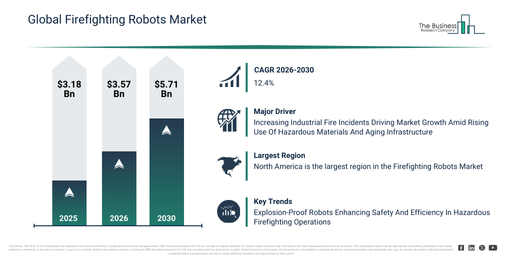
The firefighting robots market has observed rapid growth in recent years. It is anticipated to expand from $3.18 billion in 2025 to $3.57 billion in 2026, progressing at a compound annual growth rate (CAGR) of 12.5%. This historical growth can be attributed to several factors including the increasing expansion of industrial safety automation, a rise in incidents within hazardous environments, greater adoption by the defense sector, the development of robotic emergency response systems, and the availability of rugged robotic platforms.
The firefighting robots market is poised for significant expansion in the next few years. It is forecast to grow to $5.71 billion in 2030, demonstrating a compound annual growth rate (CAGR) of 12.4%. This growth during the projection period is primarily driven by the increasing adoption of fully autonomous robots, rising investments in smart city safety infrastructure, the expansion of AI-driven navigation systems, a growing demand for unmanned emergency solutions, and increasing government support for robotics. Prominent trends anticipated in the forecast period involve the escalating deployment of autonomous firefighting robots, the rising integration of advanced sensors and cameras, their growing utilization in hazardous industrial environments, the expansion of remote-controlled fire suppression systems, and an enhanced focus on human safety.
Free Firefighting Robots Market Sample: Market Size, Growth Drivers And Competitive Landscape:
Firefighting Robots Market Drivers Explained: What Is Supporting A 12.4% CAGR?
The projected increase in industrial fire incidents is anticipated to boost the growth of the firefighting robots market. These industrial fires are largely due to the expanded use of hazardous materials, aging infrastructure, insufficient safety protocols, and the escalating complexity of industrial operations. The surge in such fires is further linked to more intricate manufacturing processes, higher volumes of flammable substances, deteriorating infrastructure, inadequate fire safety measures, and a rising demand for energy-intensive operations, all of which elevate the likelihood of fire events across various sectors. Firefighting robots enhance industrial fire safety by offering swift, remote-controlled intervention in dangerous environments, thereby minimizing human risk and ensuring effective fire suppression with their advanced sensors, autonomous navigation, and powerful extinguishing systems. The increasing occurrence of industrial fire incidents is a key driver for the growth of the firefighting robots market.
Firefighting Robots Market Segment Guide: Main Divisions And Subsegments
The firefighting robots market covered in this report is segmented –
1) By Robot Type: Tracked Firefighting Robots, Wheeled Firefighting Robots
2) By Payload: Fire Extinguishing Agents, Cameras And Sensors, Communication Equipment, Tools And Equipment
3) By Autonomy Level: Teleoperated, Semi-Autonomous
4) By Size: Small (Under 100 kg), Medium (100-500 kg), Large (Over 500 kg),
5) By Application: Military And Defense, Industrial, Government
Subsegments:
1) By Tracked Firefighting Robots: Remote-Controlled Tracked Firefighting Robots, Semi-Autonomous Tracked Firefighting Robots
2) By Wheeled Firefighting Robots: Four-Wheeled Firefighting Robots, Multi-Wheeled (6×6 / 8×8) Firefighting Robots
Firefighting Robots Market Trends And Opportunities For 2026–2030
Leading firms within the firefighting robot market are prioritizing the creation of advanced technologies, like explosion-proof robots, to boost safety and operational effectiveness in dangerous settings. These explosion-proof robots are built to endure harsh conditions, such as intense heat, poisonous gases, and volatile substances, allowing them to promptly control fires and reduce additional harm without risking human lives.
Which Major Players Are Active In The Firefighting Robots Market?
Major companies operating in the firefighting robots market are Shark Robotics, DOK-ING d.o.o., Howe & Howe Technologies, Mitsubishi Heavy Industries Ltd., ECA Group, LUF GmbH, Milrem Robotics (Milrem AS), Unifire AB, EmiControls, QinetiQ Group plc, Lockheed Martin Corporation, Thales Group, Hoya Robot Co. Ltd., HOPE Technik, LeoTronics Robotics, Parosha Innovators Pvt. Ltd., Tecdron Robotics, InRob Tech Ltd., Roboteam Ltd., Autonomous Solutions Inc.
Unlock The Complete Firefighting Robots Market Report With Company Benchmarking:
Firefighting Robots Market World Regions Compared: Which Leads In Revenue?
North America was the largest region in the firefighting robots market in 2025. The regions covered in the firefighting robots market report are Asia-Pacific, South East Asia, Western Europe, Eastern Europe, North America, South America, Middle East, Africa
Reach Out To Our Team:
The Business Research Company: https://www.thebusinessresearchcompany.com/
Americas: +1 310-496-7795
Asia: +44 7882 955267 & +91 8897263534
Europe: +44 7882 955267
Email us at: marketing@tbrc.info
Follow us on:
LinkedIn: https://in.linkedin.com/company/the-business-research-company
YouTube: https://www.youtube.com/channel/UC24_fI0rV8cR5DxlCpgmyFQ
Global Market Model: https://www.thebusinessresearchcompany.com/global-market-model

Wasay has over a decade of experience in market research, data modelling, and analytics, with prior experience at GlobalData and Decision Tree Consulting Services. At The Business Research Company , he leads research operations across syndicated studies, customized consulting engagements, and the Global Market Model platform. His professional experience includes supporting organizations such as Boston Consulting Group, KPMG, and Ernst & Young. Wasay holds a degree in Electronics and Communications Engineering, postgraduate management qualifications from International Management Institute Belgium and Indian School of Business and Entrepreneurship, and completed the Integrated Program in Business Analytics from Indian Institute of Management Indore.