Designed to make market research more actionable and strategically valuable, The Business Research Company’s 2026 market reports feature market attractiveness scoring, total addressable market sizing, company benchmarking matrices, interactive Excel dashboards, deeper supply chain intelligence, emerging startup tracking, and granular product-level insights.
Food Automation Market To Expand At A 9.9% CAGR: Size And Growth Projections Through 2030
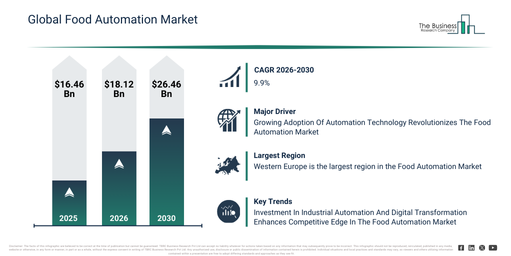
The food automation market has experienced rapid expansion recently. It is projected to increase from $16.46 billion in 2025 to $18.12 billion in 2026 at a compound annual growth rate (CAGR) of 10.1%. This historical growth can be attributed to factors such as the increasing industrialization of food processing, escalating labor costs, a surge in demand for packaged food items, the proliferation of large-scale food manufacturing sites, and the implementation of mechanized production methods.
The food automation market is anticipated to experience substantial expansion over the upcoming years, projected to reach $26.46 billion in 2030, exhibiting a compound annual growth rate (CAGR) of 9.9%. This projected growth is driven by several factors, including increasing investments in intelligent food manufacturing facilities, the growing use of AI for quality inspection, the expanding consumption of ready-to-eat foods, a heightened emphasis on adhering to food safety regulations, and a rising need for adaptable automation systems. Key trends anticipated during this period encompass the wider implementation of fully automated food processing lines, greater integration of vision systems and sensors, increasing demand for clean and contamination-free automation solutions, the broader application of robotics in packaging and handling processes, and a stronger emphasis on enhancing operational efficiency.
Get Your Free Food Automation Market Report Sample Today:
Which Factor Is Expected To Drive The Food Automation Market Over The Forecast Period?
The escalating consumer need for processed foods is anticipated to propel the expansion of the food automation market in the future. These food items are those that have undergone alterations from their original state, utilizing techniques such as canning, freezing, drying, or the incorporation of preservatives to extend their shelf life and improve convenience. This heightened demand for processed food products stems from various factors, such as hectic modern lifestyles, increasing urbanization, and the appeal of extended shelf life, which offers both convenience and a reduction in food waste. Furthermore, automated machinery ensures a consistent level of product quality, thereby mitigating inconsistencies typically associated with human-based production. The growing consumer preference for processed foods is set to fuel the expansion of the food automation market.
Food Automation Market Segmentation Insights: How Is The Industry Categorized?
The food automation market covered in this report is segmented –
1) By Type: Motors And Generators, Motor Controls, Discrete Controllers And Visualization, Rotary Products, Linear Products, Other Types
2) By Operation: Semi Automatic, Fully Automatic
3) By Component: Plant Instrumentation, Plant-Level Controls
4) By Application: Bakery Products, Drinks, Candy, Snacks, Fruits And Vegetables, Meat, Other Applications
Subsegments:
1) By Motors and Generators: AC Motors, DC Motors, Servo Motors, Stepper Motors
2) By Motor Controls: Variable Frequency Drives (VFD), Soft Starters, Motor Protection Relays
3) By Discrete Controllers and Visualization: Programmable Logic Controllers (PLC), Human-Machine Interfaces (HMI), Supervisory Control and Data Acquisition (SCADA) Systems
4) By Rotary Products: Rotary Actuators, Rotary Encoders, Gearboxes
5) By Linear Products: Linear Actuators, Linear Guides, Positioning Systems
6) By Other Types: Sensors and Switches, Safety Relays, Control Panels
Food Automation Market Trends Explained: What Is Changing And Why It Matters
Leading companies in the food automation market are prioritizing new capital expenditure in industrial automation and digital transformation to achieve a competitive edge. Such investments enable enhanced and rapid deployment of powerful tools and the generation of results.
Food Automation Market Competitor Landscape: Who Are The Major Companies?
Major companies operating in the food automation market are ABB Group, GEA Group AG, Mitsubishi Electric Corporation, Rexnord Corporation, Rockwell Automation Inc., Schneider Electric SE, Honeywell International Inc., Emerson Electric Company, Siemens AG, Yokogawa Electric Corporation, Yaskawa Electric Corporation, MicroThermics Inc., Semi-Bulk Systems Inc., Atlantic Packaging Products Ltd., Endress+Hauser Group, Krones AG, Tetra Pak International S.A., Robert Bosch GmbH, Duravant LLC, Bühler AG, JBT Corporation, Heat and Control Inc., Key Technology Inc., FANUC Corporation, Kawasaki Heavy Industries Ltd., KUKA AG, Adept Technology Inc., Stäubli International AG, Omron Corporation
See The Full Food Automation Market Report For Complete Market Sizing And Trends:
Food Automation Market Regional Demand Analysis And Leading Geography
Western Europe was the largest region in the food automation market in 2025. Asia-Pacific is expected to be the fastest-growing region in the forecast period. The regions covered in the food automation market report are Asia-Pacific, South East Asia, Western Europe, Eastern Europe, North America, South America, Middle East, Africa
Reach Out To Our Team:
The Business Research Company: https://www.thebusinessresearchcompany.com/
Americas: +1 310-496-7795
Asia: +44 7882 955267 & +91 8897263534
Europe: +44 7882 955267
Email us at: marketing@tbrc.info
Follow us on:
LinkedIn: https://in.linkedin.com/company/the-business-research-company
YouTube: https://www.youtube.com/channel/UC24_fI0rV8cR5DxlCpgmyFQ
Global Market Model: https://www.thebusinessresearchcompany.com/global-market-model

Wasay has over a decade of experience in market research, data modelling, and analytics, with prior experience at GlobalData and Decision Tree Consulting Services. At The Business Research Company , he leads research operations across syndicated studies, customized consulting engagements, and the Global Market Model platform. His professional experience includes supporting organizations such as Boston Consulting Group, KPMG, and Ernst & Young. Wasay holds a degree in Electronics and Communications Engineering, postgraduate management qualifications from International Management Institute Belgium and Indian School of Business and Entrepreneurship, and completed the Integrated Program in Business Analytics from Indian Institute of Management Indore.