The Business Research Company’s 2026 market reports combine market attractiveness scoring, total addressable market sizing, company benchmarking matrices, interactive Excel dashboards, deeper supply chain intelligence, emerging startup tracking, and granular product-level insights to deliver research that is more actionable and strategically valuable.
Food Processing Machinery Market Size Trajectory: Key Numbers Every Industry Stakeholder Should Know
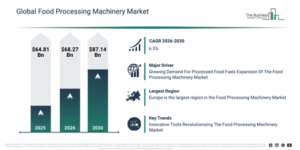
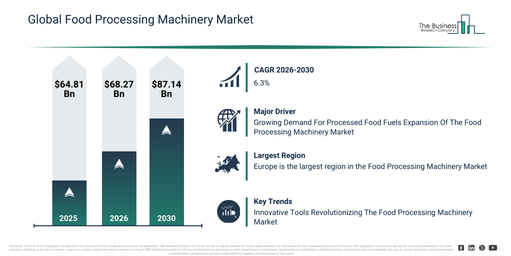
The food processing machinery market size has experienced strong growth in recent years. This market is forecasted to expand from $64.81 billion in 2025 to $68.27 billion in 2026, achieving a compound annual growth rate (CAGR) of 5.3%. The historical growth can be attributed to the expansion of industrial food manufacturing, rising demand for packaged foods, growth in cold chain infrastructure, increasing adoption of mechanized food handling, and the availability of advanced processing equipment.
The food processing machinery market is projected to experience substantial expansion over the upcoming years. This market is anticipated to reach $87.14 billion by 2030, exhibiting a compound annual growth rate (CAGR) of 6.3%. Key factors driving this growth during the forecast period include greater investments in smart factory technologies, increased integration of AI for process optimization, the broadening of global food supply networks, a rising need for sustainable processing methods, and a heightened emphasis on reducing waste. Noteworthy trends for this period encompass the growing implementation of automated equipment for food processing, the increasing incorporation of smart monitoring systems, a heightened demand for machinery capable of high output, the proliferation of modular processing lines, and a reinforced commitment to food safety regulations.
Looking For Reliable Food Processing Machinery Market Data? Request A Free Sample:
What Is Behind The Rising Demand In The Food Processing Machinery Market?
The food processing machinery market is anticipated to expand due to the rising need for processed food. Processed foods are defined as any food item that has undergone some form of preparation from its original state, such as cooking, canning, freezing, drying, or packaging. These operations are performed with food processing machinery. The increasing consumption of processed food is a key driver for the food processing machinery market.
Food Processing Machinery Market Segment Coverage And Subsegment Analysis
The food processing machinery market covered in this report is segmented –
1) By Type: Depositor, Extruding Machines, Mixers, Refrigeration, Slicers And Dicers, Other Types
2) By Mode Of Operation: Semiautomatic, Fully Automatic
3) By Application: Bakery And Confectionery, Meat, Poultry And Seafood, Dairy, Beverages, Other Applications
Subsegments:
1) By Depositor: Cookie Depositors, Cake Depositors, Chocolate Depositors
2) By Extruding Machines: Single-Screw Extruders, Twin-Screw Extruders, Sheet Extruders
3) By Mixers: Planetary Mixers, Ribbon Mixers, Batch Mixers
4) By Refrigeration: Industrial Refrigeration Systems, Blast Freezers, Refrigerated Storage Units
5) By Slicers And Dicers: Vegetable Slicers, Meat Slicers, Fruit Dicers
6) By Other Types: Filling Machines, Packaging Machines, Cooking Equipment
Food Processing Machinery Market Future Trends: Where Is The Industry Heading?
Major companies operating in the food processing machinery market are prioritizing innovative products, such as food processing automation solutions. Their aim is to enhance efficiency, improve product quality, and meet the evolving demands of consumers for safer and more sustainable food processing methods. Food processing automation solutions involve the use of advanced technology and systems to streamline, control, and improve various stages of food production, including processing, packaging, and quality control.
Food Processing Machinery Market Top Players List For 2026
Major companies operating in the food processing machinery market are Tetra Laval International S.A., SPX Corporation, Nichimo Co Ltd., GEA Group AG, Hosokawa Micron Corp., John Bean Technologies Corporation, Heat and Control Inc., Tomora Systems ASA, AFE Group Ltd., Bühler AG, Krones AG, Alfa Laval AB, Meyer Industries Inc., Baader North America Corporation, Satake Corp., The Middleby Corp., Bucher Industries AG, Marel, Clextral, Fenco Food Machinery, Braunschweigische Maschinenbauanstalt AG, KHS GmbH, Bizerba SE & Co. KG, Atlas Pacific Engineering Company Inc., Duravant Company, Asea Brown Boveri Ltd., Baader, Mecatherm, FAM Stumabo, Rheon Automatic Machinery Co. Ltd., Heatcraft Worldwide Refrigeration, Anko Food Machine Co. Ltd., Baker Perkins
Order Your Copy Of The Food Processing Machinery Market Report 2026:
How Does The Food Processing Machinery Market Vary By Region?
Europe was the largest region in the food processing machinery market in 2025.Asia-Pacific is expected to be the fastest-growing region in the global food processing machinery market report during the forecast period. The regions covered in the food processing machinery market report are Asia-Pacific, South East Asia, Western Europe, Eastern Europe, North America, South America, Middle East, Africa
Reach Out To Our Team:
The Business Research Company: https://www.thebusinessresearchcompany.com/
Americas: +1 310-496-7795
Asia: +44 7882 955267 & +91 8897263534
Europe: +44 7882 955267
Email us at: marketing@tbrc.info
Follow us on:
LinkedIn: https://in.linkedin.com/company/the-business-research-company
YouTube: https://www.youtube.com/channel/UC24_fI0rV8cR5DxlCpgmyFQ
Global Market Model: https://www.thebusinessresearchcompany.com/global-market-model

Wasay has over a decade of experience in market research, data modelling, and analytics, with prior experience at GlobalData and Decision Tree Consulting Services. At The Business Research Company , he leads research operations across syndicated studies, customized consulting engagements, and the Global Market Model platform. His professional experience includes supporting organizations such as Boston Consulting Group, KPMG, and Ernst & Young. Wasay holds a degree in Electronics and Communications Engineering, postgraduate management qualifications from International Management Institute Belgium and Indian School of Business and Entrepreneurship, and completed the Integrated Program in Business Analytics from Indian Institute of Management Indore.