The Business Research Company’s 2026 market reports combine market attractiveness scoring, total addressable market sizing, company benchmarking matrices, interactive Excel dashboards, deeper supply chain intelligence, emerging startup tracking, and granular product-level insights to deliver research that is more actionable and strategically valuable.
Hydronic Radiators Market Size Review: What Shaped Past Growth And What Will Drive Future Expansion?
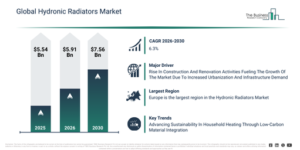
The hydronic radiators market has experienced substantial growth in recent years. Projections indicate a rise from $5.54 billion in 2025 to $5.91 billion in 2026, demonstrating a compound annual growth rate (CAGR) of 6.7%. Historically, this expansion has been driven by factors such as demand for housing in cold climates, the increasing scale of residential construction, concerns regarding energy costs, the gradual replacement of traditional heating methods, and an overall increase in commercial building projects.
The hydronic radiators market is projected to experience substantial growth in the upcoming years. It is anticipated to expand to $7.56 billion by 2030, exhibiting a compound annual growth rate (CAGR) of 6.3%. This expansion during the forecast period is driven by factors such as net zero building initiatives, the increasing adoption of smart home heating solutions, a rising demand for low emission heating systems, ongoing urban residential expansion, and the renovation of aging infrastructure. Prominent trends for this period include a growing demand for energy-efficient heating, the integration of smart heating controls, the broader expansion of underfloor heating systems, a shift towards modern radiator designs, and their increasing utilization in green buildings.
Access Free Sample Pages From The Hydronic Radiators Market Report 2026:
Understanding The Main Driver Of The Hydronic Radiators Market
The future expansion of the hydronic radiators market is expected to be propelled by an increase in construction and renovation activities. These activities refer to processes involved in erecting new structures or modifying, repairing, and upgrading existing ones to enhance functionality, aesthetics, or conform to updated standards. The surge in construction and renovation activities is attributed to urbanization and population growth, as more individuals move to cities, generating higher demand for housing, transportation, and public services. Hydronic radiators support construction efforts by providing energy-efficient, customizable heating solutions that seamlessly integrate with modern building systems, ensuring comfort and sustainability in both residential and commercial projects. The rising volume of construction and renovation activities is driving the growth of the hydronic radiators market.
Hydronic Radiators Market Segment Mapping For 2026 And Beyond
The hydronic radiators market covered in this report is segmented –
1) By Product Type: Panel Radiators, Column Radiators, Towel Radiators, Custom Radiators
2) By Material: Steel, Aluminium, Cast Iron, Other Materials
3) By Distribution Channel: Online Sales, Retail Sales, Wholesale Distribution, Direct Sales
4) By End-Use: Residential, Commercial
Subsegments:
1) By Panel Radiators: Single Panel, Double Panel, Triple Panel
2) By Column Radiators: 2-Column, 3-Column, 4-Column And Above
3) By Towel Radiators: Straight Towel Radiators, Curved Towel Radiators, Designer Towel Radiators
4) By Custom Radiators: Material-Based Customization, Design-Based Customization
What Key Trend Is Expected To Shape The Hydronic Radiators Market Over The Forecast Period?
Leading companies in the hydronic radiators market are increasingly focusing on integrating sustainability initiatives, such as low-carbon steel manufacturing, to boost environmental efficiency and minimize embodied emissions. Low-carbon steel manufacturing involves producing steel with cleaner energy sources and recycled content, which significantly reduces the carbon footprint during production and enables greener construction choices along with decreased lifecycle emissions.
Hydronic Radiators Market Major Players And Industry Competition Overview
Major companies operating in the hydronic radiators market are Purmo Group Plc, Zehnder Group AG, Stelrad Group Ltd., Arbonia AG, JAGA N.V., Vasco Group NV, Runtal Radiators Inc., Vogel & Noot Heiztechnik GmbH, Deltacalor S.r.l., Myson Inc., Hudson Reed Group Ltd., Castrads Ltd., Sterling Radiator Company, IRSAP S.p.A., Fondital S.p.A., Kermi GmbH, Radson, Biasi Radiators S.p.A., De’Longhi Radiators (De’Longhi Group), Hudevad Radiator Design (a brand of Rettig Group), Henrad Radiators
Full Hydronic Radiators Market Report: Market Size, Trends, Segments And Key Players:
Hydronic Radiators Market Geographic Segmentation: Regions Covered In The Report
Europe was the largest region in the hydronic radiators market in 2025. Asia-Pacific is expected to be the fastest-growing region in the forecast period. The regions covered in the hydronic radiators market report are Asia-Pacific, South East Asia, Western Europe, Eastern Europe, North America, South America, Middle East, Africa
Reach Out To Our Team:
The Business Research Company: https://www.thebusinessresearchcompany.com/
Americas: +1 310-496-7795
Asia: +44 7882 955267 & +91 8897263534
Europe: +44 7882 955267
Email us at: marketing@tbrc.info
Follow us on:
LinkedIn: https://in.linkedin.com/company/the-business-research-company
YouTube: https://www.youtube.com/channel/UC24_fI0rV8cR5DxlCpgmyFQ
Global Market Model: https://www.thebusinessresearchcompany.com/global-market-model

Wasay has over a decade of experience in market research, data modelling, and analytics, with prior experience at GlobalData and Decision Tree Consulting Services. At The Business Research Company , he leads research operations across syndicated studies, customized consulting engagements, and the Global Market Model platform. His professional experience includes supporting organizations such as Boston Consulting Group, KPMG, and Ernst & Young. Wasay holds a degree in Electronics and Communications Engineering, postgraduate management qualifications from International Management Institute Belgium and Indian School of Business and Entrepreneurship, and completed the Integrated Program in Business Analytics from Indian Institute of Management Indore.