Market attractiveness scoring, total addressable market sizing, company benchmarking matrices, interactive Excel dashboards, deeper supply chain intelligence, emerging startup tracking, and granular product-level insights are among the key offerings featured in The Business Research Company’s 2026 market reports, designed to deliver more actionable and strategically valuable research.
Industrial Brakes Market Size Overview: From Historical Performance To The 2030 Forecast
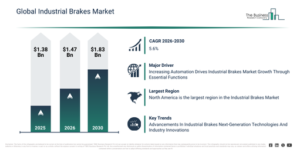
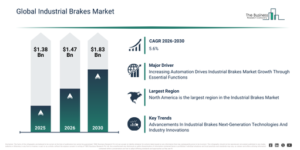
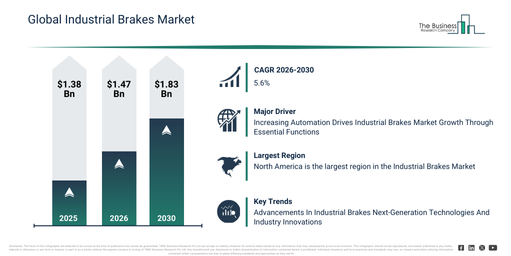
The industrial brakes market size has demonstrated strong growth in recent years. It is projected to increase from $1.38 billion in 2025 to $1.47 billion in 2026, achieving a compound annual growth rate (CAGR) of 5.9%. Historically, this expansion has been driven by factors such as manufacturing equipment growth, mining industry expansion, material handling demand, maritime industry development, and heavy machinery usage.
The industrial brakes market is projected to experience substantial expansion in the coming years. This market is anticipated to reach $1.83 billion in 2030, showing a compound annual growth rate (CAGR) of 5.6%. This expansion during the projection period stems from factors such as increasing automation in industrial machinery, the rise of renewable energy setups, stringent safety compliance needs, the development of logistics infrastructure, and the demand for sophisticated motion control. Key developments expected over the forecast horizon encompass high-load braking technologies, the integration of electromagnetic brakes, designs focused on safety for braking, automated braking mechanisms, and improved brake longevity.
Get A Free Sample Of The Business Research Company’s Industrial Brakes Market Report:
What Factor Is Increasing Demand In The Industrial Brakes Market?
The anticipated expansion of the industrial brakes market is linked to the rising trend of automation in manufacturing. This automation involves the deployment of technologies like robots and control systems to execute tasks and processes with minimal human involvement, thereby boosting efficiency, precision, and productivity. The surge in manufacturing automation stems from the imperative for improved efficiency, reduced costs, heightened accuracy, better safety, and the capacity to fulfill significant production requirements. Industrial brakes play a vital role in advancing manufacturing automation through critical functions like precise motion control, dependable emergency stops, steady performance across diverse loads, and improved safety protocols, all of which are fundamental to the operational efficiency and dependability of automated setups. The expansion of manufacturing automation is fueling the growth of the industrial brakes market.
Which Segments Make Up The Industrial Brakes Market?
The industrial brakes market covered in this report is segmented –
1) By Type: Mechanically Applied Brakes, Hydraulically Applied Brakes, Pneumatically Applied Brakes, Electrically Applied Brakes
2) By Application: Holding Brakes, Dynamic And Emergency Brakes, Tension Brakes
3) By End-User: Marine And Shipping, Mining, Manufacturing, Construction, Entertainments, Other End-Users
Subsegments:
1) By Mechanically Applied Brakes: Spring Applied Brakes, Band Brakes, Drum Brakes, Disc Brakes
2) By Hydraulically Applied Brakes: Hydraulic Disc Brakes, Hydraulic Drum Brakes, Oil-Immersed Brakes
3) By Pneumatically Applied Brakes: Pneumatic Disc Brakes, Pneumatic Drum Brakes, Spring-Actuated Pneumatic Brakes
4) By Electrically Applied Brakes: Electromagnetic Brakes, Electric Disc Brakes, Electric Drum Brakes
Industrial Brakes Market Emerging Trends: What Are Industry Leaders Focusing On?
Leading companies in the industrial brakes market are focusing on developing advanced products, such as next-generation braking technologies, to improve performance, enhance safety, and increase efficiency in various industrial applications. Next-generation braking technologies represent advanced braking systems that incorporate innovative technologies and materials to enhance performance, safety, and efficiency.
Major Companies To Know In The Industrial Brakes Market
Major companies operating in the industrial brakes market are Eaton Corporation plc, Parker Hannifin Corporation, Altra Industrial Motion Corp., Dellner Bubenzer, Hilliard Corporation, SIBRE Siegerland Bremsen GmbH, Carlisle Brake & Friction, Coremo Ocmea S.p.A., Emco Precima Engineering Pvt. Ltd., KTR Systems GmbH, Nabtesco Corporation, Haldex AB, Kobelt Manufacturing Co. Ltd., Antec SA, Kor-Pak Corporation, Jiaozuo Changjiang Brake Co. Ltd., Jiangxi Huawu Brake Co. Ltd., Shanghai Borui Electric Co. Ltd., Warner Electric, Stromag GmbH, Wichita Clutch
Read The In-Depth Industrial Brakes Market Report:
Industrial Brakes Market Regional Landscape: Largest Region In 2025
North America was the largest region in the industrial brakes market in 2025. Asia-Pacific is expected to be the fastest-growing region in the forecast period. The regions covered in the industrial brakes market report are Asia-Pacific, South East Asia, Western Europe, Eastern Europe, North America, South America, Middle East, Africa
Reach Out To Our Team:
The Business Research Company: https://www.thebusinessresearchcompany.com/
Americas: +1 310-496-7795
Asia: +44 7882 955267 & +91 8897263534
Europe: +44 7882 955267
Email us at: marketing@tbrc.info
Follow us on:
LinkedIn: https://in.linkedin.com/company/the-business-research-company
YouTube: https://www.youtube.com/channel/UC24_fI0rV8cR5DxlCpgmyFQ
Global Market Model: https://www.thebusinessresearchcompany.com/global-market-model

Wasay has over a decade of experience in market research, data modelling, and analytics, with prior experience at GlobalData and Decision Tree Consulting Services. At The Business Research Company , he leads research operations across syndicated studies, customized consulting engagements, and the Global Market Model platform. His professional experience includes supporting organizations such as Boston Consulting Group, KPMG, and Ernst & Young. Wasay holds a degree in Electronics and Communications Engineering, postgraduate management qualifications from International Management Institute Belgium and Indian School of Business and Entrepreneurship, and completed the Integrated Program in Business Analytics from Indian Institute of Management Indore.