Through market attractiveness analysis, total addressable market evaluation, company benchmarking matrices, interactive Excel dashboards, expanded supply chain intelligence, emerging startup coverage, and detailed product insights, The Business Research Company’s 2026 market reports provide more actionable and strategically valuable research.
Automotive Traction Motor Market Revenue Outlook: What CAGR Is Expected Through 2030?
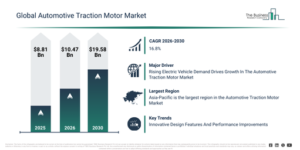
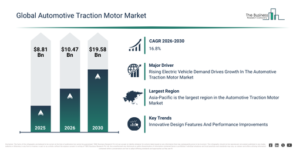
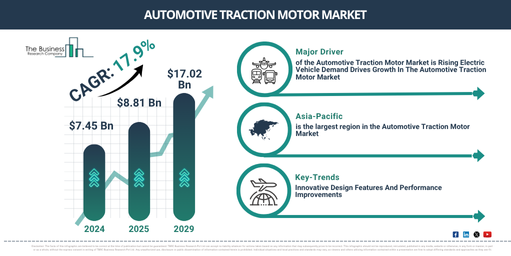
The automotive traction motor market size has experienced rapid growth in recent years. It is anticipated to expand from $8.81 billion in 2025 to $10.47 billion in 2026, demonstrating a compound annual growth rate (CAGR) of 18.9%. The market’s historical growth can be attributed to electric vehicle commercialization, battery cost reduction, early hybrid vehicle adoption, advancements in motor control, and automotive electrification investments.
The automotive traction motor market is anticipated to experience substantial expansion over the upcoming years. By 2030, this market is projected to reach $19.58 billion, demonstrating a compound annual growth rate (CAGR) of 16.9%. This projected growth is driven by factors such as increased electric vehicle (EV) production, the need for motors with high torque density, advancements in rare-earth optimization, stricter efficiency regulations, and the widening availability of charging infrastructure. Key trends during this period are expected to encompass a move towards more efficient traction motors, a greater uptake of permanent magnet synchronous motors (PMSM), the combination of motors with power electronics, a preference for smaller motor designs, and the development of multi-motor EV platforms.
Download A Free Sample Report For Comprehensive Market Insights:
#Automotive Traction Motor Market Growth Drivers And Industry Catalysts
The rising global interest in electric vehicles is projected to boost the growth of the automotive traction motor market moving ahead. Electric vehicles are defined as cars powered by electric motors, utilizing rechargeable batteries or other energy storage systems as their primary means of propulsion. This heightened demand for electric vehicles stems from environmental concerns, government incentives, advances in battery technology, increasing fuel costs, and better charging infrastructure. Traction motors play a vital role in the functioning of electric vehicles, converting electrical energy into mechanical movement with high efficiency, delivering instant torque, enabling regenerative braking, and enhancing the overall performance, reliability, and environmental benefits of electric vehicles. For instance, the International Energy Agency (IEA), a France-based intergovernmental organization, reported in April 2024 that new electric car registrations in China reached 8.1 million in 2023, marking a 35% rise compared to 2022. Thus, the escalating demand for electric vehicles is expected to significantly influence the automotive traction motor market.
Automotive Traction Motor Market Segments: Where Are The Largest Growth Opportunities?
The automotive traction motor market covered in this report is segmented –
1) By Motor Type: Alternating Current (AC) Induction Motors, Brushless Direct Current Motor, Permanent Magnet Synchronous Motor, Switched Reluctance Motor
2) By Power Output: Less Than 200 Kw, 200-400 kW, Above 400 kW
3) By Vehicle Type: Passenger Cars, Trucks, Buses, Pickup Trucks, Vans
4) By Electric Vehicle (EV) Type: Battery Electric Vehicle, Fuel Cell Electric Vehicle, Hybrid Electric Vehicle, Plug-In Hybrid Electric Vehicle
Subsegments:
1) By Alternating Current (AC) Induction Motors: Squirrel Cage Induction Motors, Wound Rotor Induction Motors, High Efficiency Ac Induction Motors, High-Torque Ac Induction Motors For Evs, Low-Speed Ac Induction Motors For City Vehicles, Ac Induction Motors With Regenerative Braking Capabilities
2) By Brushless Direct Current (BLDC) Motors: Inner Rotor Bldc Motors, Outer Rotor Bldc Motors, High-Power Bldc Motors For Performance Evs, Low-Cost And Compact Bldc Motors For Urban Mobility, Bldc Motors With Integrated Controllers For Efficiency, Water-Cooled Bldc Motors For Heavy-Duty Applications
3) By Permanent Magnet Synchronous Motors (PMSM): Surface-Mounted Pmsm, Interior Permanent Magnet (IPM) Motors, High-Speed Pmsm For Sports And Performance Vehicles, Pmsm With Integrated Power Electronics, High-Torque Density Pmsm For Commercial Evs, Pmsm For Hybrid Electric Vehicles (HEVS)
4) By Switched Reluctance Motors (SRM): Radial Switched Reluctance Motors, Axial Switched Reluctance Motors, High-Torque Srms For Heavy-Duty Evs, Low-Cost And Simple Srms For Budget Ev Models, High-Speed Switched Reluctance Motors For High-Performance Evs, Srm With Advanced Control Systems For Efficiency
#Automotive Traction Motor Market Trends Influencing Long-Term Demand
Leading companies in the automotive traction motor market are concentrating on developing innovative products, such as electric motors that operate without magnets, to boost performance and extend vehicle range. A magnet-free electric motor is a type of electric motor that functions without permanent magnets, typically employing alternative technologies like reluctance or induction to generate motion. For instance, in September 2023, ZF Friedrichshafen AG, a Germany-based automotive technology company, launched its magnet-free electric motor, the I2SM (In-Rotor Inductive-Excited Synchronous Motor). In this design, the magnetic field within the rotor is created by inductive excitation, which achieves high torque and power density without the size and frictional limitations associated with traditional brush or slip-ring systems. In contrast to conventional SESM designs, the I2SM’s compact and effective inductive transmitter is integrated inside the rotor shaft, requiring up to 90 mm less axial space. This innovative motor not only enhances efficiency by reducing energy transmission losses by 15% but also significantly lowers the CO2 footprint during production by up to 50% compared to traditional permanent-magnet synchronous motors.
Automotive Traction Motor Market Major Participants And Competitive Dynamics
Major companies operating in the automotive traction motor market report include Robert Bosch GmbH, Hitachi Ltd., Siemens AG, ZF Friedrichshafen AG, Continental AG, Magna International Inc., Mitsubishi Electric Corporation, ABB Ltd, Toshiba Corporation, Schaeffler Technologies AG & Co. KG, Nidec Corporation, Mahle Group, BorgWarner Inc., Dana Incorporated, Regal Beloit Corporation, Shenzhen Inovance Technology Co. Ltd, Mitsuba Corporation, CG Power and Industrial Solutions Ltd., American Traction Systems, Jing-Jin Electric Technologies Co Ltd.
Access The Complete Automotive Traction Motor Market Report:
Automotive Traction Motor Market Leading Geography: Which Region Generates The Most Revenue?
Asia-Pacific was the largest region in the automotive traction motor market in 2025. Asia-Pacific is expected to be the fastest-growing region in the forecast period. The regions covered in the automotive traction motor market report include Asia-Pacific, South East Asia, Western Europe, Eastern Europe, North America, South America, Middle East, Africa.
Get in touch with us:
The Business Research Company: https://www.thebusinessresearchcompany.com/
Americas: +1 310-496-7795
Asia: +44 7882 955267 & +91 8897263534
Europe: +44 7882 955267
Email us at: marketing@tbrc.info
Follow us on:
LinkedIn: https://in.linkedin.com/company/the-business-research-company
YouTube: https://www.youtube.com/channel/UC24_fI0rV8cR5DxlCpgmyFQ
Global Market Model: https://www.thebusinessresearchcompany.com/global-market-model

Wasay has over a decade of experience in market research, data modelling, and analytics, with prior experience at GlobalData and Decision Tree Consulting Services. At The Business Research Company , he leads research operations across syndicated studies, customized consulting engagements, and the Global Market Model platform. His professional experience includes supporting organizations such as Boston Consulting Group, KPMG, and Ernst & Young. Wasay holds a degree in Electronics and Communications Engineering, postgraduate management qualifications from International Management Institute Belgium and Indian School of Business and Entrepreneurship, and completed the Integrated Program in Business Analytics from Indian Institute of Management Indore.