With a focus on actionable insights and strategic value, The Business Research Company’s 2026 market reports include market attractiveness scoring, total addressable market sizing, company benchmarking matrices, interactive Excel dashboards, deeper supply chain intelligence, emerging startup tracking, and granular product-level insights.
How Much Will The Industrial Refrigeration Systems Market Be Worth By 2030?
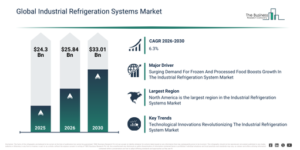
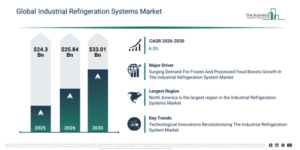
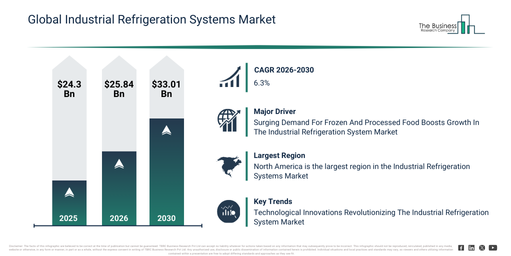
The industrial refrigeration systems market has demonstrated robust growth over recent years. Its valuation is forecast to climb from $24.3 billion in 2025 to $25.84 billion in 2026, registering a compound annual growth rate (CAGR) of 6.3%. This historical expansion is largely due to factors like the development of dairy and beverage industries, the expansion of cold storage facilities, a reliance on centralized refrigeration, and the ongoing requirements for industrial food preservation.
The industrial refrigeration systems market is anticipated to experience robust expansion over the coming years. It will grow to $33.01 billion in 2030 at a compound annual growth rate (CAGR) of 6.3%. This projected growth is driven by factors such as environmental compliance pressures, the expansion of cold chains, efforts towards energy optimization, the integration of smart controls, and increasing demand for high-capacity systems. Key trends during this forecast period involve the uptake of integrated refrigeration systems, a growing need for extensive cold storage facilities, a move towards ammonia and CO₂ based systems, the automation of refrigeration processes, and the growth in beverage and dairy processing sectors.
Get Access To A Free Industrial Refrigeration Systems Market Report Sample:
The Key Driver Behind The Industrial Refrigeration Systems Market’s 6.3% CAGR
The increasing demand for frozen and processed food is anticipated to stimulate the growth of the industrial refrigeration system market. Frozen food refers to items rapidly frozen and kept frozen until use, whereas processed food is an item subjected to various mechanical or chemical procedures for alteration or preservation. Industrial refrigeration systems are crucial in food processing for cooling substantial volumes of water utilized in these operations. The expanding demand for frozen and processed food is a primary driver for the industrial refrigeration system market.
Industrial Refrigeration Systems Market Classification: Main Segments And Detailed Subsegments
The industrial refrigeration systems market covered in this report is segmented –
1) By Component: Compressors, Rotary Screw Compressors, Centrifugal Compressors, Reciprocating Compressors, Evaporators, Condensers, Controls
2) By Refrigerant: Ammonia, Carbon Dioxide
3) By Application: Refrigerated Warehouse, Refrigerated Transportation, Beverage Processing, Dairy And Ice Cream Processing
Subsegments:
1) By Compressors: Technology, Refrigerant Type, Capacity
2) By Rotary Screw Compressors: Oil-Flooded, Dry Screw
3) By Centrifugal Compressors: Radial Flow, Axial Flow
4) By Reciprocating Compressors: Open-Type Compressors, Hermetic Compressors, Semi-Hermetic Compressors
5) By Evaporators: Direct Expansion Evaporators, Flooded Evaporators, Shell And Tube Evaporators
6) By Condensers: Air-Cooled Condensers, Water-Cooled Condensers, Evaporative Condensers
7) By Controls: Electronic Controllers, Mechanical Controllers, Pressure Controls, Temperature Controls
Industrial Refrigeration Systems Market Strategic Shifts: What Leading Players Are Prioritizing
Major companies operating within the industrial refrigeration system market are concentrating on advancing technological innovations, like Refrigeration-as-a-Service (RaaS), to secure a competitive edge. Refrigeration-as-a-Service (RaaS) functions as a subscription-based model where companies lease refrigeration equipment and services from a provider, instead of directly purchasing and maintaining these assets themselves.
Industrial Refrigeration Systems Market Company Analysis: Major Industry Participants
Major companies operating in the industrial refrigeration systems market are Johnson Controls International plc, GEA Group Aktiengesellschaft, Daikin Industries, Ltd., EVAPCO, Inc., Bitzer Kühlmaschinenbau GmbH, LU-VE Group, Güntner GmbH And Co. KG, Star Refrigeration Limited, Emerson Electric Co., Mayekawa Manufacturing Co., Ltd., Dover Corporation, Ingersoll Rand plc, MAN Energy Solutions SE, Mark Refrigeration Equipment Company, MTI Micro-Tech International Inc., Polycold Systems Inc., Enviro Tech International Inc., Refrigeration Engineering Corporation, Rivacold S.r.l., SCM Frigo Group S.r.l., Sterling Cryogenics B.V., Trane Technologies plc, Vilter Manufacturing Corporation, Vogt Ice Machine Company, Weiss Umwelttechnik GmbH
Get Full Access To The Industrial Refrigeration Systems Market Report 2026:
Industrial Refrigeration Systems Market Global Regional Breakdown: Key Regions Analyzed
North America was the largest region in the Industrial Refrigeration System in 2025. The regions covered in the industrial refrigeration systems market report are Asia-Pacific, South East Asia, Western Europe, Eastern Europe, North America, South America, Middle East, Africa
Reach Out To Our Team:
The Business Research Company: https://www.thebusinessresearchcompany.com/
Americas: +1 310-496-7795
Asia: +44 7882 955267 & +91 8897263534
Europe: +44 7882 955267
Email us at: marketing@tbrc.info
Follow us on:
LinkedIn: https://in.linkedin.com/company/the-business-research-company
YouTube: https://www.youtube.com/channel/UC24_fI0rV8cR5DxlCpgmyFQ
Global Market Model: https://www.thebusinessresearchcompany.com/global-market-model

Wasay has over a decade of experience in market research, data modelling, and analytics, with prior experience at GlobalData and Decision Tree Consulting Services. At The Business Research Company , he leads research operations across syndicated studies, customized consulting engagements, and the Global Market Model platform. His professional experience includes supporting organizations such as Boston Consulting Group, KPMG, and Ernst & Young. Wasay holds a degree in Electronics and Communications Engineering, postgraduate management qualifications from International Management Institute Belgium and Indian School of Business and Entrepreneurship, and completed the Integrated Program in Business Analytics from Indian Institute of Management Indore.