The Business Research Company’s 2026 market reports are designed to deliver research that is more actionable and strategically valuable. Key offerings include market attractiveness scoring, total addressable market sizing, company benchmarking matrices, interactive Excel dashboards, deeper supply chain intelligence, emerging startup tracking, and granular product-level insights.
Which Factors Will Shape The Forklift Market Size Through 2030?
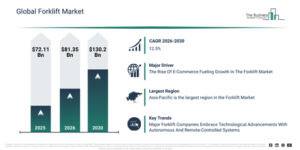
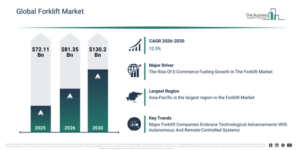
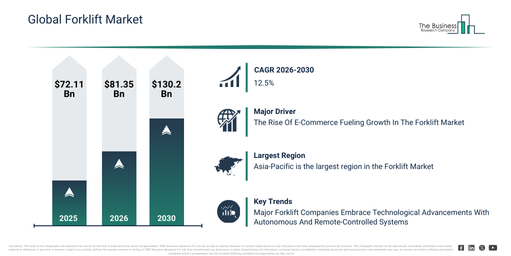
The forklift market size has seen rapid growth in recent years. It is expected to expand from $72.11 billion in 2025 to $81.35 billion in 2026, exhibiting a compound annual growth rate (CAGR) of 12.8%. This historical growth can be attributed to various factors, including the expansion of the logistics industry, an increase in manufacturing facilities, the need for efficient material handling, the rising volume of palletized goods, and developments in warehouse infrastructure.
The forklift market is projected to experience substantial expansion over the upcoming years. Its valuation is anticipated to reach $130.2 billion by 2030, demonstrating a compound annual growth rate (CAGR) of 12.5%. This projected growth during the forecast period is primarily driven by factors such as the expansion of e-commerce, the uptake of smart warehouses, electrification mandates, the development of autonomous material handling systems, and a strong emphasis on energy efficiency. Key trends identified for the forecast period encompass an increasing embrace of electric forklifts, a heightened demand for warehouse automation, the integration of telematics and fleet management solutions, a wider deployment of lithium-ion battery forklifts, and a sustained focus on improving operator safety.
Request A Free Forklift Market Sample To Support Your Strategic Planning:
What Is Propelling The Forklift Market Toward $130.2 Billion By 2030?
The increasing need for e-commerce is projected to fuel the expansion of the forklift market in the future. E-commerce, or electronic commerce, involves conducting transactions for goods and services over the internet. This demand stems from advancements in mobile technology, digital marketing, logistics, and supply chain management, as well as the use of AI for personalized buying experiences and the availability of buy-now-pay-later services. Forklifts enhance e-commerce operations by improving inventory handling, accelerating order processing, and optimizing warehouse layouts, simultaneously boosting safety and cost-effectiveness. Their adaptability and effectiveness are vital for meeting the rigorous demands and rapid pace inherent in the e-commerce sector. The increasing demand for e-commerce is a key driver for the expansion of the forklift market.
What Are The Key Segments And Subsegments In The Forklift Market?
The forklift market covered in this report is segmented –
1) By Propulsion: Electric, Internal Combustion Engine
2) By Fuel Type: Gasoline And Compressed Natural Gas (CNG) And liquefied Petroleum Gas (LPG), Diesel, Battery-Electric
3) By Class: Class 1, Class 2, Class 3, Class 4 Or 5
4) By Tonnage: Below 5 Ton, 5 Ton – 10 Ton, 11 Ton – 36 Ton, Above 36 Ton
5) By Application: Freight And Logistics, Wholesale And Retail Distribution, Manufacturing, Other Applications
Subsegments:
1) By Electric Forklifts: Lead-Acid Battery, Lithium-Ion Battery, Fuel Cell Electric Forklifts, Swappable Battery Systems
2) By Internal Combustion Engine Forklifts: Propane Forklifts, Diesel Forklifts, Gasoline Forklifts, Dual-Fuel Forklifts
Forklift Market Trends Behind The 12.5% CAGR Forecast
Major companies in the forklift market are prioritizing the development of innovative technologies, such as autonomous and remote-controlled forklift systems, to enhance operational efficiency, reduce labor costs, and improve safety in warehouses and industrial environments. This autonomous and remote-controlled forklift technology refers to advanced material handling systems and innovations that allow forklifts to operate with minimal or no direct human intervention, thereby boosting efficiency, safety, and cost-effectiveness.
Major Companies Profiled In The Forklift Market Report
Major companies operating in the forklift market are Toyota Industries Corporation, KION Group AG, Jungheinrich AG, Mitsubishi Logisnext Co. Ltd., Hyster-Yale Inc., Crown Equipment Corporation, Komatsu Ltd., Caterpillar Inc., Anhui Heli Co. Ltd., Hangcha Group Co. Ltd., Clark Material Handling Company, Doosan Industrial Vehicle, Manitou Group, Noblelift Intelligent Equipment Co. Ltd., TCM Corporation, AUSA Center S.L., Action Construction Equipment Ltd., Lonking Holdings Limited, Godrej & Boyce Manufacturing Company Limited, Hyundai Construction Equipment, Baoli EMEA S.p.A., EP Equipment Group
Explore The Business Research Company’s Complete Forklift Market Report:
Where Does The Forklift Market Generate The Most Revenue?
Asia-Pacific was the largest region in the forklift market in 2025. North America is expected to be the fastest-growing region in the market going forward. The regions covered in the forklift market report are Asia-Pacific, South East Asia, Western Europe, Eastern Europe, North America, South America, Middle East, Africa
Reach Out To Our Team:
The Business Research Company: https://www.thebusinessresearchcompany.com/
Americas: +1 310-496-7795
Asia: +44 7882 955267 & +91 8897263534
Europe: +44 7882 955267
Email us at: marketing@tbrc.info
Follow us on:
LinkedIn: https://in.linkedin.com/company/the-business-research-company
YouTube: https://www.youtube.com/channel/UC24_fI0rV8cR5DxlCpgmyFQ
Global Market Model: https://www.thebusinessresearchcompany.com/global-market-model

Wasay has over a decade of experience in market research, data modelling, and analytics, with prior experience at GlobalData and Decision Tree Consulting Services. At The Business Research Company , he leads research operations across syndicated studies, customized consulting engagements, and the Global Market Model platform. His professional experience includes supporting organizations such as Boston Consulting Group, KPMG, and Ernst & Young. Wasay holds a degree in Electronics and Communications Engineering, postgraduate management qualifications from International Management Institute Belgium and Indian School of Business and Entrepreneurship, and completed the Integrated Program in Business Analytics from Indian Institute of Management Indore.