The Business Research Company’s 2026 market reports are designed to deliver research that is more actionable and strategically valuable. Key offerings include market attractiveness scoring, total addressable market sizing, company benchmarking matrices, interactive Excel dashboards, deeper supply chain intelligence, emerging startup tracking, and granular product-level insights.
Dark Factories Market Size 2026: Valuation, Growth Rate And Forecast To 2030
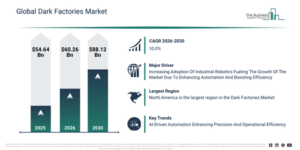
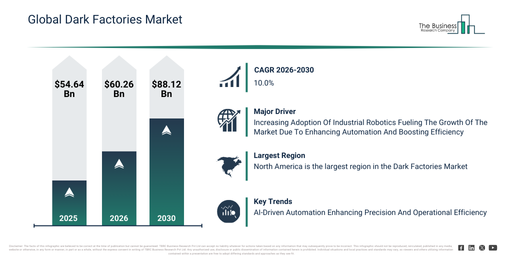
The dark factories market has experienced rapid growth in recent years. It is projected to expand from $54.64 billion in 2025 to $60.26 billion in 2026, achieving a compound annual growth rate (CAGR) of 10.3%. The market’s historical growth can be attributed to factors such as labor cost pressures, the imperative for operational efficiency, the maturation of robotics technology, stringent quality consistency requirements, and significant investments in industrial automation.
The dark factories market is projected for substantial expansion in the coming years. By 2030, its size is anticipated to reach $88.12 billion, exhibiting a compound annual growth rate (CAGR) of 10.0%. This growth during the forecast period is fueled by factors such as AI-driven manufacturing, a scarcity of skilled workers, continuous production requirements, smart factory initiatives, and cost-efficiency approaches. Key developments expected over this period involve the proliferation of fully automated manufacturing facilities, increased deployment of industrial robots and collaborative robots (cobots), the adoption of Industrial IoT (IIoT) and predictive analytics, the rise of lights-out production paradigms, and a greater uptake of autonomous material handling solutions.
Get A Free Sample Of The Dark Factories Market Report 2026:
What Is Driving The Growth Of The Dark Factories Market?
The expanding embrace of industrial robotics is anticipated to fuel the expansion of the dark factories market in the coming period. Industrial robotics involves employing programmable, automated machinery crafted to execute manufacturing operations with exceptional accuracy and effectiveness. This surge in industrial robotics adoption stems from the inherent precision and dependability of these robots, guaranteeing uniform quality and minimizing human mistakes within manufacturing processes. Such robotics improve dark factories by facilitating completely automated production, thus removing any requirement for human involvement. They guarantee accuracy, uniformity, and continuous operation, leading to substantial gains in manufacturing efficiency and a decrease in operational expenditures. The growing integration of industrial robotics is a key factor propelling the expansion of the dark factories market.
How Is The Dark Factories Market Segmented?
The dark factories market covered in this report is segmented –
1) By Type: Industrial Robotics, Additive Manufacturing, Industrial Internet of Things (IIoT), Automated Guided Vehicles (AGVs)
2) By Deployment: Greenfield Projects, Brownfield Projects
3) By End-User: Automotive, Pharmaceuticals, Aerospace, Electronics, Other End-Users
Subsegments:
1) By Industrial Robotics: Articulated Robots, Cartesian Robots, SCARA Robots, Cylindrical Robots, Delta Robots, Collaborative Robots (Cobots)
2) By Additive Manufacturing: Fused Deposition Modeling (FDM), Stereolithography (SLA), Selective Laser Sintering (SLS), Electron Beam Melting (EBM), Direct Metal Laser Sintering (DMLS), Binder Jetting, Powder Bed Fusion (PBF)
3) By Industrial Internet of Things (IIoT): Smart Sensors, Asset Tracking and Management, Predictive Maintenance, Remote Monitoring, Industrial Cloud Computing, Machine-to-Machine (M2M) Communication, Edge Computing
4) By Automated Guided Vehicles (AGVs): Automated Towing Vehicles (ATVs), Unit Load Automated Guided Vehicles, Automated Forklifts, Autonomous Mobile Robots (AMRs), Tow Tractors, Hybrid Automated Guided Vehicles
What Are The Latest Trends In The Dark Factories Market?
Leading companies within the dark factories market are concentrating on developing technologically advanced solutions, such as the hyper-intelligent manufacturing platform (HyperIMP), to enable fully autonomous, continuous production with enhanced efficiency, precision, and minimal human involvement. A hyper-intelligent manufacturing platform is an advanced artificial intelligence (AI)-driven system that integrates automation, machine learning, and real-time data analytics to optimize, control, and autonomously manage end-to-end manufacturing processes.
Who Are The Key Players In The Dark Factories Market?
Major companies operating in the dark factories market are Siemens AG, Schneider Electric, Mitsubishi Electric, Honeywell International, ABB Ltd, Toshiba Infrastructure Systems & Solutions, Bosch Rexroth, Rockwell Automation, Omron Corporation, Keyence Corporation, FANUC Corporation, Dassault Systèmes, Autodesk, Yaskawa Electric Corporation, KUKA AG, Teradyne, Nachi-Fujikoshi Corp, Staubli Robotics, Beckhoff Automation, Universal Robots, Mobile Industrial Robots (MiR), Denso Wave.
Read The Complete Dark Factories Market Report 2026:
Which Region Is The Largest In The Dark Factories Market?
North America was the largest region in the dark factories market in 2025. Asia-Pacific is expected to be the fastest-growing region in the forecast period. The regions covered in the dark factories market report are Asia-Pacific, South East Asia, Western Europe, Eastern Europe, North America, South America, Middle East, Africa
Reach Out To Our Team:
The Business Research Company: https://www.thebusinessresearchcompany.com/
Americas: +1 310-496-7795
Asia: +44 7882 955267 & +91 8897263534
Europe: +44 7882 955267
Email us at: marketing@tbrc.info
Follow us on:
LinkedIn: https://in.linkedin.com/company/the-business-research-company
YouTube: https://www.youtube.com/channel/UC24_fI0rV8cR5DxlCpgmyFQ
Global Market Model: https://www.thebusinessresearchcompany.com/global-market-model

Wasay has over a decade of experience in market research, data modelling, and analytics, with prior experience at GlobalData and Decision Tree Consulting Services. At The Business Research Company , he leads research operations across syndicated studies, customized consulting engagements, and the Global Market Model platform. His professional experience includes supporting organizations such as Boston Consulting Group, KPMG, and Ernst & Young. Wasay holds a degree in Electronics and Communications Engineering, postgraduate management qualifications from International Management Institute Belgium and Indian School of Business and Entrepreneurship, and completed the Integrated Program in Business Analytics from Indian Institute of Management Indore.