
Read more about the article Aircraft Actuator Market Led By North America: Size, Growth And Regional Outlook
Aircraft Actuator Market Analysis

Aircraft Actuator Market Led By North America: Size, Growth And Regional Outlook

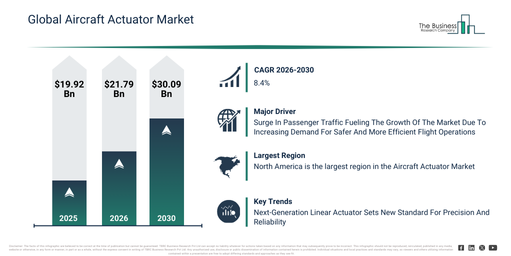
#Aircraft Actuator Market Size Forecast Points To $30.09 Billion In Revenue By 2030#_x000D_ The aircraft actuator market size has experienced robust growth in recent years. It is projected to expand from $19.92 billion in 2025 to $21.79 billion in 2026, at a compound annual growth rate (CAGR) of 9.4%. Historically, this market expansion is attributed to several factors, including an increase in commercial aircraft production driving demand for flight control surface actuators, the growing adoption of advanced actuation systems for landing gear and cargo door operations, the expansion of engine development programs requiring precise actuator-controlled components, a heightened emphasis on aircraft safety and reliability promoting the use of high-performance actuators, and the widespread integration of hydraulic and electrohydraulic actuators across major aircraft platforms._x000D_ _x000D_ The aircraft actuator market size is expected to experience strong growth in the coming years, projected to reach $30.09 billion by 2030, with a compound annual growth rate (CAGR) of 8.4%. This expansion during the forecast period can be attributed to a growing transition towards electro-mechanical actuators to reduce weight and enhance efficiency, an anticipated rise in next-generation aircraft platforms demanding more sophisticated actuation systems, the increasing integration of smart and health-monitoring actuators for predictive maintenance, expanding fleet modernization efforts driving replacement demand for legacy actuators, and technological advancements boosting actuator precision, durability, and energy efficiency. Key trends anticipated during this period include the increasing adoption of electromechanical actuators over traditional hydraulic units, a rising demand for lightweight actuator materials to improve fuel efficiency, the expansion of fly-by-wire systems in next-generation aircraft, growth in maintenance, repair, and overhaul requirements for aircraft actuation systems, and a higher integration of actuators in aircraft engine control mechanisms._x000D_ _x000D_ #Get A Free Aircraft Actuator Market Sample Covering Drivers, Trends And Key Players:#_x000D_ https://thebusinessresearchcompany.com/sample_request?id=97627887&type=smp&name=Aircraft%20Actuator%20Market%20Report%202026&utm_source=Blogs&utm_medium=Paid&utm_campaign=Oct_PR_x000D_ _x000D_ #Aircraft Actuator Market Driver Analysis: Key Factor Supporting Revenue Growth#_x000D_ The global increase in passenger traffic is projected to fuel the expansion of the aircraft actuators market moving forward. Passenger traffic denotes the total count of individuals traveling via a transportation system, such as airlines, trains, or buses, during a specific period. This rise in passenger numbers is driven by increasing demand for transportation services, prompting operators to expand their capacity and introduce new routes. Aircraft actuators facilitate improved passenger movement by enhancing aircraft control, reliability, and operational efficiency, leading to safer and more effective flight operations. For instance, in December 2024, according to Eurostat, a Luxembourg-based government agency, 976 million air passengers were carried in the EU in 2023, representing a 19 % increase compared to 2022. Thus, the escalating passenger traffic worldwide is a key factor driving the growth of the aircraft actuators market._x000D_ _x000D_ #Aircraft Actuator Market Segmentation Framework: Major Segments At A Glance#_x000D_ The aircraft actuator market covered in this report is segmented –_x000D_ _x000D_ 1) By Actuators Type: Hydraulic, Pneumatic, Electric, Electromechanical, Electrohydrostatic_x000D_ 2) By Motion: Linear, Rotary_x000D_ 3) By Platform: Fixed Wing, Rotary Wing_x000D_ 4) By End User: Commercial Aircraft, Military Aircraft, Other End Users_x000D_ _x000D_ Subsegments:_x000D_ 1) By Hydraulic Actuators: Linear Hydraulic Actuators, Rotary Hydraulic Actuators, Hydraulic Servo Actuators_x000D_ 2) By Pneumatic Actuators: Linear Pneumatic Actuators, Rotary Pneumatic Actuators, Pneumatic Cylinder Actuators_x000D_ 3) By Electric Actuators: Brushless DC Electric Actuators, Stepper Electric Actuators, AC Electric Actuators_x000D_ 4) By Electromechanical Actuators: DC Gear Motor Actuators, Linear Actuators with Gear Mechanism, Electric Actuators with Feedback Control_x000D_ 5) By Electrohydrostatic Actuators: Direct Drive Electrohydrostatic Actuators, Integrated Electrohydrostatic Actuators_x000D_ _x000D_ #Latest Aircraft Actuator Market Developments And Emerging Trends#_x000D_ Leading companies within the aircraft actuator market are concentrating on developing innovative products like linear servo actuators to enhance the precision, reliability, and efficiency of flight control systems. These linear servo actuators are electromechanical devices that convert electrical signals into precise linear motion, aiding in improved flight control accuracy, reduced system weight, minimized maintenance needs, and enabling smoother, more dependable aircraft operations compared to traditional hydraulic or mechanical actuators. For instance, in October 2024, UAVOS Inc., a U.S.-based aerospace technology company, launched the SDLM-04B Linear Servo Actuator, a cutting-edge device specifically engineered for applications demanding high force, precision, and long-term reliability. This actuator features a brushless DC motor with a high-performance FOC servo drive, a contactless multiturn absolute position encoder, and integrated feedback on position, velocity, torque, and current. Its compact yet robust design, incorporating hardened steel gears and an aluminum housing rated IP66, allows it to operate reliably even in harsh environments, including conditions with intense shock and vibration. The SDLM-04B is particularly well-suited for unmanned aircraft systems, having been successfully integrated into the Albatross MALE aircraft and UVH 500 helicopters, thereby enhancing flight control reliability and operational flexibility. Beyond aerospace, this actuator is also applicable in robotics and industrial automation, offering zero-backlash precision, high-speed actuation, and simplified installation thanks to its integrated controller._x000D_ _x000D_ #Which Companies Are Shaping The Aircraft Actuator Market?#_x000D_ Major companies operating in the aircraft actuator market are Honeywell International Inc., Eaton Corporation, Moog Inc., Parker Hannifin Corporation, Safran S.A., Meggitt plc, Woodward Inc., Sitec Aerospace GmbH, Progressive Automations Inc., Tamagawa Seiki Co. Ltd., Aero Space Controls Corporation, Beaver Aerospace & Defense Inc., Rockwell Collins Inc., Curtiss-Wright Corporation, Raytheon Technologies Corporation, Liebherr Group, Nabtesco Corporation, SKF Group, Arkwin Industries Inc., ITT Inc., AAR Corporation, GE Aviation Systems LLC, TransDigm Group Incorporated, BAE Systems plc, Héroux-Devtek Inc., Raytheon Technologies Corp., Lufthansa Technik AG, Electromech Technologies LLC, Hemisphere Engineering Inc._x000D_ _x000D_ #Dive Deeper Into The Aircraft Actuator Market With The Full Report:#_x000D_ https://thebusinessresearchcompany.com/report/aircraft-actuator-global-market-report?utm_source=Blogs&utm_medium=Paid&utm_campaign=Oct_PR_x000D_ _x000D_ #Aircraft Actuator Market Regional Distribution: Where Is Revenue Concentrated?#_x000D_ North America was the largest region in the aircraft actuators market in 2025. Asia-Pacific is expected to be the fastest-growing region in the forecast period. The regions covered in the aircraft actuator market report are Asia-Pacific, South East Asia, Western Europe, Eastern Europe, North America, South America, Middle East, Africa._x000D_ _x000D_ #Reach Out To Our Team:#_x000D_ _x000D_ The Business Research Company: https://www.thebusinessresearchcompany.com/_x000D_ Americas: +1 310-496-7795_x000D_ Asia: +44 7882 955267 & +91 8897263534_x000D_ Europe: +44 7882 955267_x000D_ Email us at: marketing@tbrc.info_x000D_ _x000D_ #Follow us on:#_x000D_ _x000D_ LinkedIn: https://in.linkedin.com/company/the-business-research-company_x000D_ YouTube: https://www.youtube.com/channel/UC24_fI0rV8cR5DxlCpgmyFQ_x000D_ Global Market Model: https://www.thebusinessresearchcompany.com/global-market-model
Continue ReadingAircraft Actuator Market Led By North America: Size, Growth And Regional Outlook

Artificial Intelligence (AI) Smart Glasses Market Forecast To Reach $3.64 Billion By 2030: Key Trends Explained

Artificial Intelligence (AI) Smart Glasses market size stood at $2.34 billion in 2026 and is projected to reach $3.64 billion by 2030 at a 11.7% CAGR. Key players: Amazon.com Inc., Apple Inc., Google LLC

Continue ReadingArtificial Intelligence (AI) Smart Glasses Market Forecast To Reach $3.64 Billion By 2030: Key Trends Explained
Read more about the article Airborne Target Acquisition Systems Market Forecast To 2030: The Growing Role Of AI-Enabled Airborne Targeting Systems Enhance Precision And Mission Efficiency In Modern Combat Operations
Airborne Target Acquisition Systems Market Analysis

Airborne Target Acquisition Systems Market Forecast To 2030: The Growing Role Of AI-Enabled Airborne Targeting Systems Enhance Precision And Mission Efficiency In Modern Combat Operations

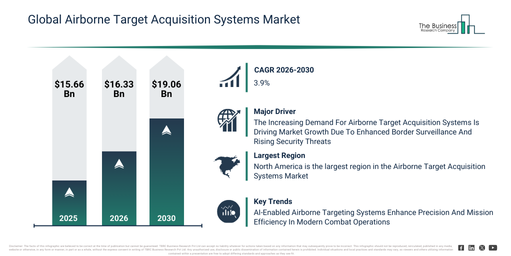
#Airborne Target Acquisition Systems Market Size Trajectory: Key Numbers Every Industry Stakeholder Should Know#_x000D_ The airborne target acquisition systems market has experienced consistent growth over recent years. It will grow from $15.66 billion in 2025 to $16.33 billion in 2026 at a compound annual growth rate (CAGR) of 4.3%. This historical expansion is largely attributable to several factors, including the increasing adoption of airborne sensors for target detection and tracking, the integration of precision targeting solutions in military aircraft, a rising demand for real-time surveillance and situational awareness, the deployment of advanced sensor payloads for reconnaissance missions, and the development of communication and fire control systems for coordinated targeting._x000D_ _x000D_ The airborne target acquisition systems market size is projected to experience consistent expansion over the coming years. It is forecasted to reach $19.06 billion in 2030, demonstrating a compound annual growth rate (CAGR) of 3.9%. This anticipated growth during the forecast period can be attributed to factors such as increased investment in AI-powered target acquisition and automated threat identification, the broadening application of airborne systems for unmanned aerial vehicles (UAVs), an emphasis on integrating multiple sensors for improved precision, a growing need for connected and interoperable targeting systems, and the increased acquisition of next-generation combat aircraft and defense platforms. Key trends anticipated over this period encompass a wider adoption of multi-sensor fusion, an increase in high-resolution electro-optical/infrared (EO/IR) targeting, the expansion of UAV-driven target acquisition, the seamless integration of fire-control and communication systems, and a sustained demand for sophisticated threat detection capabilities._x000D_ _x000D_ #Looking For Reliable Airborne Target Acquisition Systems Market Data? Request A Free Sample:#_x000D_ https://thebusinessresearchcompany.com/sample_request?id=45695191&type=smp&name=Airborne%20Target%20Acquisition%20Systems%20Market%20Report%202026&utm_source=Blogs&utm_medium=Paid&utm_campaign=Oct_PR_x000D_ _x000D_ #What Is Behind The Rising Demand In The Airborne Target Acquisition Systems Market?#_x000D_ The growing demand for border surveillance is projected to boost the expansion of the airborne target acquisition systems market. This involves utilizing cutting-edge technologies for real-time monitoring of border areas, with the goal of identifying, deterring, and addressing illicit entries or potential dangers. Escalating security risks are accelerating the adoption of border surveillance, leading to a greater deployment of sophisticated systems to monitor threats and unauthorized crossings. Airborne target acquisition systems aid border surveillance by providing aerial detection, tracking, and threat identification capabilities in real time. Their advanced sensor technology and extensive coverage facilitate rapid responses in remote or challenging-to-monitor border regions. For instance, in October 2025, as reported by KXAN Austin, a US-based television station, US Border Patrol agents detained 10,203 individuals in September, marking a 26% increase compared to the previous month. Consequently, the heightened requirement for border surveillance is a key driver for the growth of the airborne target acquisition systems market._x000D_ _x000D_ #Airborne Target Acquisition Systems Market Segment Coverage And Subsegment Analysis#_x000D_ The airborne target acquisition systems market covered in this report is segmented –_x000D_ _x000D_ 1) By Platform: Fixed-Wing Aircraft, Helicopters, Unmanned Aerial Vehicles (UAVs)_x000D_ 2) By Technology: Radar, Electro-Optical Or Infrared (EO Or IR) Systems, Electronic Support Measures (ESM)_x000D_ 3) By Range: Short Range (0-8 Kilometers (Km)), Medium Range (8-250 Kilometers (Km)), Long Range (Above 250 Kilometers (Km))_x000D_ 4) By Applications: Air-To-Air Combat, Air-To-Ground Surveillance, Maritime Surveillance, Electronic Warfare_x000D_ 5) By End-User: Military, Homeland Security_x000D_ _x000D_ Subsegments:_x000D_ 1) By Fixed-Wing Aircraft: Fighter Aircraft, Transport Aircraft, Maritime Patrol Aircraft, Surveillance Aircraft, Reconnaissance Aircraft_x000D_ 2) By Helicopters: Attack Helicopters, Reconnaissance Helicopters, Transport Helicopters, Maritime Helicopters_x000D_ 3) By Unmanned Aerial Vehicles (UAVs): Tactical Unmanned Aerial Vehicles (UAVs), Strategic Unmanned Aerial Vehicles (UAVs), Combat Unmanned Aerial Vehicles (UAVs), Mini Or Micro Unmanned Aerial Vehicles (UAVs), Medium Altitude Long Endurance Unmanned Aerial Vehicles (UAVs), High Altitude Long Endurance (HALE) Unmanned Aerial Vehicles (UAVs)_x000D_ _x000D_ #Airborne Target Acquisition Systems Market Future Trends: Where Is The Industry Heading?#_x000D_ Prominent companies within the airborne target acquisition systems market are concentrating on developing cutting-edge solutions like AI-enabled airborne targeting systems to elevate operational effectiveness in challenging combat environments. An AI-enabled airborne targeting system is an advanced aerial solution that harnesses artificial intelligence to autonomously detect, classify, and track targets with improved speed and accuracy. It substantially enhances situational awareness, threat evaluation, and targeting effectiveness in evolving combat and surveillance situations. For instance, in September 2024, Hensoldt, a Germany-based defense electronics company, revealed the ARGOS-15 at the Africa Aerospace and Defense Expo 2024. This 15-inch gimbal system integrates AI-powered object detection, classification, and tracking features, thereby boosting real-time decision-making and mission efficiency. The ARGOS-15 is engineered for both manned and unmanned airborne platforms, delivering superior performance for intelligence, surveillance, target acquisition, and reconnaissance (ISTAR) operations._x000D_ _x000D_ #Airborne Target Acquisition Systems Market Top Players List For 2026#_x000D_ Major companies operating in the airborne target acquisition systems market are Raytheon Technologies Corporation, The Boeing Company, Lockhee Martin Corporation, Airbus, General Dynamics Corporation, Northrop Grumman Corporation, BAE Systems plc, Safran SA, Thales Group, L3Harris Technologies Inc., Leidos Holdings Inc., Rheinmetall AG, Saab AB, Hensoldt AG, Aselsan A.S., Kratos Defense & Security Solutions Inc., Teledyne FLIR, Kearfott Corporation, Thermoteknix Systems Ltd., Blighter Surveillance Systems Limited_x000D_ _x000D_ #Order Your Copy Of The Airborne Target Acquisition Systems Market Report 2026:#_x000D_ https://thebusinessresearchcompany.com/report/airborne-target-acquisition-systems-global-market-report?utm_source=Blogs&utm_medium=Paid&utm_campaign=Oct_PR_x000D_ _x000D_ #How Does The Airborne Target Acquisition Systems Market Vary By Region?#_x000D_ North America was the largest region in the airborne target acquisition systems market in 2025. Asia-Pacific is expected to be the fastest-growing region in the forecast period. The regions covered in the airborne target acquisition systems market report are Asia-Pacific, South East Asia, Western Europe, Eastern Europe, North America, South America, Middle East, Africa._x000D_ _x000D_ #Reach Out To Our Team:#_x000D_ _x000D_ The Business Research Company: https://www.thebusinessresearchcompany.com/_x000D_ Americas: +1 310-496-7795_x000D_ Asia: +44 7882 955267 & +91 8897263534_x000D_ Europe: +44 7882 955267_x000D_ Email us at: marketing@tbrc.info_x000D_ _x000D_ #Follow us on:#_x000D_ _x000D_ LinkedIn: https://in.linkedin.com/company/the-business-research-company_x000D_ YouTube: https://www.youtube.com/channel/UC24_fI0rV8cR5DxlCpgmyFQ_x000D_ Global Market Model: https://www.thebusinessresearchcompany.com/global-market-model

Continue ReadingAirborne Target Acquisition Systems Market Forecast To 2030: The Growing Role Of AI-Enabled Airborne Targeting Systems Enhance Precision And Mission Efficiency In Modern Combat Operations
Read more about the article Airborne Swarm Coordination System Market Set To Reach $4.77 Billion By 2030, Driven By Rising Defense Expenditure
Airborne Swarm Coordination System Market Analysis

Airborne Swarm Coordination System Market Set To Reach $4.77 Billion By 2030, Driven By Rising Defense Expenditure

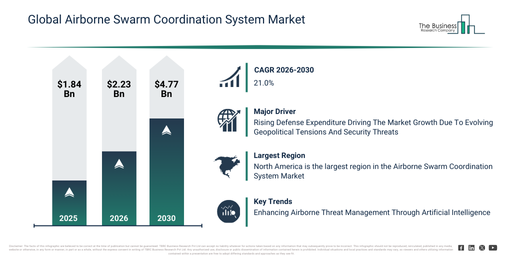
#What Is The Airborne Swarm Coordination System Market Size In 2026, And Where Is It Heading By 2030?#_x000D_ Recent years have seen exponential growth in the size of the airborne swarm coordination system market. This market is projected to expand from $1.84 billion in 2025 to $2.23 billion by 2026, exhibiting a compound annual growth rate (CAGR) of 21.2%. The historical expansion can be attributed to factors such as the increasing adoption of autonomous drone fleets, advancements in real-time communication protocols, rising defense modernization budgets, improvements in multi-agent coordination algorithms, and the demand for resilient mission-critical operations._x000D_ _x000D_ The airborne swarm coordination system market is projected to experience substantial expansion over the upcoming years. This market is anticipated to reach a valuation of $4.77 billion by 2030, exhibiting a compound annual growth rate (CAGR) of 21.0%. Key factors fueling this expansion during the projected period include the incorporation of AI-driven decision-making, the broadening of commercial uses beyond military applications, strengthened cybersecurity for swarm networks, the creation of interoperable hardware modules, and the uptake of cloud-based platforms for swarm management. Noteworthy trends observed over the forecast duration encompass swarm-based mission optimization, continuous data communication, algorithms for multi-UAV coordination, autonomous navigation at the fleet level, and system validation driven by simulations._x000D_ _x000D_ #Request Your Free Airborne Swarm Coordination System Market Sample With Segment And Regional Data:#_x000D_ https://thebusinessresearchcompany.com/sample_request?id=52084090&type=smp&name=Airborne%20Swarm%20Coordination%20System%20Market%20Report%202026&utm_source=Blogs&utm_medium=Paid&utm_campaign=Oct_PR_x000D_ _x000D_ #Airborne Swarm Coordination System Market Growth Drivers And Their Impact On Future Demand#_x000D_ The increasing defense expenditure is anticipated to propel the expansion of the airborne swarm coordination system market. This spending encompasses government allocations for military forces, defense ministries, and associated security infrastructure, covering personnel, operations, procurement, and research and development. A primary factor behind this rise is evolving geopolitical tensions and security challenges, prompting nations to prioritize modernizing their military and acquiring advanced defense capabilities. This ensures strategic deterrence and operational preparedness amidst a complex global security landscape. Larger defense budgets stimulate the demand for airborne swarm coordination systems, as military forces seek sophisticated autonomous technologies to improve battlefield effectiveness and enable coordinated operations across numerous unmanned platforms. For example, according to the UK Parliament's House of Commons Library in May 2025, UK defence spending is projected to reach around $70.5 billion(£56.9 billion) in the 2024-25 financial year, with a further increase to approximately $73.9 billion(£59.8 billion) in 2025-26. Consequently, the increase in defense expenditure is a key driver for the growth of the airborne swarm coordination system market._x000D_ _x000D_ #What Categories Define The Airborne Swarm Coordination System Market?#_x000D_ The airborne swarm coordination system market covered in this report is segmented –_x000D_ _x000D_ 1) By Component: Hardware, Software, Services_x000D_ 2) By Technology: Artificial Intelligence, Machine Learning, Communication Systems, Sensor Integration, Other Technologies_x000D_ 3) By Platform: Unmanned Aerial Vehicles, Manned Aircraft, Hybrid Systems_x000D_ 4) By End-User: Government, Defense, Commercial, Other End-Users_x000D_ _x000D_ Subsegments:_x000D_ 1) By Hardware: Sensors, Communication Devices, Navigation Systems, Control Units, Power Supply Systems_x000D_ 2) By Software: Mission Planning Software, Flight Control Software, Data Analytics Software, Simulation Software, Communication Management Software_x000D_ 3) By Services: System Integration, Maintenance And Support, Training And Consultation, Testing And Certification, Deployment Services_x000D_ _x000D_ #What New Developments Are Emerging In The Airborne Swarm Coordination System Market?#_x000D_ Leading companies within the airborne swarm coordination system market are prioritizing the utilization of innovative technologies, such as artificial intelligence (AI)-enabled detection, to improve real-time threat identification, tracking, and response effectiveness. AI-enabled detection involves the application of AI algorithms to automatically locate and monitor objects or threats, including drones, through real-time analysis of sensor data, thereby boosting the speed, precision, and efficiency in discerning, classifying, and reacting to airborne dangers. For instance, in February 2025, Lockheed Martin Corporation, a U.S.-based aerospace and defense company, introduced a scalable Counter-Unmanned Aerial System (C-UAS) solution. This solution integrates AI-enabled detection, advanced command and control (C2), and modular effectors to identify, track, classify, and neutralize both individual drones and drone swarms. This offering demonstrates swift, networked coordination between sensors and mitigation systems, emphasizing the company's commitment to leveraging AI and open-architecture designs to enhance real-time threat reactions and maintain operational superiority against evolving aerial threats. The system's modular architecture permits the integration of various sensors and effectors, allowing for customized responses to different threat scenarios and ensuring adaptability as drone technology advances._x000D_ _x000D_ #Major Players Driving Competition In The Airborne Swarm Coordination System Market#_x000D_ Major companies operating in the airborne swarm coordination system market are The Boeing Company, Lockheed Martin Corporation, Northrop Grumman Corporation, Bae Systems Plc, Thales S.A., Leonardo S.P.A., Elbit Systems Ltd., Teledyne Technologies Incorporated, Saab AB, General Atomics Aeronautical Systems, Inc., Kratos Defense & Security Solutions, Inc., Telespazio S.P.A., AeroVironment, Inc., Havelsan A.S., Aevex Aerospace, Quantum Systems GmbH, Charles River Analytics, Inc., UAV Navigation S.L., Sky-Drones Technologies Ltd., Swarmer_x000D_ _x000D_ #View The Comprehensive Airborne Swarm Coordination System Market Analysis:#_x000D_ https://thebusinessresearchcompany.com/report/airborne-swarm-coordination-system-global-market-report?utm_source=Blogs&utm_medium=Paid&utm_campaign=Oct_PR_x000D_ _x000D_ #Airborne Swarm Coordination System Market Regional Leaders: Insights From The 2026 Report#_x000D_ North America was the largest region in the airborne swarm coordination system market in 2025. Asia-Pacific is expected to be the fastest-growing region in the forecast period. The regions covered in the airborne swarm coordination system market report are Asia-Pacific, South East Asia, Western Europe, Eastern Europe, North America, South America, Middle East, Africa._x000D_ _x000D_ #Reach Out To Our Team:#_x000D_ _x000D_ The Business Research Company: https://www.thebusinessresearchcompany.com/_x000D_ Americas: +1 310-496-7795_x000D_ Asia: +44 7882 955267 & +91 8897263534_x000D_ Europe: +44 7882 955267_x000D_ Email us at: marketing@tbrc.info_x000D_ _x000D_ #Follow us on:#_x000D_ _x000D_ LinkedIn: https://in.linkedin.com/company/the-business-research-company_x000D_ YouTube: https://www.youtube.com/channel/UC24_fI0rV8cR5DxlCpgmyFQ_x000D_ Global Market Model: https://www.thebusinessresearchcompany.com/global-market-model

Continue ReadingAirborne Swarm Coordination System Market Set To Reach $4.77 Billion By 2030, Driven By Rising Defense Expenditure